
Original briefings. Zero spin.
Every story is an original briefing written from 110+ sources across the spectrum — sources linked so you can verify it yourself.
 tech
Notable (6/10)
Event date: September 10, 2026
tech
Notable (6/10)
Event date: September 10, 2026
IQM Lays Out Three-Stage Build for Europe's First Logical-Qubit Quantum Computer, Finishing in 2029
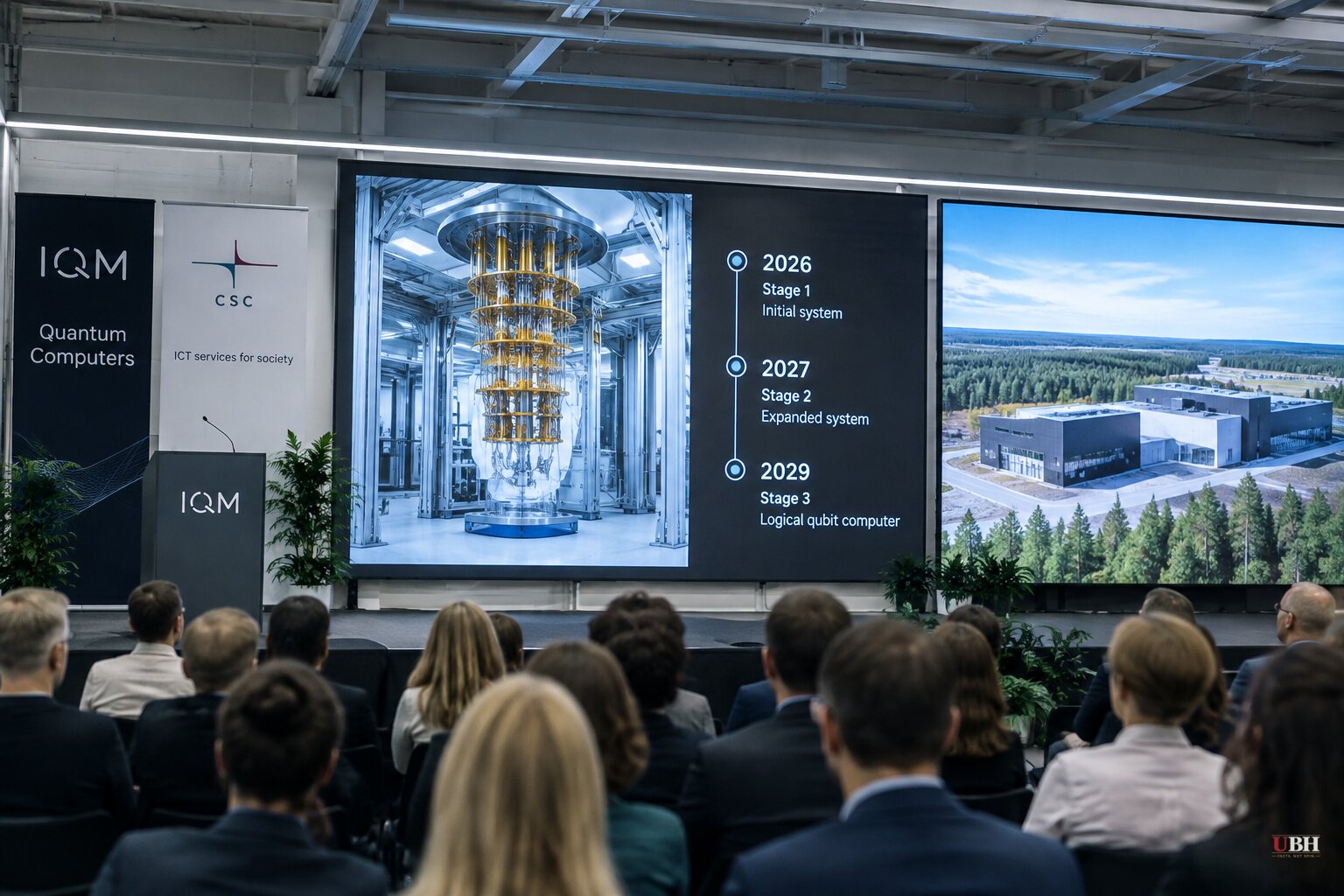
IQM Quantum Computers announced on September 10, 2026 that it will build Europe's first superconducting quantum computer designed from the start to run on logical qubits, a system called LUMI-IQ, according to a joint statement carried by Business Wire and reported by Yahoo Finance and Quantum Computing Report.
The machine will be installed at CSC – IT Center for Science's new data center in Kajaani, Finland, and wired into the LUMI AI Factory, an existing hybrid supercomputing and AI environment. The project is jointly funded by the EuroHPC Joint Undertaking and four governments: Finland, Czechia, Norway, and Poland, per the announcement. IQM was selected for the contract in July 2026, according to data-central.
Three Stages, Three Years
The build isn't a single install. It's staged.
Stage one arrives in 2027: an IQM Halocene H4 system with 150 physical qubits and early quantum error correction, according to the joint announcement. Stage two, in 2028, is meant to lower logical error rates and add real-time error correction. Stage three, in 2029, brings a Halocene H5 system capable of what IQM calls full logical operations, including lattice surgery and T-gate distillation.
By the end of that 2029 upgrade, LUMI-IQ is supposed to run up to 9 logical qubits using distance-3 surface and color codes, with the hardware structurally capable of encoding single logical qubits up to distance-11 surface code and distance-9 color code, per the announcement and Quantum Zeitgeist's reporting.
Why 'Logical' Qubits Matter
A physical qubit is fragile. It loses its quantum state from heat, vibration, or stray electromagnetic noise almost as fast as you can use it. A logical qubit bundles many physical qubits together with error-correction code so the group behaves as one much more reliable unit, according to the LUMI project's own description. That reliability is what a computer needs to run the longer, more complex calculations that quantum computing has promised for two decades and mostly hasn't delivered yet.
IQM's roadmap is explicitly framed as a step toward fault-tolerant quantum computing by 2030, according to the Yahoo Finance and Europe Says versions of the announcement. Nine logical qubits by 2029 is not a machine that will crack encryption or discover new drugs on its own. It's a research platform meant to let European scientists get hands-on experience with error-corrected quantum hardware before the technology matures.
What the Announcement Doesn't Say
Quantum Computing Report and data-central both cover the same three-stage roadmap, but data-central went further and pointed out what's missing: neither IQM nor LUMI disclosed the electrical load or cooling requirements for LUMI-IQ in the September material. For a project publicly funded by four governments and the EU, that's a notable gap.
Quantum computers need cryogenic cooling systems and specialized control electronics that are completely different from the GPU racks running AI workloads next door, data-central noted. This means LUMI-IQ shouldn't be measured against AI data center capacity using the same megawatt yardstick everyone uses for AI buildouts. The public still doesn't know the operating cost of the thing it's paying for.
No dollar or euro figure for the LUMI-IQ contract itself appears in any of the announcements reviewed. Data-central has previously reported a separate €387.8 million contract tied to the broader LUMI-AI buildout at the same Kajaani site, but that figure covers the AI supercomputing side, not this quantum system specifically. Taxpayers in Finland, Czechia, Norway, and Poland are funding a multi-year hardware program without a published price tag for the quantum piece of it.
The Market Side
IQM Quantum Computers is a privately held company, and no verified source confirms that it trades publicly on Nasdaq or under any specific ticker symbol. Claims of a public listing and same-day share-price movement tied to the LUMI-IQ announcement could not be substantiated and are not included here. Readers should treat any assertion of IQM stock trading activity with caution until a verifiable, dated source confirms it.
What's Actually Contestable Here
Skeptics of large multi-year government tech programs have a fair complaint: quantum computing has a long history of roadmaps that slip, and a nine-logical-qubit machine delivered in 2029 is still years from doing anything a classical supercomputer can't already do faster and cheaper. That's a legitimate caution, not a dismissal. IQM itself frames this as an R&D step toward fault tolerance by 2030, not a finished commercial product.
Supporters would counter that Europe has historically imported its most advanced computing hardware from the U.S. and Asia, and a jointly owned, EU-funded system gives four member states direct control over infrastructure and expertise instead of renting cloud access from an American vendor. Both things can be true at once: this is a real infrastructure investment, and it's also a bet on a technology roadmap that hasn't proven out yet anywhere in the world.
The unresolved question is straightforward. IQM and CSC have committed to a three-stage build running through 2029. Neither has published what it costs the four funding governments or how much power the Kajaani site will draw once LUMI-IQ is fully installed. Until that number surfaces, there's no way to judge whether Europe's first logical-qubit machine is a bargain or a blank check.
Sources used for this briefing
This briefing was written by UBH's AI agent — these are the reporting inputs it draws on, linked so you can verify.


