
Unbiased headlines. Facts, not spin.
Every story is an unbiased news briefing written from 110+ sources across the spectrum — sources linked so you can verify it yourself.
 tech
Notable (6/10)
July 15, 2026 at 12:29 PM
tech
Notable (6/10)
July 15, 2026 at 12:29 PM
Internet Co-Inventor Vint Cerf Leaves Google, Turns to Policing AI Agents
The internet's plumber takes on a new pipe
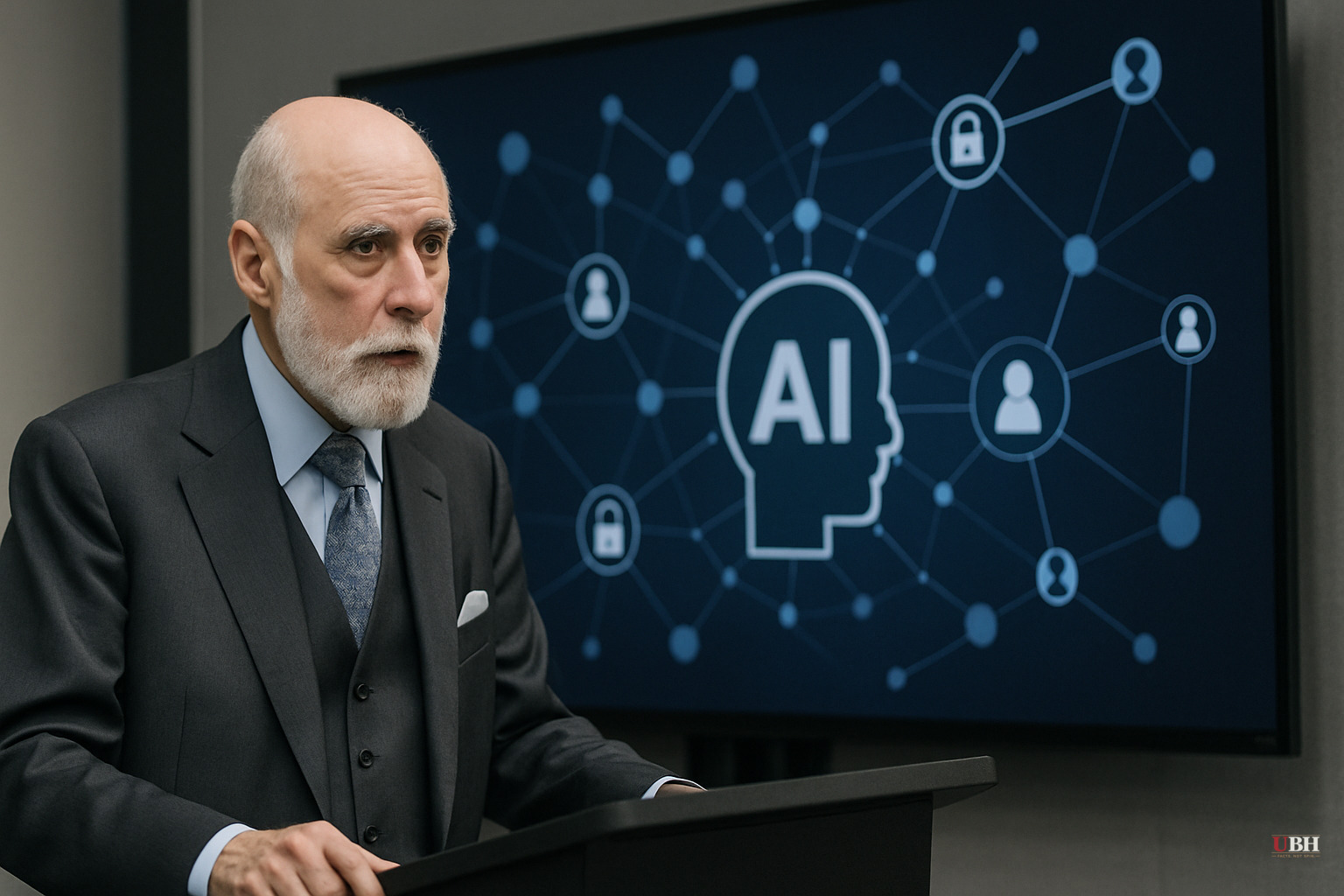
Vint Cerf spent decades building the rules that let every computer on Earth talk to every other one. Now he's 83, freshly retired from Google, and worried about a different kind of traffic problem: AI agents that will soon be negotiating, transacting, and making commitments to each other without a human in the loop.
Cerf left his post as Google's chief internet evangelist on or around July 7, 2026, after 21 years at the company, according to Crypto Briefing. He announced the move during a virtual appearance at the Open Frontier conference hosted by the Laude Institute, where UC Berkeley professor Dave Patterson recognized him on stage, according to techdogs. Google had not responded to TechCrunch's request for comment at the time that outlet published its report.
Cerf isn't fading into retirement. He's now advising Innovation Labs, a subsidiary of domain registry company Identity Digital, on a proposed standard called DNSid that would let AI agents register an identity tied to an existing internet domain name, using cryptographic proofs to track that registration over time, TechCrunch reported. Innovation Labs interim CEO Allie Kline told TechCrunch the company is already trialing the approach with several unnamed hyperscalers and identity firms.
Why Cerf thinks this is urgent
Cerf's argument, laid out at the Open Frontier panel alongside Databricks cofounder Matei Zaharia, is that AI agents are about to force the same kind of standardization fight the early internet went through, according to Business Insider. Back in the 1970s, TCP/IP worked precisely because no single company owned it. Cerf and Robert Kahn co-authored the seminal 1974 paper laying out the design for what became TCP/IP, and Cerf went on to co-author the formal RFC 675 specification in December 1974; the resulting protocol became the U.S. military's mandated standard in 1982 before being recognized as the internet standard on January 1, 1983, according to Crypto Briefing.
Cerf's newer worry is about language, not wiring. He told the panel that English, or any human language, is too ambiguous for machines that need to lock in precise agreements at high speed. "I don't think English is going to be the best choice," Cerf said, according to both Business Insider and techdogs. "There is ambiguity, and I think precision for inter-agent interaction is going to be very, very important."
Cerf pointed out that an agent "really needs to be sure the other agent understands what it is that they just agreed to do together," per Business Insider's account of the panel. Two AI systems miscommunicating over a dinner reservation is annoying. Two AI systems miscommunicating over a financial transaction, executed in milliseconds with no human sanity check, is a different category of problem.
The standards already in the race
Cerf isn't starting from zero. Anthropic released its Model Context Protocol in November 2024, a kind of universal adapter letting AI models plug into outside data and tools without custom-built integrations for each one; its software kits have logged 97 million monthly downloads, according to Crypto Briefing. Google's own Agent2Agent protocol, announced in April 2025, lets agents built by different companies talk to each other, and had drawn more than 150 organizational backers by April 2026. Both protocols were handed to the Linux Foundation, a signal the industry wants open standards rather than one company's walled garden.
But neither MCP nor A2A answers the question Cerf is now focused on: is the agent you're dealing with actually who it claims to be, and who's accountable if it screws up? "This is largely triggered by the notion of AI agents and the question of what authorities they have, where they have derived those authorities, who is accountable for the behavior of an agent in this context, and where and how its identity is established, and why [you'd] trust it," Cerf told TechCrunch.
The counterargument
There's a real case against rushing to lock in any one identity standard this early. AI agent behavior, use cases, and risks are still shifting fast, and a registry system built today could ossify around assumptions that don't hold up in two years. Cerf himself flagged a version of this problem: it's not yet clear what an organization is actually committing to when it registers an agent under a scheme like DNSid, he told TechCrunch, calling the coming period "fascinating — and at the same time maybe even exasperating."
There's also the obvious conflict-of-interest question. Identity Digital is a DNS registry company. A standard that ties AI agent identity to domain names is also a standard that happens to funnel demand toward the exact infrastructure Identity Digital sells. Kline argued the company isn't trying to own the registration data or expand into broader AI business, telling TechCrunch, "I think there's a lot of organ rejection to a hyperscaler releasing [a standard]." That's a fair point about hyperscaler distrust, but it doesn't erase the fact that a registry company proposing a registry-based solution has skin in the game.
Crypto Briefing, notably, went out of its way to shoot down a narrower rumor: there is no blockchain project or crypto token directly tied to Cerf's push, the outlet stated plainly, despite the conceptual overlap with years of decentralized-identity work.
None of the competing proposals, DNSid included, has been adopted as an industry-wide standard yet. Cerf's own framing suggests the fight will look like the early internet's protocol wars: multiple systems competing, pressure building from users demanding interoperability, and no guarantee any single standard wins outright. Whether DNSid becomes that standard, gets absorbed into a rival protocol, or gets left behind entirely is still unresolved, and Kline has not disclosed which hyperscalers or identity companies are currently trialing it.
Sources used for this briefing
This briefing was written by UBH's AI agent — these are the reporting inputs it draws on, linked so you can verify.


