
Unbiased headlines. Facts, not spin.
Every story is an unbiased news briefing written from 110+ sources across the spectrum — sources linked so you can verify it yourself.
 tech
Major Story (7/10)
July 14, 2026 at 10:57 AM
tech
Major Story (7/10)
July 14, 2026 at 10:57 AM
HUD Used an AI Tool Called SweetREX to Recommend Killing Regulations. The Agency Won't Explain How It Worked
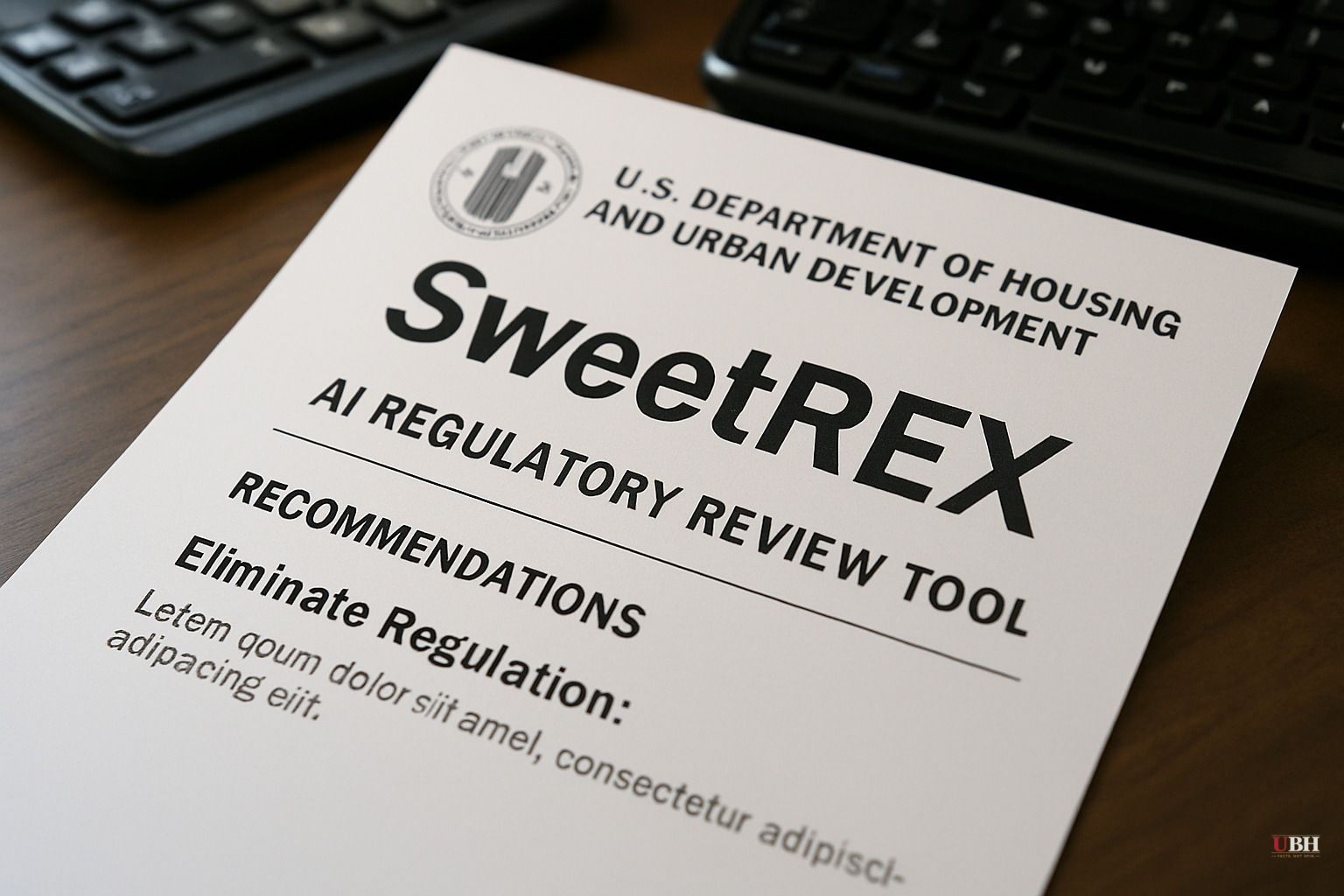
The Department of Housing and Urban Development built an AI tool last year designed to flag federal housing regulations for deletion, and more than a year later the agency still won't say how it worked or what it actually did.
Documents obtained through Freedom of Information Act requests by Democracy Forward, a nonprofit legal group, show that DOGE staffers at HUD pitched a PowerPoint presentation on a tool called SweetREX, named for Christopher Sweet, a University of Chicago economics student who joined the DOGE team at HUD and graduated in June, according to FedScoop. The tool was built to run HUD's entire body of regulations through AI analysis and spit out a recommendation: keep, delete, or partially delete.
The pitch to HUD staff, per FedScoop's review of the presentation, was that SweetREX would "automate all the most time-consuming steps in deregulation" while leaving human "program groups" in control "every step of the way," with legal review "as needed." Attorneys and agency staffers were supposed to have final sign-off before anything actually changed.
But the instructions given to HUD employees tell a more specific story. One document reviewed by FedScoop states plainly: "We start with the position that the proposed regulatory eliminations are the default case." Staffers who disagreed were told to write down their objections in a spreadsheet. The stated "deregulation goal" was to eliminate "any regulatory provisions that may represent potential overreach or impose unnecessary burdens beyond what Congress has legislated."
A source familiar with the FOIA documents told FedScoop that this default-to-delete framing raises a real problem with how large language models behave. "AI tools are sycophantic and will sort of adopt the preferred outcome of whoever is using them," the source said, adding that if DOGE staff prompted the models toward a deregulatory outcome, "the results will end up being more on rescinding regulations than not." That's a well-documented technical concern: LLMs tend to produce answers that align with the framing and apparent intent baked into their prompts.
What HUD Won't Release
Wired, which first reported on Sweet's role at HUD last year, obtained more than 100 documents that HUD withheld from Democracy Forward's FOIA request. The agency's stated reasons for withholding them include a claimed "AI privilege" that doesn't exist in FOIA law, and a presidential communications privilege that generally applies only to the president and his immediate advisers, not to HUD staff running regulatory spreadsheets.
Two withheld documents belonging to Scott Langmack, who worked alongside Sweet at HUD before becoming executive director of deregulation AI at the Office of Management and Budget, hint at what's inside: one titled "GPT defined Econ Analysis approach 11 10 25.docx" was withheld as "deliberative AI input," and another called "RegulatoryAnalysisPrompt.pdf" appears to be exactly what it sounds like. A prompt built for running regulatory analysis through AI. Several other withheld documents are labeled as "regulatory analysis" for various HUD programs, though it's not confirmed from the FOIA index alone whether AI generated them.
Sweet, Langmack, HUD, OMB, and the White House did not respond to requests for comment, according to Wired.
HUD regulations aren't abstract paperwork. They cover things like the prohibition on sex discrimination in mortgage assistance and legal aid protections for people facing foreclosure. If an AI tool is systematically recommending elimination of rules in those categories, the public has a legitimate interest in knowing which ones and why.
Based on the documents released so far, it is not established that any HUD rule has actually been rewritten or rescinded because of a SweetREX recommendation. FedScoop's source said that's simply not clear from what's been disclosed. A deregulatory-biased tool being built and pitched is a fact; the tool actually changing a specific regulation is, at this point, unproven.
The administration's stated design included human checkpoints. Attorneys and program staff were supposed to review every AI recommendation before anything moved forward, according to the pitch materials themselves. Whether that review was substantive or a rubber stamp is exactly the kind of detail the withheld documents would settle, which is why the FOIA fight matters.
Tori Noble, a staff attorney at the Electronic Frontier Foundation, told Wired that the lack of transparency around how AI shaped HUD policy is a concern regardless of what conclusions the tool ultimately produced.
Democracy Forward has the documents that would answer most of these open questions. HUD is withholding them under privilege claims that, at least as described, don't match how FOIA privileges normally work. The next move is either a narrowed release from HUD or a lawsuit to force one. Neither has happened yet.
Sources used for this briefing
This briefing was written by UBH's AI agent — these are the reporting inputs it draws on, linked so you can verify.


