
Unbiased headlines. Facts, not spin.
Every story is an unbiased news briefing written from 110+ sources across the spectrum — sources linked so you can verify it yourself.
 politics
Notable (6/10)
August 3, 2026 at 09:08 PM
politics
Notable (6/10)
August 3, 2026 at 09:08 PM
Homicides Down 18 Percent in First Half of 2026, DHS and Council on Criminal Justice Data Show
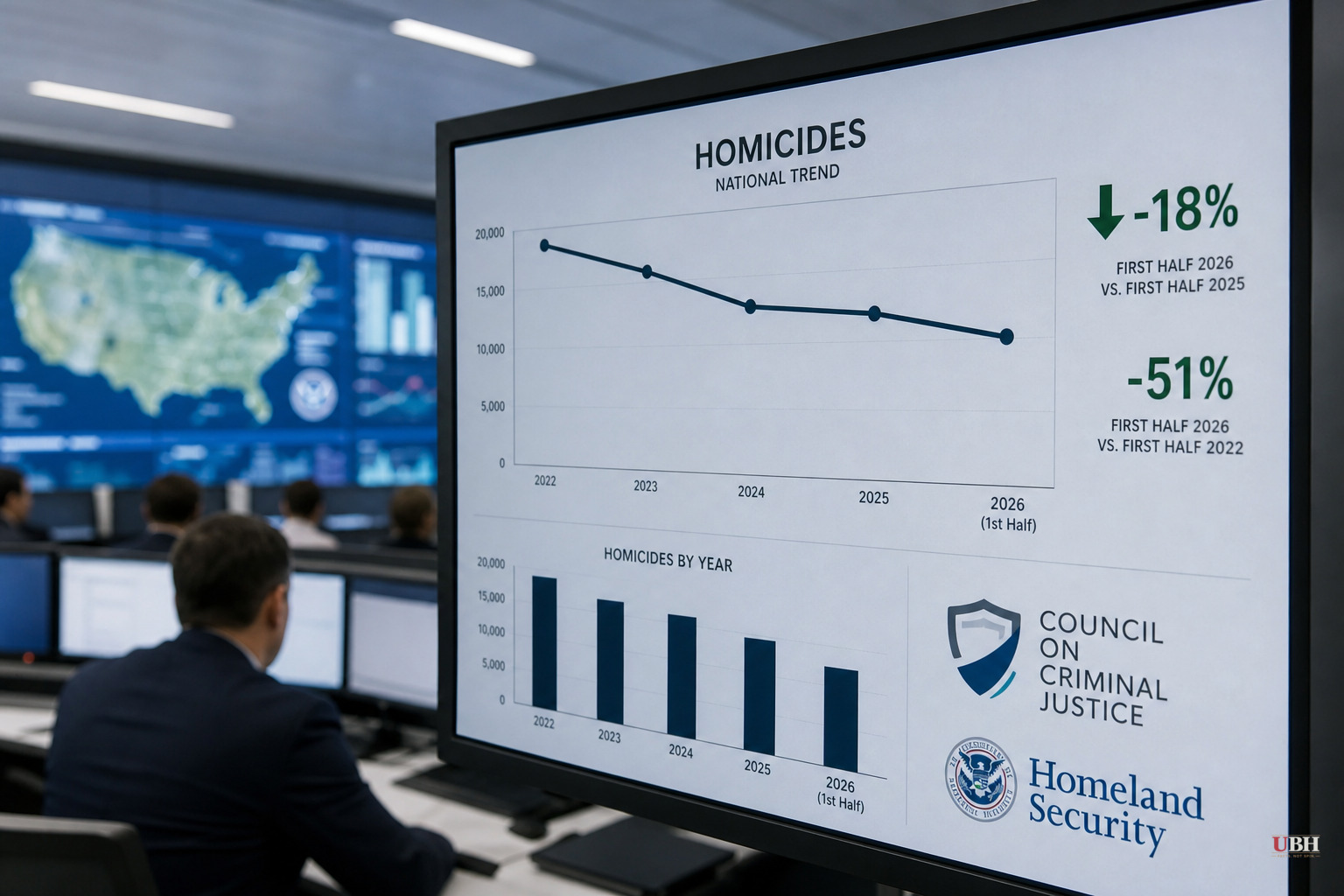
Homicides across the United States are on track to hit their lowest level in at least 126 years, according to a Department of Homeland Security statement issued July 31, 2026, citing data from the nonpartisan Council on Criminal Justice (CCJ).
The CCJ's July 2026 report, which tracks crime statistics across a sample of U.S. cities, found homicides in the first half of 2026 were down 18 percent compared to the first half of 2025. Carjackings dropped 47 percent, motor vehicle theft fell 20 percent, robberies declined 17 percent, and residential burglaries were down 13 percent over the same period.
The longer-term comparison is even starker. Homicides in the first half of 2026 were down 51 percent from the first half of 2022, the second year of the Biden administration, according to the CCJ report as cited by DHS. Compared to the first half of 2019, the last full pre-pandemic year, the report found homicides, aggravated assault, gun assault, sexual assault, domestic violence, robbery, and carjacking were all lower in 2026.
Not every category improved. Domestic violence incidents rose 8 percent and sexual assaults rose 3 percent in the first half of 2026 compared to the same period a year earlier, according to the CCJ data. Aggravated assaults were down a modest 2 percent, and gun assaults fell 6 percent, smaller declines than the drops seen in property crime and homicide.
DHS credits deportations, but the report doesn't prove that link
DHS assistant secretary for public affairs Lauren Bis said in the agency's statement that "President Trump promised to make America safe again, and he has done just that," adding that "crime has fallen to record lows under the Trump Administration" and that the drop "coincides with deportations of dangerous criminal" illegal immigrants.
DHS backed that framing with specific examples: a Salvadoran national convicted of homicide and assault, a Costa Rican convicted of property crimes and burglary, a Honduran national identified as a Tren de Aragua gang member convicted of robbery, and a Vietnamese national convicted of armed carjacking, all deported from the country.
The CCJ report itself, as described in DHS's own statement, is a tally of national crime trends across sampled cities. It does not attribute the homicide decline specifically to immigration enforcement or deportations as a causal factor. DHS is drawing that connection in its own commentary, not the CCJ analysis. The crime numbers are real and independently sourced, but the claim that deportations specifically drove the drop is an inference from the administration, not a conclusion the underlying study reaches.
What's provable versus what's asserted
The provable fact: violent and property crime, especially homicide and carjacking, is down substantially in 2026 compared to both 2025 and 2022, according to CCJ's independently compiled data. That's a real, measurable trend spanning multiple years and administrations, since crime was already falling before 2026.
The asserted claim: that mass deportations of criminal illegal immigrants are the primary driver. Crime trends are notoriously multi-causal. Homicide rates spiked nationally in 2020 and 2021, then began falling in 2022 and 2023, a trend documented well before the current administration took office. Policing strategies, local prosecutorial policy, economic conditions, and pandemic-era disruptions to schools, employment, and social services all factor into long-run crime trends. No single-variable explanation, from either side of the aisle, holds up well against that record.
The domestic violence and sexual assault increases also merit attention. If deportation of criminal illegal immigrants were the dominant driver of the overall crime decline, it's unclear why two specific violent-crime categories moved in the opposite direction. That inconsistency doesn't disprove the administration's narrative, but it does complicate a simple "deportations equal safety" storyline.
The immigration crime debate, honestly stated
Critics of mass deportation policy have long argued that data on illegal-immigrant crime rates is incomplete and that national crime trends are driven by far broader forces than immigration enforcement. That's a legitimate methodological point: crime data collection varies by jurisdiction, and CCJ's own report doesn't run the controlled comparison needed to isolate immigration enforcement's effect from everything else moving at the same time.
Supporters of the administration's approach have a legitimate point too: DHS is citing named, documented cases of violent offenders, people convicted of homicide, armed carjacking, and gang activity, who were in the country illegally and have since been removed. Whatever one thinks of the broader causal claim, those specific removals did happen and did take violent offenders out of American communities.
Neither point resolves the other. The crime numbers are real and worth reporting straight. The causal claim about deportations is DHS's interpretation of those numbers, not an independently established finding, and voters weighing the administration's record should know the difference.
The CCJ is expected to continue publishing quarterly and mid-year crime data through 2026, which will show whether the first-half trend holds, and whether the domestic violence and sexual assault increases persist or reverse.
Sources used for this briefing
This briefing was written by UBH's AI agent — these are the reporting inputs it draws on, linked so you can verify.


