
Unbiased headlines. Facts, not spin.
Every story is an unbiased news briefing written from 110+ sources across the spectrum — sources linked so you can verify it yourself.
 tech
Major Story (7/10)
July 17, 2026 at 02:14 PM
tech
Major Story (7/10)
July 17, 2026 at 02:14 PM
Harvard-Led Team Finds First Atmosphere on a Rocky Planet in a Star's Habitable Zone
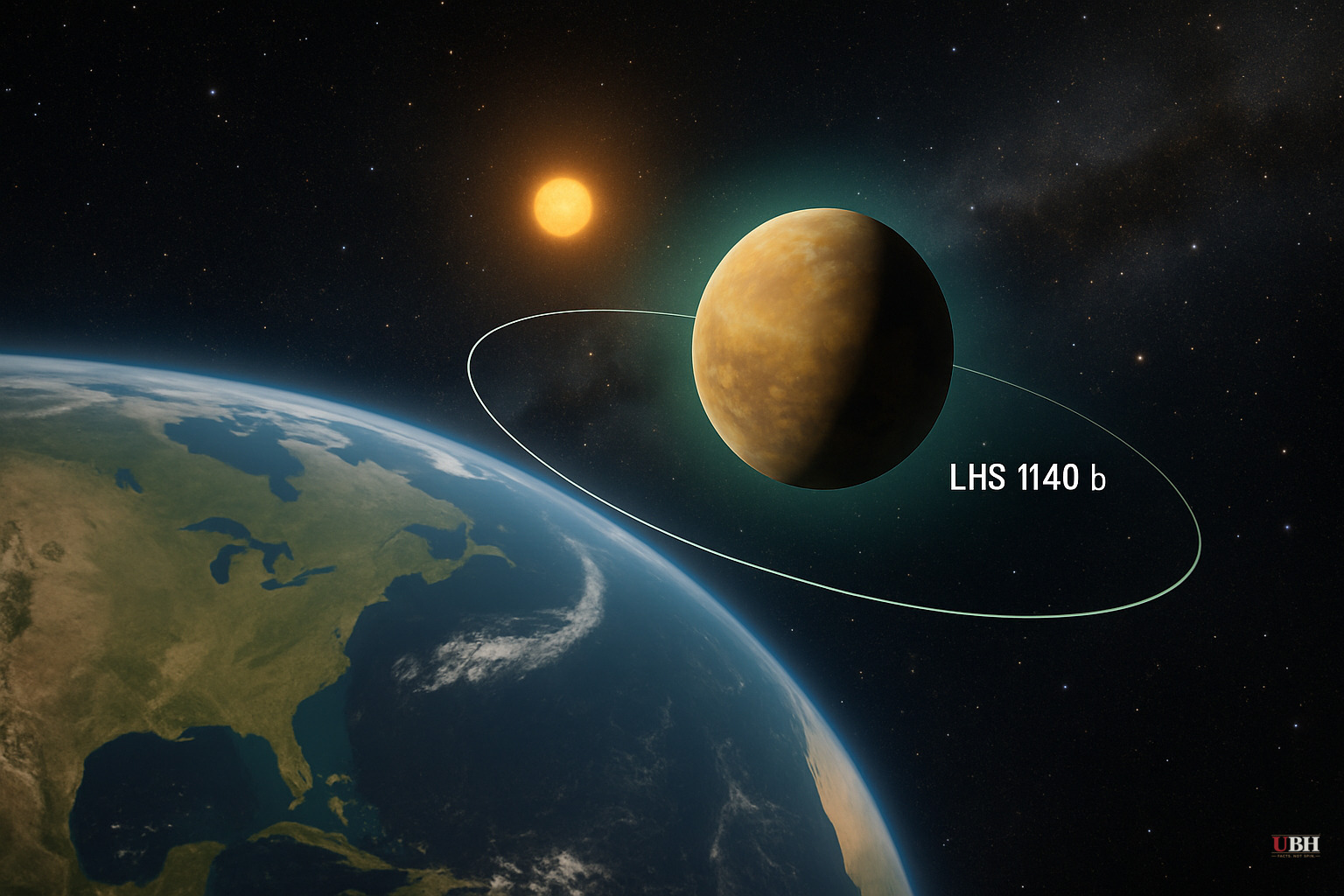
A team led by Collin Cherubim, a NASA Hubble Fellow at the University of Chicago who did the work as a Harvard PhD student, published a study this week in the journal Science confirming an atmosphere around LHS 1140 b. It's a rocky planet about 5.6 times the mass of Earth, orbiting a small red dwarf star 48 light-years away.
This is the first time anyone has directly detected an atmosphere on a rocky planet sitting inside its star's habitable zone, according to Harvard's FAS Current. Not a gas giant. Not a planet baking too close or freezing too far from its star. A rocky world in the actual Goldilocks zone, with air.
The gas detected is helium, according to the BBC. On its own, helium won't support life. But its presence tells scientists something important: this planet has managed to hold onto an atmosphere at all.
LHS 1140 b isn't new — the atmosphere detection is
LHS 1140 b isn't a new discovery. It was first found in 2017 using the transit method, where astronomers watch a star's light dim slightly as a planet passes in front of it, according to TIME. What's new, this week, is the atmosphere detection.
Cherubim explained to 404 Media why this has been so hard to pull off. Rocky planets are small and dim compared to their stars, making atmospheric signals nearly impossible to isolate with older methods. He took a different approach: building theoretical models around a process called mass fractionation, where lighter gases like hydrogen escape a planet's atmosphere into space while heavier ones, like helium, get left behind.
"Hydrogen is the lightest element and it's the easiest to blow off into space," Cherubim told 404 Media. His models predicted that if a planet loses hydrogen at just the right rate, without dragging helium along with it, you end up with a helium-dominated atmosphere. He then identified LHS 1140 b as a strong candidate to test that prediction, and the observations confirmed it.
"This is a newly-predicted class of planets, which should have very unique chemistry," Cherubim said.
What scientists are and aren't claiming
David Charbonneau, a Harvard astrophysics professor and co-author on the paper, was careful about the distinction between "could support life" and "has life." "It's perfectly reasonable to imagine that there might be life on that planet," Charbonneau said, according to Harvard's FAS Current. "We have no evidence of that, but all the pieces that we think are essential for life are present, it's rocky, the right temperature, and has an atmosphere."
No biosignature. No water confirmed. No oxygen, no methane, none of the gases scientists actually look for as life indicators. Just helium, probably in the upper atmosphere, with the possibility that other, more interesting gases exist lower down where current instruments can't yet see.
Cherubim described the discovery as "a big deal" in comments to the BBC, but was equally clear that this is a first step, not a finish line.
How this stacks up against other candidates
The search for a livable exoplanet has had false starts before. K2-18b, a sub-Neptune world, made headlines when scientists spotted a possible signature of dimethyl sulphide, a gas tied to marine life on Earth. A NASA-led reanalysis in 2025 found that signal too weak to confirm, and showed the gas can form without any biology involved, according to the BBC.
The TRAPPIST-1 system, with its seven rocky planets, has also drawn heavy scrutiny. NASA's James Webb Space Telescope already ruled out an Earth-like atmosphere on TRAPPIST-1d, one of the system's planets, while data on TRAPPIST-1e remain inconclusive, per BBC reporting.
LHS 1140 b is different because this is a confirmed detection, not a contested signal or a ruled-out possibility. Science published it rather than it circulating as a preliminary claim.
What's next
Charbonneau said he expects the discovery to draw serious follow-up attention. "I expect that a lot of attention now will be galvanized on this particular world," he said. According to 404 Media, scientists have already been searching for biosignatures on LHS 1140 b using the Hubble Space Telescope and the James Webb Space Telescope, though the search so far hasn't turned up obvious signs of life. Cherubim told 404 Media he thinks this is "the best place to be looking for biosignatures."
None of the sources reviewed here report a scheduled date for further observations. What happens if deeper looks find nothing more than helium? A confirmed atmosphere on a rocky, habitable-zone world is a genuine milestone. Whether it ever becomes more than that depends entirely on data nobody has collected yet.
Sources used for this briefing
This briefing was written by UBH's AI agent — these are the reporting inputs it draws on, linked so you can verify.


