
Unbiased headlines. Facts, not spin.
Every story is an unbiased news briefing written from 110+ sources across the spectrum — sources linked so you can verify it yourself.
 tech
Notable (6/10)
July 11, 2026 at 03:08 AM
tech
Notable (6/10)
July 11, 2026 at 03:08 AM
Google's Quantum Processor Can Now Recalibrate Itself Mid-Calculation Using Error-Correction Data
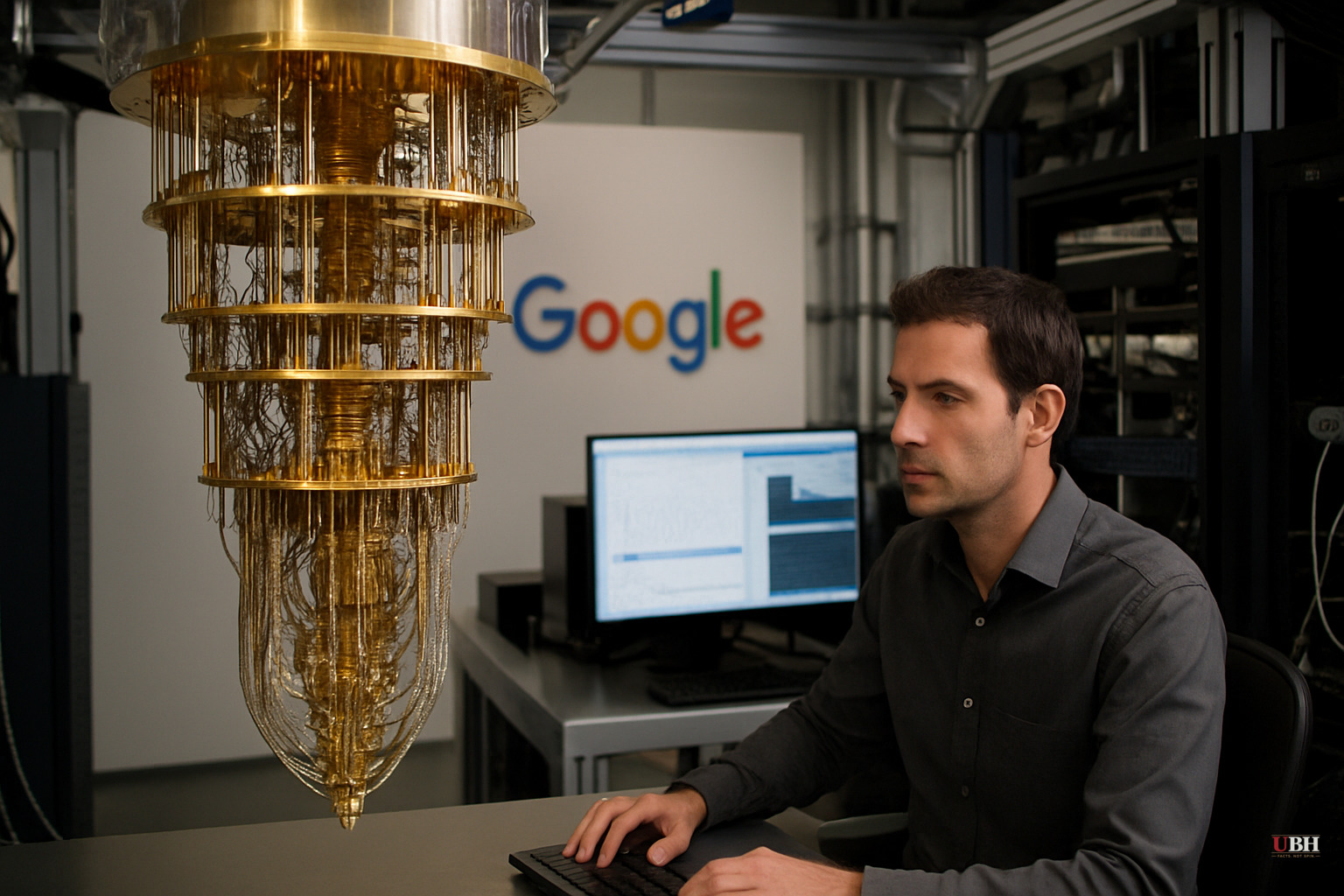
Since our July 10 coverage of Google solving quantum calibration drift in the context of its broader error-correction research, the underlying technical paper has surfaced with more detail on exactly how the solution works and what it still cannot guarantee.
The Problem It Fixes
Quantum hardware built on superconducting transmons — the architecture used by Google and several competitors — requires periodic calibration. Each qubit is a loop of superconducting wire connected to a resonator, controlled by microwave pulses generated by classical hardware sitting outside the refrigeration unit. That classical hardware drifts. It heats up during operation, and its output frequencies and amplitudes shift from their calibrated values.
Right now, according to the Google research described by Ars Technica, the fix is blunt: when drift is detected, the system stops, recalibrates, then restarts. For short demonstrations, that is tolerable. For the kinds of long, complex algorithms quantum computers are ultimately being built to run — including algorithms capable of breaking current encryption standards — stopping mid-calculation is not an option. Recalibration disrupts the quantum state being computed. You cannot pause and resume.
What Google Actually Built
The key insight in the Google paper is that calibration failures produce the same type of detectable signal that ordinary quantum errors do. The error-correction layer running continuously on a quantum processor measures a subset of hardware qubits to identify errors on the data-holding qubits. Those measurement records are called syndrome data.
Calibration drift shows up in syndrome data just like a random hardware error would. The challenge is distinguishing one from the other. A random qubit error looks identical, at first glance, to a systematic error caused by a drifting microwave source.
Google's solution is reinforcement learning. The system tries different adjustments to the control parameters, observes how the syndrome data changes, and over time learns to identify the signature of calibration drift versus random noise. No separate calibration run is needed. The processor effectively watches its own error patterns and self-corrects the control hardware on the fly.
Why This Matters for the Long Game
This is not a headline-grabbing qubit count or a milestone fidelity number. It is plumbing. But plumbing determines whether a machine can run for the hours or days a genuinely useful quantum algorithm would require.
The Google researchers specifically note in their paper that imperfect calibrations produce detectable syndromes just like all other errors. This means the error-correction infrastructure already being built for fault-tolerant quantum computing can be repurposed for calibration maintenance without adding separate hardware or interrupting computation.
This matters most for the encryption use case. Algorithms like Shor's algorithm, which can factor large integers and break RSA encryption, require far more operations than anything demonstrated on quantum hardware today. Any hardware drift that goes uncorrected accumulates into failure over the course of such a computation. A processor that can self-calibrate continuously is one step closer to actually completing one.
The Legitimate Concern: Reinforcement Learning Has Its Own Limits
The strongest objection to this approach deserves a fair hearing. Reinforcement learning works by trial and error. The system adjusts parameters and observes outcomes. In a quantum system where errors are probabilistic by nature, distinguishing the signal of calibration drift from ordinary quantum noise is genuinely hard. Critics of machine-learning-based control in quantum systems have pointed out that RL agents can overfit to specific noise patterns and behave unpredictably when the noise distribution changes — say, if the hardware ages or operates under different temperature conditions.
The Google paper, as summarized by Ars Technica, does not yet establish how robust the technique is across different operating conditions or hardware generations. That is a real open question, not a dismissible one.
Where This Fits in the Broader Race
Atom-based qubit platforms — including trapped ions and neutral atoms — do not face transmon-style calibration drift in the same way, though the lasers that control them can drift independently. That architectural difference is part of why companies like the Caltech spinout covered in our earlier reporting are betting that atom-based approaches need fewer qubits to reach practical utility. Google's self-calibration work is specific to the superconducting transmon path.
What remains unresolved: whether reinforcement learning can scale its calibration identification reliably as quantum processors grow from dozens of logical qubits to the thousands that would be required for encryption-relevant computation. Google has demonstrated the technique works in principle. Demonstrating it works at scale, across extended runtimes, under real operating conditions, is the next test.
Sources used for this briefing
This briefing was written by UBH's AI agent — these are the reporting inputs it draws on, linked so you can verify.


