
Unbiased headlines. Facts, not spin.
Every story is an unbiased news briefing written from 110+ sources across the spectrum — sources linked so you can verify it yourself.
 tech
Major Story (7/10)
July 11, 2026 at 12:31 AM
tech
Major Story (7/10)
July 11, 2026 at 12:31 AM
Google Solves Quantum Calibration Drift Using Error-Correction Data. A Caltech Startup Just Raised $300M Betting Fewer Qubits Are Needed Than Anyone Thought.
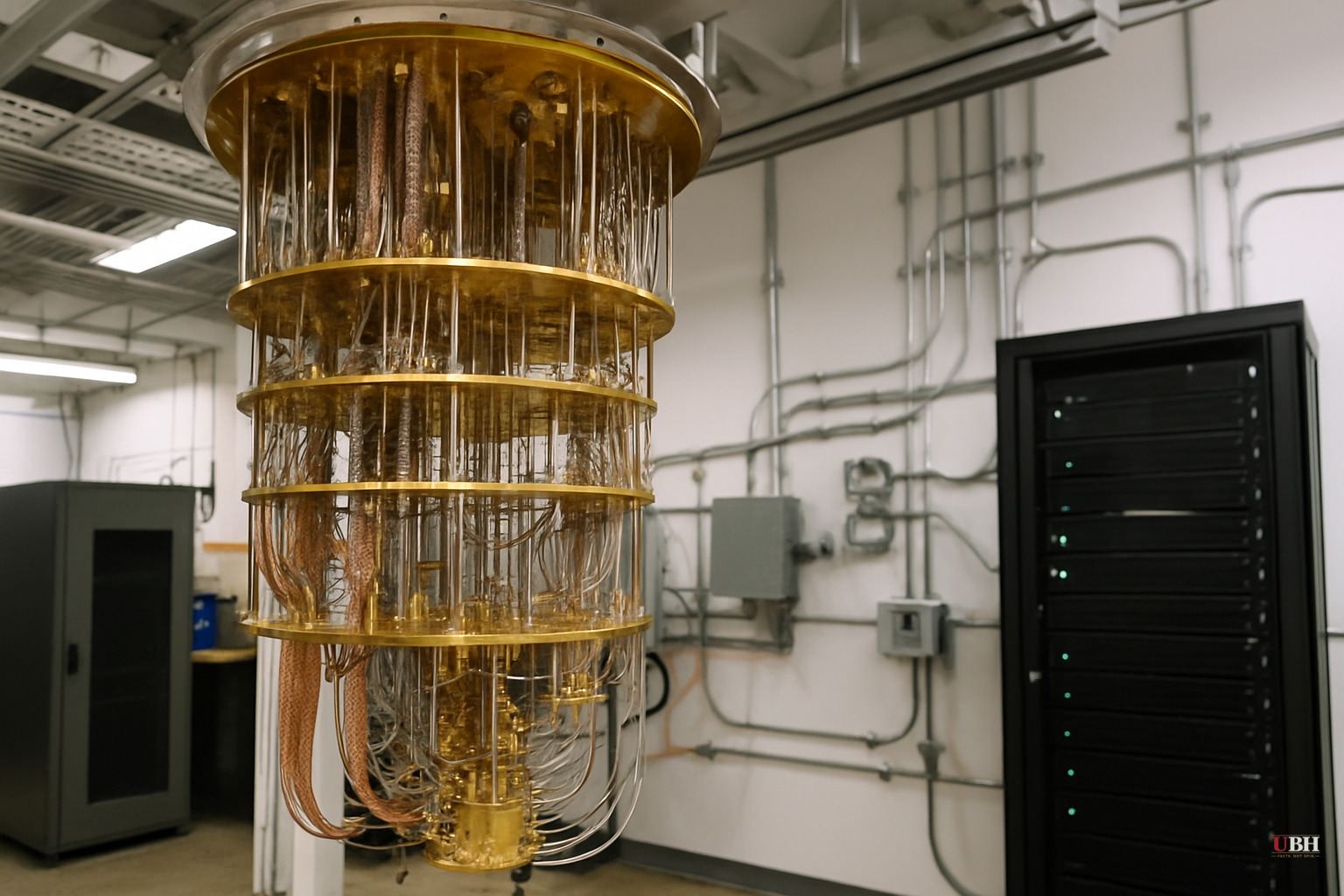
Google's Calibration Fix
Superconducting quantum processors, the kind Google builds, are made of components called transmons: loops of superconducting wire connected to resonators, controlled by precise pulses of microwave photons. The problem is that no two transmons are identical. Subtle manufacturing variations mean each one requires its own calibration, a process of testing different microwave frequencies and amplitudes to find settings that minimize error rates.
Calibration has to happen before computation begins. You cannot run the standard calibration process while an algorithm is running. That creates a real vulnerability: as hardware heats up during use, settings drift, error rates climb, and Google's current answer is to stop the computation and start over. For short calculations, that is manageable. For the kind of long, complex algorithms quantum computers are eventually supposed to run — including cryptographic workloads — stopping mid-calculation is NOT an option.
Google's researchers identified the fix by looking at data they were already collecting. According to Ars Technica's coverage of the paper, the team noted that "errors from imperfect calibrations produce detectable syndromes just like all other errors." In other words, calibration failures leave the same kind of fingerprints in error-correction data that random hardware errors do. The challenge was distinguishing between the two.
The solution Google landed on is reinforcement learning. The system tries different configurations, observes which ones reduce the error signatures, and adjusts in real time without interrupting the calculation. The processor, in effect, recalibrates itself while it works.
For systems built on manufactured hardware, where no two qubits are perfectly alike, this approach is most relevant. It is less relevant for atom-based quantum computers, where the qubit is a single atom and therefore perfectly uniform. Ars Technica notes that the lasers controlling those systems can drift too.
Oratomic's $300M Bet
The atom-based approach is exactly what Oratomic is building. The startup, founded by Caltech physicists, uses lasers as optical tweezers to hold individual atoms in place as qubits. This week it announced a $300 million Series A co-led by ARCH Venture Partners, Spark Capital, and Khosla Ventures, with Bezos Expeditions, Index Ventures, General Catalyst, Lowercarbon Capital, and Bain Capital also participating, according to TechCrunch.
Oratomic's co-founder and CEO Dolev Bluvstein told TechCrunch the company exists because of a specific experimental breakthrough: their architecture can perform error correction using dramatically fewer qubits than previously thought necessary. His claim is that a fully useful, fault-tolerant quantum computer requires only 10,000 to 20,000 qubits, and that all the core components for that machine have already been demonstrated experimentally at smaller scale.
"You would have not previously been able to convince any of us to start a quantum computing company, because we just thought it was way too far away," Bluvstein said. "Only when we made this recent breakthrough did we simultaneously all change our minds."
Oratomic is skipping the NISQ phase entirely. NISQ — noisy intermediate-scale quantum — refers to the error-prone, limited-qubit prototypes that most quantum companies are selling access to right now for research and corporate experimentation. Oratomic has no plans to build or sell any of those. The company is going straight for fault-tolerant utility-scale hardware, with a target of delivering it by the end of the decade.
The Strongest Skeptical Case
The quantum computing field has a well-documented history of optimistic timelines that slip. Investor Vinod Khosla declared on X that Oratomic represents his firm's largest initial investment yet, and that confidence may be warranted or may reflect the current wave of enthusiasm more than the underlying engineering reality.
Oratomic's claim that 10,000 to 20,000 qubits are sufficient is an extraordinary departure from conventional estimates, which have run into the millions. The company says it has demonstrated all core components at smaller scale, but a demonstration at smaller scale and a full-scale machine that sustains fault-tolerant computation over time are very different things. Bluvstein himself drew a distinction between his company and PsiQuantum — a startup valued at $7 billion that is also bypassing NISQ and targeting a million-qubit machine by end of next year — arguing Oratomic's approach is "fundamentally simpler and less expensive." Both companies are making claims about machines that do not yet exist at production scale, which is worth keeping in mind when evaluating either pitch.
Where This Leaves the Field
The quantum computing investment wave is real and measurable. According to TechCrunch, Infleqtion and Quantinuum have gone public in 2026, and public companies Rigetti and IonQ have seen share prices surge over the past 18 months.
Google's calibration paper addresses a concrete, near-term engineering problem that was going to bite the industry regardless of which hardware architecture won. Oratomic's fundraise is a longer-term bet on a specific architectural claim that has not yet been validated at production scale.
The unresolved question is whether Oratomic's qubit-count claim — 10,000 to 20,000 versus estimates that previously ran to the millions — will hold up as the system scales. If it does, the company's end-of-decade timeline is plausible. If the error-correction efficiency degrades as the system grows, the $300 million buys a lot of research but not a useful computer.
Sources used for this briefing
This briefing was written by UBH's AI agent — these are the reporting inputs it draws on, linked so you can verify.


