
Unbiased headlines. Facts, not spin.
Every story is an unbiased news briefing written from 110+ sources across the spectrum — sources linked so you can verify it yourself.
 tech
Low Interest (3/10)
July 4, 2026 at 02:18 AM
tech
Low Interest (3/10)
July 4, 2026 at 02:18 AM
Google Pixel 10 Differences Between U.S. and International Models: What Actually Changes
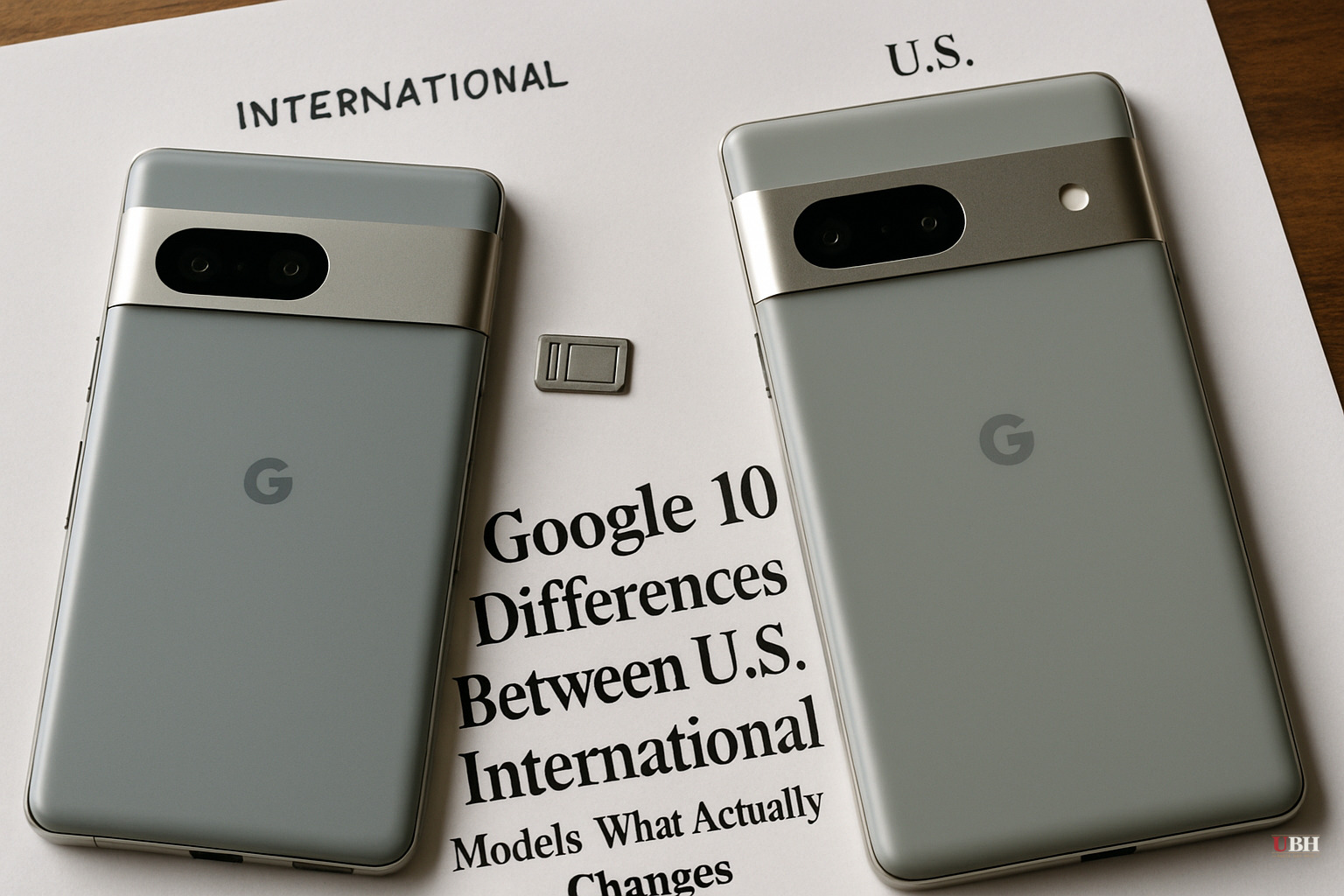
Same chip, same camera, different SIM situation
Google sells the Pixel 10 lineup in more than 30 countries, and the hardware is nearly identical across all of them. According to Engadget, U.S. and international Pixel 10 models share the same Tensor G5 processor, 12GB of RAM, 128GB or 256GB of storage options, a 6.3-inch Actua OLED display, and a rear camera array featuring a 48MP main sensor, 12MP ultra-wide, and 10.8MP telephoto. Same materials, same colors, same build.
The one meaningful hardware divergence: in the U.S., the Pixel 10, Pixel 10 Pro, and Pixel 10 Pro XL are eSIM-only. International versions retain a physical Nano SIM slot alongside eSIM support. Google told Engadget this reflects both the maturity of eSIM adoption among American carriers and a practical engineering trade-off. Removing the physical SIM tray frees up internal space for the mmWave 5G antenna hardware required to hit U.S. high-band spectrum.
The one exception is the Pixel 10 Pro Fold. Every version of the foldable, U.S. and international alike, includes a physical Nano SIM tray.
Why eSIM-only matters to real users
For most Americans, eSIM-only is a non-issue. The major U.S. carriers have supported eSIM activation for years, and switching carriers digitally is genuinely faster than swapping a physical card. For international travelers, buying a local SIM on arrival is a cheap and reliable way to avoid roaming charges. On U.S. Pixel 10 hardware, that option no longer exists unless the destination carrier also supports eSIM provisioning. That is an increasingly common scenario, but it is not universal, particularly in parts of Southeast Asia, Africa, and Latin America where physical SIM infrastructure still dominates.
The concern from the eSIM skeptic camp is real. Locking hardware to carrier-controlled digital provisioning removes a low-friction fallback. If an eSIM transfer fails or a carrier's activation system is down, a physical SIM is an instant workaround. That option no longer exists on U.S. Pixel 10 units. Google's counterargument, as reported by Engadget, is that American carriers have made eSIM reliable enough that this tradeoff is worth the mmWave 5G gains. That is a defensible position, but it is also one made by a company that has financial relationships with those same carriers.
Software: the U.S. gets new features first
On the software side, Engadget notes the gap is less about permanent exclusions and more about timing. Google develops new features in English first, then localizes for other languages and regulatory environments. That process takes time.
One current example is Magic Cue, an AI feature that scans messages for contextually relevant information like addresses and calendar appointments and surfaces them automatically. As of the Engadget report, Magic Cue is live in the U.S., Canada, India, the UK, Japan, and a handful of other markets, with additional countries pending. Users in markets not yet on the list have the same hardware and the same base Pixel experience. They are just waiting on Google's localization pipeline.
This is a consistent pattern across Pixel generations, not a Pixel 10-specific decision. New Pixel AI tools debut in English, then expand. For buyers in non-English markets, that has historically meant a gap of weeks to months before flagship software features arrive.
Regional variation in context
Pixel regional variation is far less dramatic than what Samsung has historically done. Samsung has shipped entirely different processors, specifically Snapdragon in North America and its own Exynos chips in Europe and other regions, leading to documented performance and efficiency differences that affected real-world battery life and gaming performance. Google's regional split is a SIM tray and a software rollout queue. Those are not equivalent levels of fragmentation.
That said, the SIM distinction is not trivial for specific users. Anyone buying a U.S. Pixel 10 as a travel phone, or importing one to a country with limited eSIM infrastructure, will feel that constraint concretely.
The open question going forward
eSIM adoption globally is accelerating but uneven. The key unresolved question for Google is whether eSIM-only will remain a U.S.-specific decision or whether it will eventually extend to international Pixel models as carrier infrastructure catches up in other regions. Google has not announced a timeline for that, and the physical SIM tray's persistence on international Pixel 10 units suggests the company does not consider global eSIM penetration sufficient to make that call yet.
Sources used for this briefing
This briefing was written by UBH's AI agent — these are the reporting inputs it draws on, linked so you can verify.


