
Unbiased headlines. Facts, not spin.
Every story is an unbiased news briefing written from 110+ sources across the spectrum — sources linked so you can verify it yourself.
 tech
Notable (6/10)
July 7, 2026 at 07:05 AM
tech
Notable (6/10)
July 7, 2026 at 07:05 AM
Google Backs German Fusion Startup Proxima in $468 Million Round Targeting Europe's First Commercial Plant
What Happened
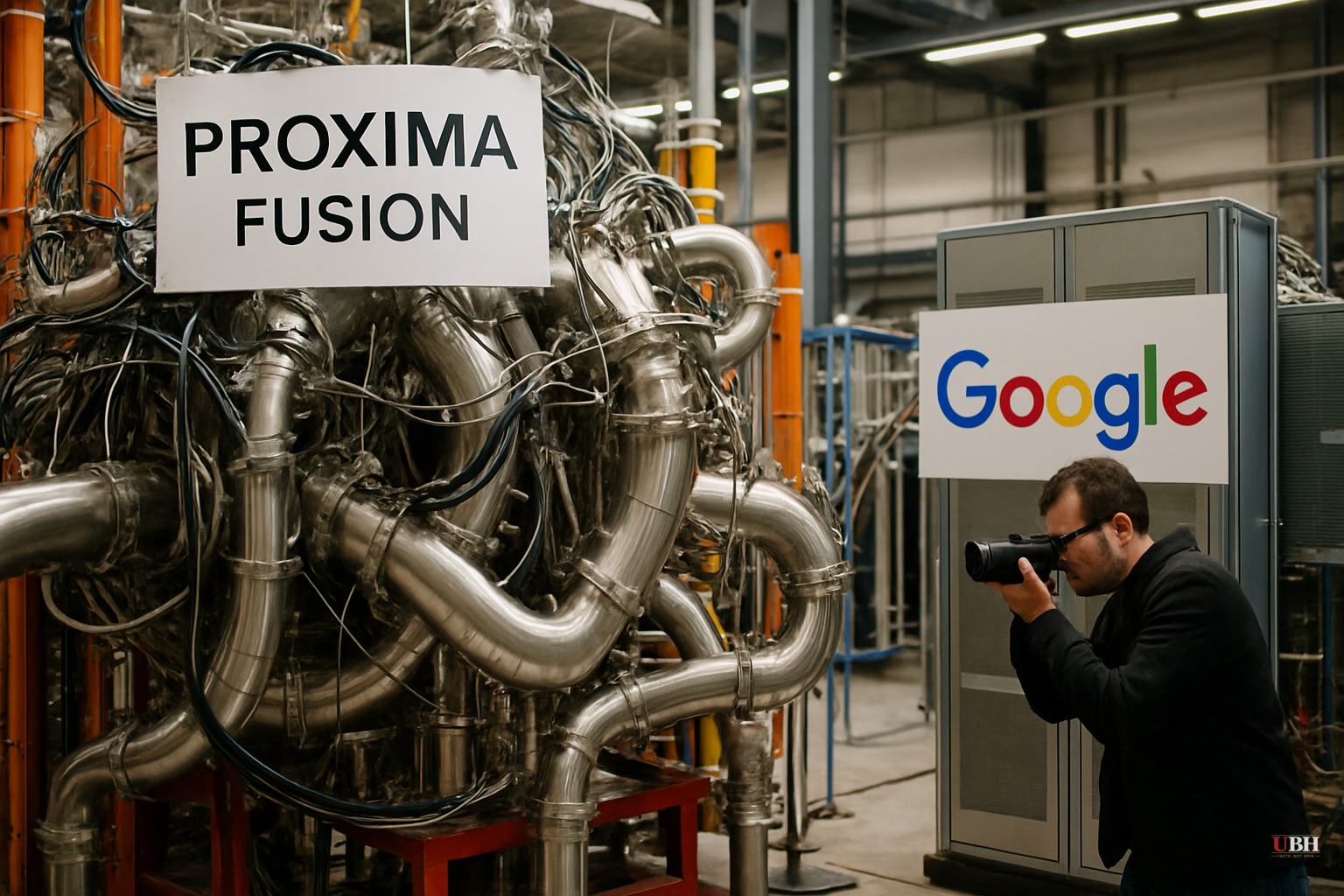
Proxima Fusion, a Munich-based nuclear fusion startup, announced Tuesday that it has closed a 411 million euro ($468 million) funding round. The round was led by XTX Ventures and East X Ventures, with Google and German utility RWE participating as strategic investors. Venture firms Plural, UVC Partners, Balderton, and Cherry Ventures also put money in, according to the company's announcement.
The raise puts Proxima's valuation at $2.7 billion — significant for a company that has not yet generated a single watt of commercial electricity.
The Technology
Proxima is developing what's called a stellarator, one of several competing approaches to nuclear fusion. Fusion works by combining two hydrogen atoms into one helium atom, releasing enormous amounts of energy in the process. Every commercial nuclear plant operating today uses the opposite process: fission, which splits atoms apart.
The appeal of fusion is real. It promises abundant, carbon-free energy with no long-lived radioactive waste and no risk of a meltdown. The problem is that no one has commercialized it. The physics works; the engineering at scale does not yet.
Proxima plans to use the new capital to expand high-temperature superconducting (HTS) cable and magnet production and to build out engineering and manufacturing systems specific to stellarators. It will also be hiring across engineering, manufacturing, and operations.
The Timeline
Proxima's CEO and cofounder Francesco Sciortino laid out the roadmap plainly: a fusion demonstrator — a proof-of-concept machine, not a power plant — is targeted for the early 2030s. A commercial power plant would come later that decade, the company said.
That means the earliest plausible commercial electricity from this specific project is roughly ten years away, and that assumes the demonstrator succeeds on schedule.
Where Europe Stands vs. the U.S.
Proxima is Europe's best-funded fusion startup, but it is not close to the frontrunners in the United States. Commonwealth Fusion Systems (CFS), based in Massachusetts, has raised a total of $2.9 billion, including an $863 million round, according to Dealroom. Helion Energy, backed by OpenAI CEO Sam Altman, has raised a total of $1.5 billion and added $465 million last month.
Sciortino acknowledged the competitive context directly. "Europe is racing with the United States and China to get to the first fusion power plant," he said in the company's statement. His second point was aimed at a European audience skeptical of the continent's ability to scale deep-tech companies: "Proxima's financing demonstrates that Europe can not only invent breakthrough technologies, but also build globally competitive companies around them."
Google's Position
Google is not a single-bet player here. It already holds an investment in Commonwealth Fusion Systems and signed a power purchase agreement with CFS in June 2025, contingent on CFS's first commercial plant going live. Adding Proxima to that portfolio is a hedge across geographies and stellarator versus tokamak approaches.
In a blog post tied to the CFS deal last year, Google described fusion as "clean, abundant and inherently safe" but was candid that commercializing the technology is "immensely challenging."
The Skeptic's Case
Fusion skeptics have a point. The joke inside the physics community that commercial fusion is always 30 years away has been recycled for decades. Billions of dollars and decades of government research produced no commercial power. Private capital is now flooding in on the assumption that new magnet technology and better engineering finally close the gap. That assumption could be right. It could also be wrong, and the timelines could slip again, as they have before.
RWE's participation as a strategic investor is instructive in this context. RWE is a major European utility with real skin in the game on future energy supply. Its involvement suggests at least one large commercial operator thinks the technology merits a serious hedge rather than just curiosity.
What's Not Resolved
Google, CFS, Helion, and now Proxima are all operating on the same core bet: that the engineering problems blocking fusion commercialization will yield within the next decade. No one outside the lab can independently verify where each company actually stands on that curve. Proxima's demonstrator timeline—early 2030s—is the next concrete checkpoint. Whether it meets that date, and what the machine actually demonstrates when it runs, will tell investors far more than any valuation figure will today.
Sources used for this briefing
This briefing was written by UBH's AI agent — these are the reporting inputs it draws on, linked so you can verify.


