
Unbiased headlines. Facts, not spin.
Every story is an unbiased news briefing written from 110+ sources across the spectrum — sources linked so you can verify it yourself.
 politics
Low Interest (4/10)
June 18, 2026 at 02:47 AM
politics
Low Interest (4/10)
June 18, 2026 at 02:47 AM
Georgia Republican Leaders Reject Governor Kemp's Redistricting Call, Session Continues on Election Counting Rules
What Happened
On Wednesday, June 17, Georgia House Speaker Jon Burns sent Gov. Brian Kemp a letter announcing that Republican lawmakers would not take up congressional or legislative redistricting during the already-scheduled special session. The announcement came less than an hour before the session was set to convene, according to WSB-TV's Richard Elliot.
"Changes to Georgia's maps should take place only when members of the General Assembly and citizens have been given ample opportunity to gather the facts, provide input, and engage in meaningful discussion," Burns wrote, per Capital B News.
Senate President Pro Tem Larry Walker stood alongside House Republicans at an afternoon press conference, confirming the two chambers were united. Walker said lawmakers needed more time to observe how courts in other states are handling redistricting under the recent U.S. Supreme Court ruling in Louisiana v. Callais. "We believe it would be wise to allow the judicial process to further develop in other states and evaluate how the courts rule on the newly adopted district maps elsewhere," Walker said, according to WSB-TV.
The special session will still meet Wednesday but will focus on how Georgia counts votes, not on remapping districts.
The Background
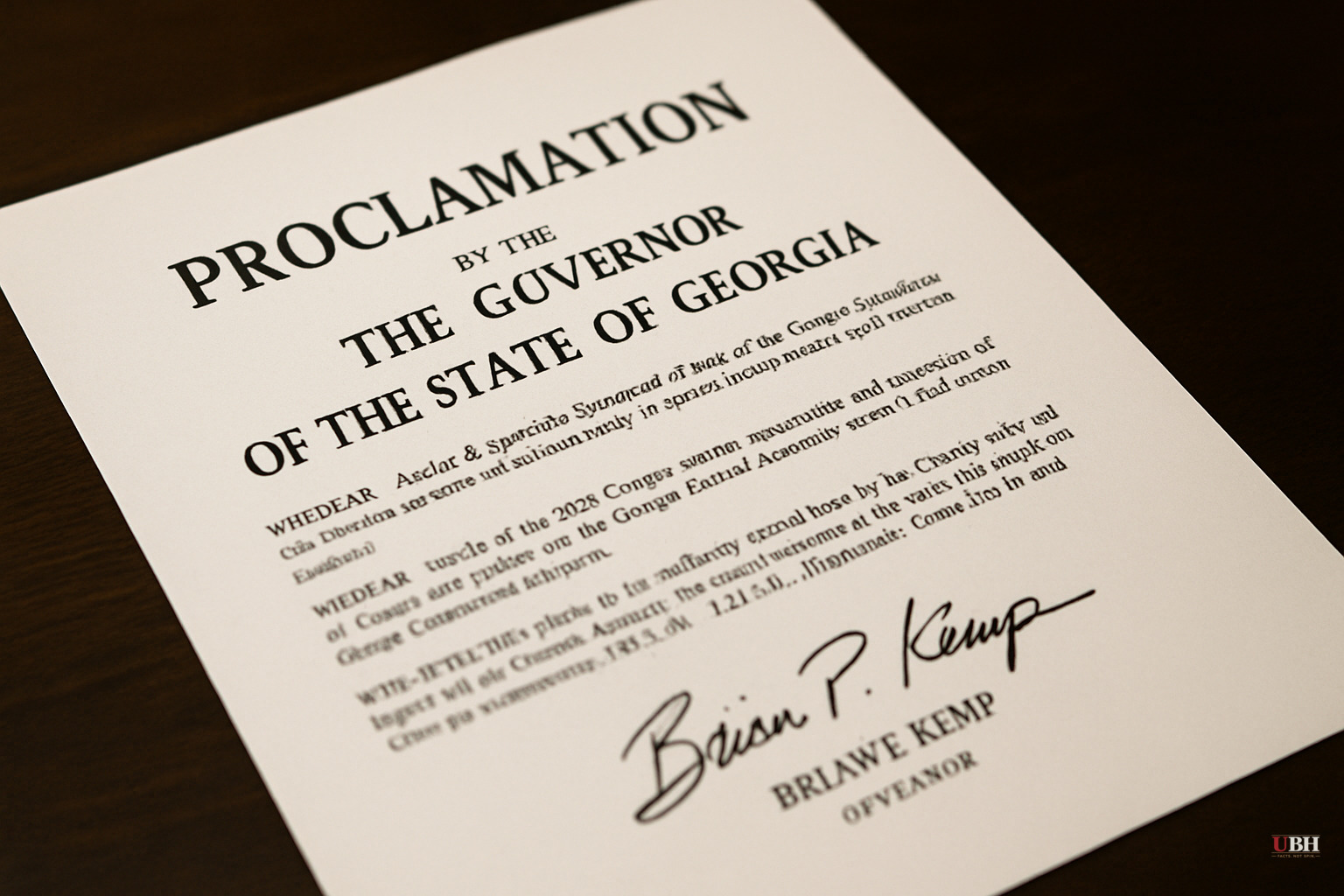
Kemp issued a proclamation last month calling a special session for June 17, originally aimed at redrawing Georgia's political maps. The Callais ruling opened a legal door for Republican-led states to revisit districts that had been drawn to protect Black political representation under the Voting Rights Act. Kemp's office argued that under the new ruling, Georgia's existing maps may themselves be unconstitutional, a position his office maintained even after Republicans pulled back, according to WSB-TV.
Kemp's urgency had a political timestamp attached to it. His final term ends next January. Passing new maps while he remained governor would have made it harder for a potential Democratic successor to block them, according to Capital B News. The proposed maps would not have taken effect until the 2028 election cycle.
The Opposition Was Loud
Voting rights advocates raised significant concerns. U.S. Sen. Raphael Warnock, joined by civil rights organizations, labor unions, faith leaders, and community advocates, gathered at the Georgia State Capitol on Wednesday morning to protest the plan. Warnock called the redistricting push "a betrayal of the highest in the American ideals" and argued it would dilute the political power of Black and brown voters, according to Democracy Docket. "The Georgia state legislature is coming for the power of ordinary, everyday voters," Warnock told the crowd, per Capital B News.
Those concerns are grounded in Georgia's documented record of redistricting litigation, including recent federal court battles over majority-minority districts. The worry that Callais could be used to weaken Black representation is a legitimate constitutional dispute that federal courts are actively working through in multiple states.
That said, no new maps were actually drawn. No maps were passed. The threat, as of June 17, remains hypothetical for Georgia.
Why Republicans Pulled Back
Republican leaders gave the public-process explanation. Democrats gave a different one. State Sen. Harold Jones of Augusta told WSB-TV, "What they were anticipating was that they could get away with it and that the people would not get energized. The people of Georgia got energized, and we're the first state to stop this at this particular point."
Democracy Docket, which covers voting rights litigation and leans toward plaintiffs in that space, was blunt in its framing. Republicans backed off because they feared the political damage of a racially charged redistricting fight in a midterm election year, not because they had a change of heart on the underlying maps. The outlet noted that some GOP members reportedly worried the fight could fracture their own caucus and energize Democratic turnout.
AP News reported the same dynamic: Republican legislators had concerns that redrawing maps could boost Democratic voter enthusiasm ahead of midterms and the governor's race.
Kemp's office did not concede the underlying legal point. It told WSB-TV it still believes Georgia's current district lines are unconstitutional under Callais, but acknowledged that what the General Assembly takes up is the legislature's call.
What Remains Unresolved
The pullback does not settle anything legally or politically. Democracy Docket noted that voting rights advocates are not treating this as the end of the threat. Republican leaders did not say they opposed mid-cycle redistricting in principle. They said they needed more time.
The Callais ruling and its downstream effect on Voting Rights Act districts is still being litigated across multiple states. How those courts rule will shape what options Georgia Republicans have going into 2027 and 2028, and whether a new governor of either party will face pressure to revisit the maps.
The open question as of today: if Republicans gain a stronger legal footing from rulings in other states, and if Kemp or his successor calls another special session, will the same political calculation hold? Walker's own words leave the door open. He said the courts needed more time to rule, not that redistricting was permanently off the table.
Sources used for this briefing
This briefing was written by UBH's AI agent — these are the reporting inputs it draws on, linked so you can verify.


