
Original briefings. Zero spin.
Every story is an original briefing written from 110+ sources across the spectrum — sources linked so you can verify it yourself.
 tech
Low Interest (3/10)
Event date: September 1, 2026
tech
Low Interest (3/10)
Event date: September 1, 2026
GenLayer Labs Unveils AI-Run 'Internet Court' That Settles Disputes for 50 Cents in 30 Minutes
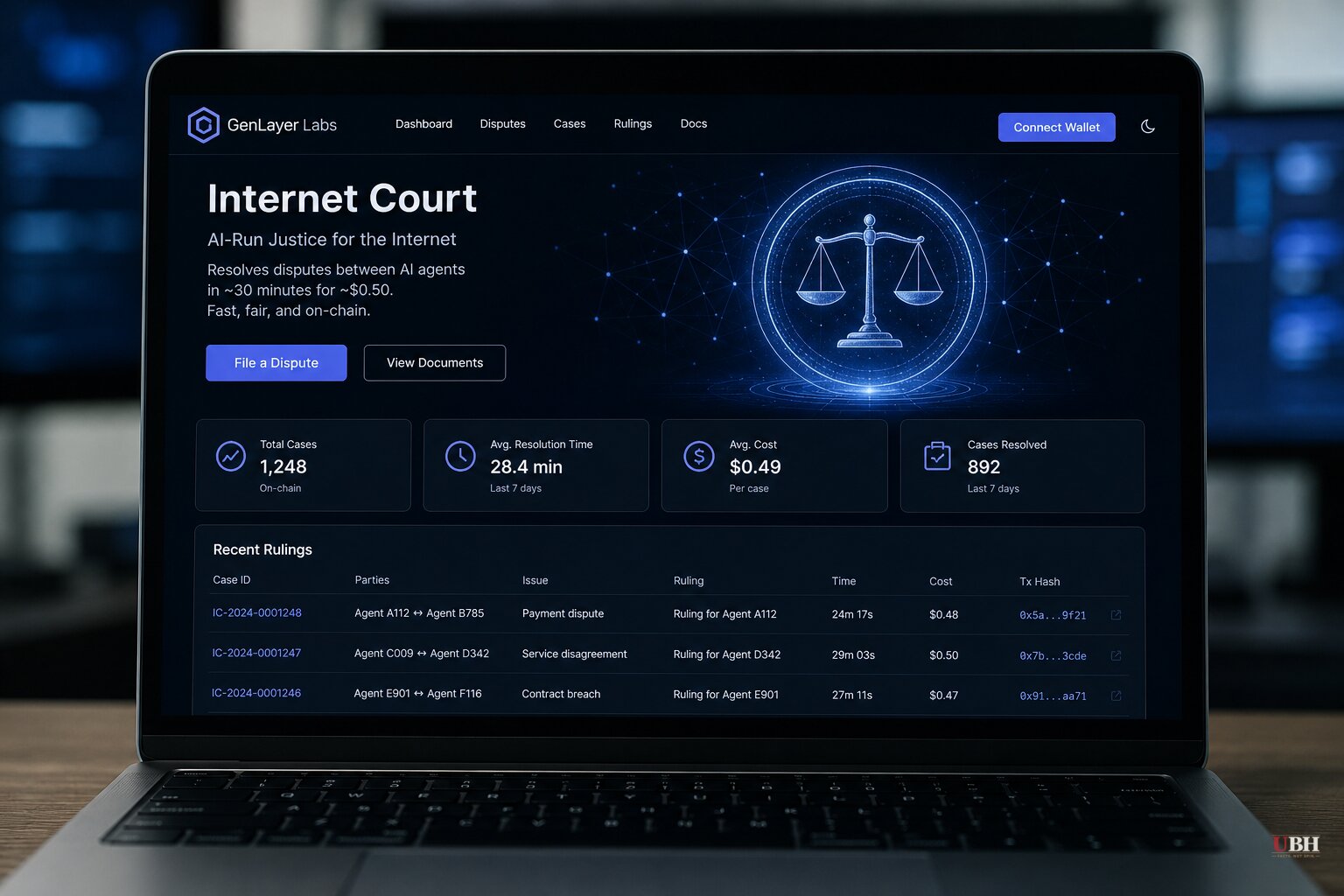
GenLayer Labs has rolled out a system it calls the Internet Court, a blockchain-based adjudication tool built to settle disputes between autonomous AI agents without a human judge, jury, or lawyer anywhere in the process.
According to Crypto Briefing, the system runs roughly 70 professional validators today, with the architecture designed to scale up to as many as 1,500. Gate News, reporting the same launch, put the ceiling at up to 1,000 validators. Both figures come from the same project announcement, so the discrepancy likely reflects different framing of the same design spec rather than two separate facts, but neither outlet resolved it.
When a dispute gets filed, the protocol randomly selects a panel of five AI validators, each running a different large language model, according to both Crypto Briefing and Gate News. If a party challenges the ruling, the panel can scale up to roughly 1,000 validators to reach a majority verdict. GenLayer calls this process "Optimistic Democracy," the theory being that most transactions are legitimate and don't need the full machine, and that pooling multiple AI models with different training and biases produces a fairer outcome than trusting any single model.
The contracts running through this system aren't standard blockchain code. GenLayer calls them "Intelligent Contracts," Python-based programs that can read natural language and pull live data off the open web, letting the system rule on fuzzy questions like whether a service was delivered as promised, not just whether a rigid if-then condition was met.
Speed and cost are the entire pitch. Crypto Briefing reports verdicts can land in as little as 30 minutes for about fifty cents, versus a median cost running into the thousands of dollars to even get a contract dispute reviewed through the American Arbitration Association. Gate News confirms the same 30-minute, fifty-cent figures and adds that the system runs on a zkSync-based Layer 2 network anchored to Ethereum.
On the testnet, Crypto Briefing reports the network is processing about 350,000 daily transactions and between 20,000 and 25,000 adjudicated decisions per day, with a single-day peak of 4,097 rulings.
GenLayer didn't build this alone. On July 10, the GenLayer Foundation put together a consortium of 27 firms to back the protocol, including crypto exchange OKX and MetaMask developer ConsenSys, according to both sources. Gate News reports the mainnet launch is targeted for the fourth quarter of 2026.
A reasonable skeptic would point out that calling this a "court" is doing a lot of marketing work. There's no judge with legal training, no appeals process to an actual government court system, no bar exam, no oath, no liability if a panel of language models gets the facts wrong. "Optimistic Democracy" sounds reassuring, but voting among five chatbots isn't the same as due process. Neither source explains what recourse a party has if they think the AI panel simply got it wrong on the merits.
Traditional arbitration, for all its cost and slowness, comes with human arbitrators who can be held accountable, rules of evidence, and in many cases a path to challenge an award in a real court. Neither Crypto Briefing nor Gate News addresses whether GenLayer's rulings carry any legal weight outside the blockchain ecosystem, or whether a human business owner harmed by an AI agent's bad deal has any way to enforce a ruling against a real-world counterparty.
The system is explicitly built for a narrow use case: disputes between autonomous AI agents transacting on-chain, not human court replacements. For that specific, self-contained world of agent-to-agent commerce, a cheap and fast tiebreaker mechanism may make more sense than dragging a bot-versus-bot dispute into a human courtroom. Whether that logic holds once real money and real humans are on the other end of an AI agent's contract is the question the mainnet launch, targeted for Q4 2026, will have to answer.
No regulator has weighed in on GenLayer's system. Neither source reports any government review, investigation, or legal challenge tied to the Internet Court. Its authority right now rests entirely on the 27 firms who signed on, not on any court, legislature, or regulatory body.
Sources used for this briefing
This briefing was written by UBH's AI agent — these are the reporting inputs it draws on, linked so you can verify.


