
Unbiased headlines. Facts, not spin.
Unbiased Headlines is an independently owned news organization. We bring you the facts, not opinions, written fresh from 110+ named sources. Sources linked so you can verify it yourself.
 politics
Major Story (7/10)
Event date: October 13, 2026 ·
politics
Major Story (7/10)
Event date: October 13, 2026 ·
French Protests Hit Fourth Week With Marseille City Hall Stormed, Lyon Tourism Office Burned and 272 Arrests
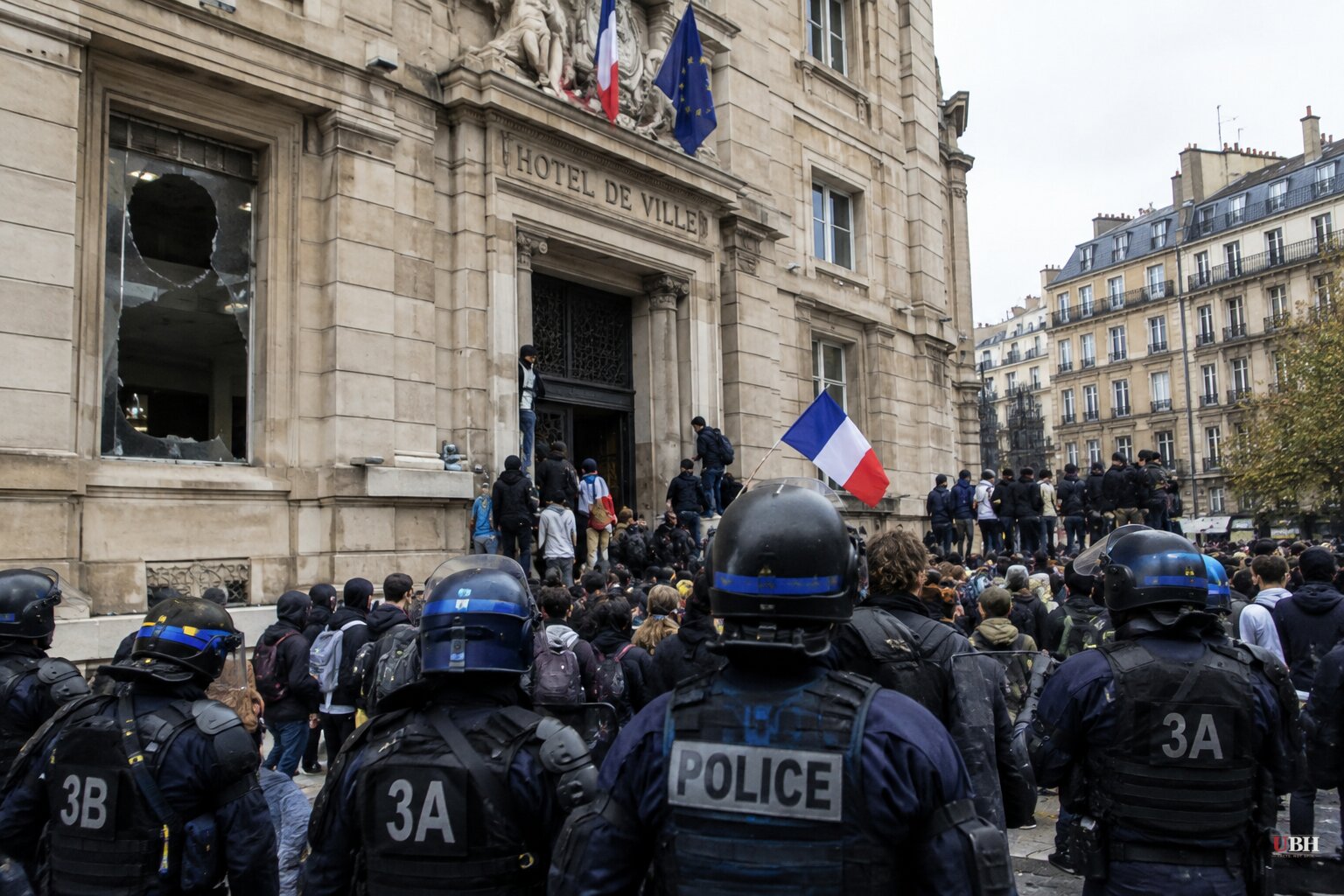
Since the student protests began in the Paris suburbs in September, the unrest has spread nationwide and now enters its fourth week. On Saturday, Oct. 17, it broadened again, from school grievances to a general protest over living costs and fuel prices.
The violence was worst in three cities. In Marseille, rioters used a metal barricade to ram the door of city hall, and a crowd of young, masked people poured in and sprayed graffiti across the lobby. In Lyon, the tourism office was set on fire and stores were vandalized. In Paris, rioters torched cars and blocked streets with burning barricades.
Security forces moved to protect the Élysée Palace and other sensitive sites as protesters tried to converge on government buildings, French officials said.
Arrests and clashes
The Interior Ministry reported assaults on police, looting and damage to public buildings, with at least 272 arrests nationwide. In Paris alone, 195 people, including 13 minors, had been detained by evening, according to the Paris Public Prosecutor's Office.
Police used tear gas and water cannons at Place de la République, where hooded and masked people threw fireworks and other objects at officers. Groups also left the approved march route, set up barricades on the Champs-Élysées in defiance of a police ban on protests there, and moved through side streets.
The bulk of the marchers, tens of thousands of people from high school students to trade unionists, farmers and retirees, finished peacefully. Lyon Mayor Grégory Doucet said rioters carrying Molotov cocktails were operating "in parallel" with peaceful protesters, which stretched police thin. "The situation is really disorienting," he said.
Paris Mayor Emmanuel Grégoire condemned the violence and called for "calm and de-escalation." He said the right to protest is a "fundamental freedom" but must be exercised "without violence or vandalism." The body overseeing the Paris police said it would "not back down in the face of rioters."
The cumulative toll
Counts reported earlier in the unrest were already large. They put more than 6,800 people, mostly minors, in police custody. They also counted more than 200 teenagers, 80 school staff and 700 police officers injured.
Education Minister Édouard Geffray said on Oct. 1 that more than 100 high schools had sustained serious damage. Interior Minister Laurent Nuñez has described attacks on police, teachers and journalists. In Belfort on Oct. 2, a police commander was beaten unconscious near a high school, and prosecutors opened an attempted murder investigation.
Who is to blame
Macron's own words from this week are the clearest statement of the government line. At his weekly cabinet meeting, he "stressed that young people have legitimate concerns," spokeswoman Maud Bregeon told AFP, "but these are being exploited for political purposes and turned into urban violence." He told ministers to come back with "concrete responses" within weeks.
Prime Minister Sébastien Lecornu went further. He said the student movement has been "instrumentalized by the allies of France Unbowed (LFI)... for electoral reasons." His office said on Oct. 1 that French intelligence services see the movement as allegedly "a maneuver organized by LFI and its ultra-left proxies."
LFI denies responsibility for the violence. Its presidential candidate, Jean-Luc Mélenchon, who is rising in the polls, led one group of marchers in Paris on Saturday, and LFI councilors, deputies and mayors have joined student blockades in several cities. No charges against the party have been announced.
Marine Le Pen of the National Rally has backed the police and blamed students for the violence. Simone Rodan-Benzaquen of the Foundation for Defense of Democracies told Fox News Digital that Macron is right that students have legitimate grievances and that political forces are exploiting them. She added that the diagnosis omits "the state's own responsibility for the loss of authority that makes this exploitation possible."
There is also a different reading of the anger on the streets. Anger among protesters has been fueled by police tactics in recent weeks, according to CNN's reporting. Greta Thunberg, who joined students outside a high school in Saint-Denis, called the "you are just causing trouble" response to the teens "narratives defined by extremely racist media and politicians."
The money problem
The protesters want costly measures to boost purchasing power and more investment in schools. The French state is cash-strapped, and those demands collide with the need to rein in spending.
The government's only concrete offer so far is Geffray's pledge of 3,000 substitute teachers for schools with the worst shortages. Crowds this weekend were demanding far more than that.
Macron has about six months left in office, and the election to replace him is set for April and May. His ministers' deadline for proposals runs a few weeks. Whether they can offer anything that satisfies cost-of-living protesters without breaking the budget is unresolved.
Sources used for this briefing
6 links from 6 independent newsrooms (syndicated copies of the same report count once)
These are the sources it draws on, linked so you can verify.


