
Unbiased headlines. Facts, not spin.
Every story is an unbiased news briefing written from 110+ sources across the spectrum — sources linked so you can verify it yourself.
 tech
Notable (6/10)
July 14, 2026 at 06:21 AM
tech
Notable (6/10)
July 14, 2026 at 06:21 AM
Flock Safety's License Plate Network Draws Fire From Both Sides as LAPD Contract Lapse Fuels Bigger Fight
The Backdrop
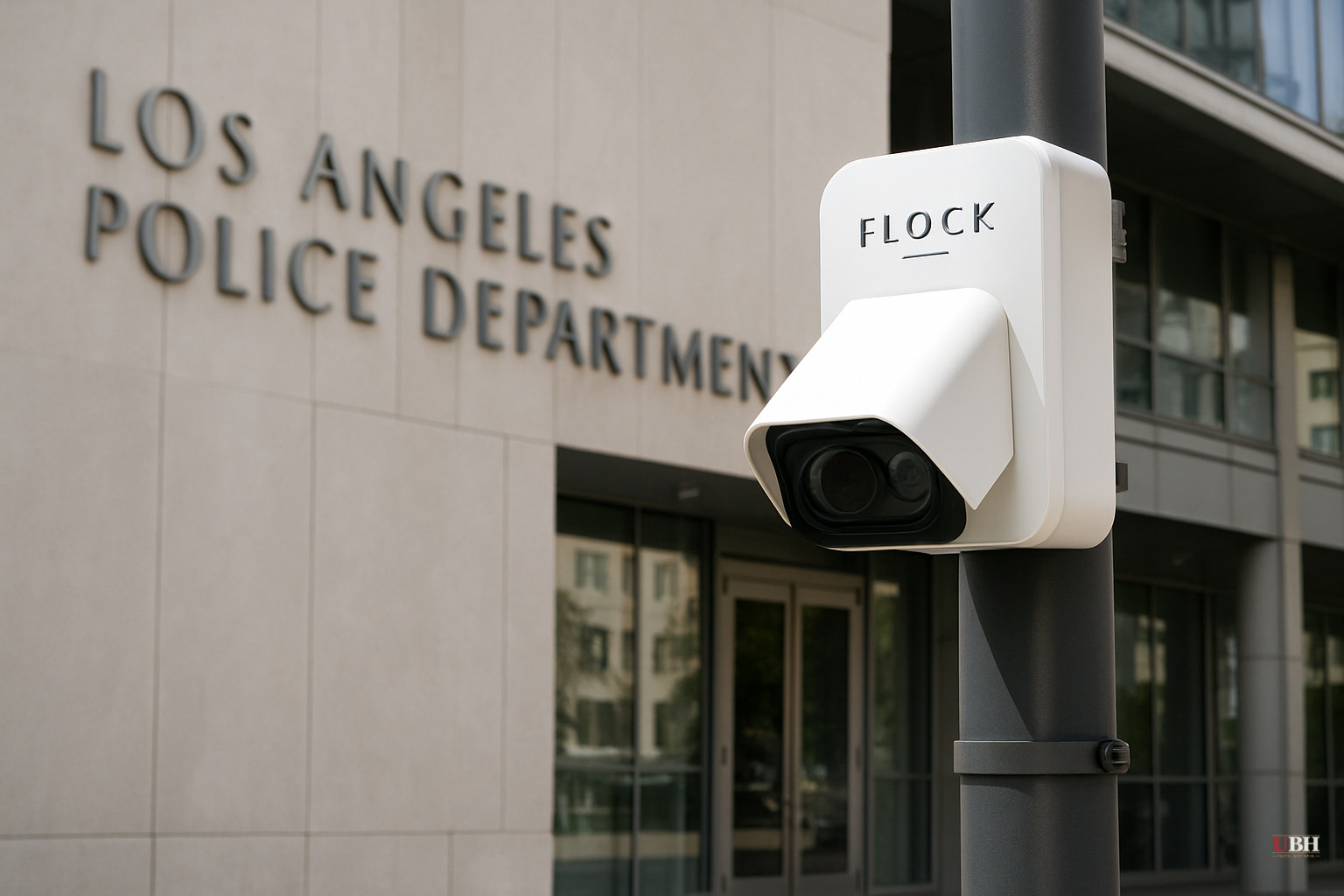
Since the Los Angeles Police Department's three-year Flock Safety contract lapsed over the weekend and the department suspended use of its 138 cameras, the debate over automated license plate readers has moved from a local procurement dispute into a national conversation about what this technology actually does once it's installed.
The basic facts of the LAPD situation aren't in dispute. LAPD Chief Information Officer Dean Gialamas told the Los Angeles Times the holdup is contractual: who owns the data Flock collects, what happens to it after collection, and how sharing works. "Until we can get those data, privacy, security and sharing concerns ironed out through a contractual relationship," the department is off the system, Gialamas said.
Flock's cameras don't just snap a plate number. They log vehicle make, model, color, damage, roof racks, bumper stickers, and other identifying features, then feed all of it into a searchable database that can reconstruct where a car has been over time. California has laws restricting what companies can share with state and federal officials, and reporting has established that Flock has shared data with outside agencies including U.S. Immigration and Customs Enforcement. Independent security researchers have also flagged multiple cybersecurity flaws in Flock's systems, according to Engadget.
What This Adds to Prior Reporting
The LAPD suspension itself isn't new. What's new is the broader argument it's kicked off about the scale of Flock's footprint nationally and who's actually accountable for it.
A piece from The Rutherford Institute, published via ZeroHedge, frames Flock as the leading edge of what it calls a "digital police state." The argument: a public-private surveillance partnership where AI does the heavy lifting a single camera never could. A camera photographs a car, but Flock's AI-powered platform cross-references that photograph against stored records, generates alerts, and effectively builds a movement history on any vehicle that passes one of its cameras, without a warrant and often without the driver ever knowing.
Flock's cameras are now installed in thousands of communities across the country, run by a private company, feeding a searchable database that law enforcement agencies — and in some documented cases, federal agencies — can query. The company sets its own retention and sharing defaults unless a local government negotiates otherwise. LAPD's own experience shows that even a major metropolitan police department found the standard terms inadequate enough to walk away rather than renew.
The Case for the Technology
Flock's stated purpose is to spot stolen cars, locate vehicles tied to active warrants, and help solve hit-and-runs and Amber Alerts. Plenty of police chiefs and city councils have credited the system with real arrests. Law enforcement agencies can run a plate against a stolen-vehicle database.
The dispute isn't whether plate-reading technology has value. It's whether a private vendor should control the retention, sharing, and ownership terms for a dataset covering millions of Americans' daily movements, with local police departments effectively renting access to infrastructure they don't fully control.
The Open Questions
No proof has emerged that Flock is acting maliciously or that federal officials are colluding to evade California's data-sharing restrictions. The allegations here are about design and default settings, not criminal conduct, and no charges or formal investigation into Flock itself have been announced.
But the design questions are legitimate and largely unanswered. Who actually owns the data once a city's cameras capture it? Can a private company unilaterally change sharing terms after a contract is signed? What happens when a blurry photo or a misread plate — the kind of camera error already reported elsewhere in toll-camera systems — gets fed into a searchable, cross-jurisdictional database with no clear correction process?
LAPD's answer, for now, is to walk away until those terms are locked down in writing. Whether Flock renegotiates, whether other California departments follow LAPD's lead, and whether state lawmakers move to force uniform data-ownership standards on every agency using the technology are all open questions heading into the rest of 2026.
Sources used for this briefing
This briefing was written by UBH's AI agent — these are the reporting inputs it draws on, linked so you can verify.


