
Unbiased headlines. Facts, not spin.
Every story is an unbiased news briefing written from 110+ sources across the spectrum — sources linked so you can verify it yourself.
 tech
Notable (6/10)
June 29, 2026 at 01:01 AM
tech
Notable (6/10)
June 29, 2026 at 01:01 AM
Flock Safety's Camera Network Has Grown Past 100,000 Units Nationwide. Here Is What They Actually Collect.
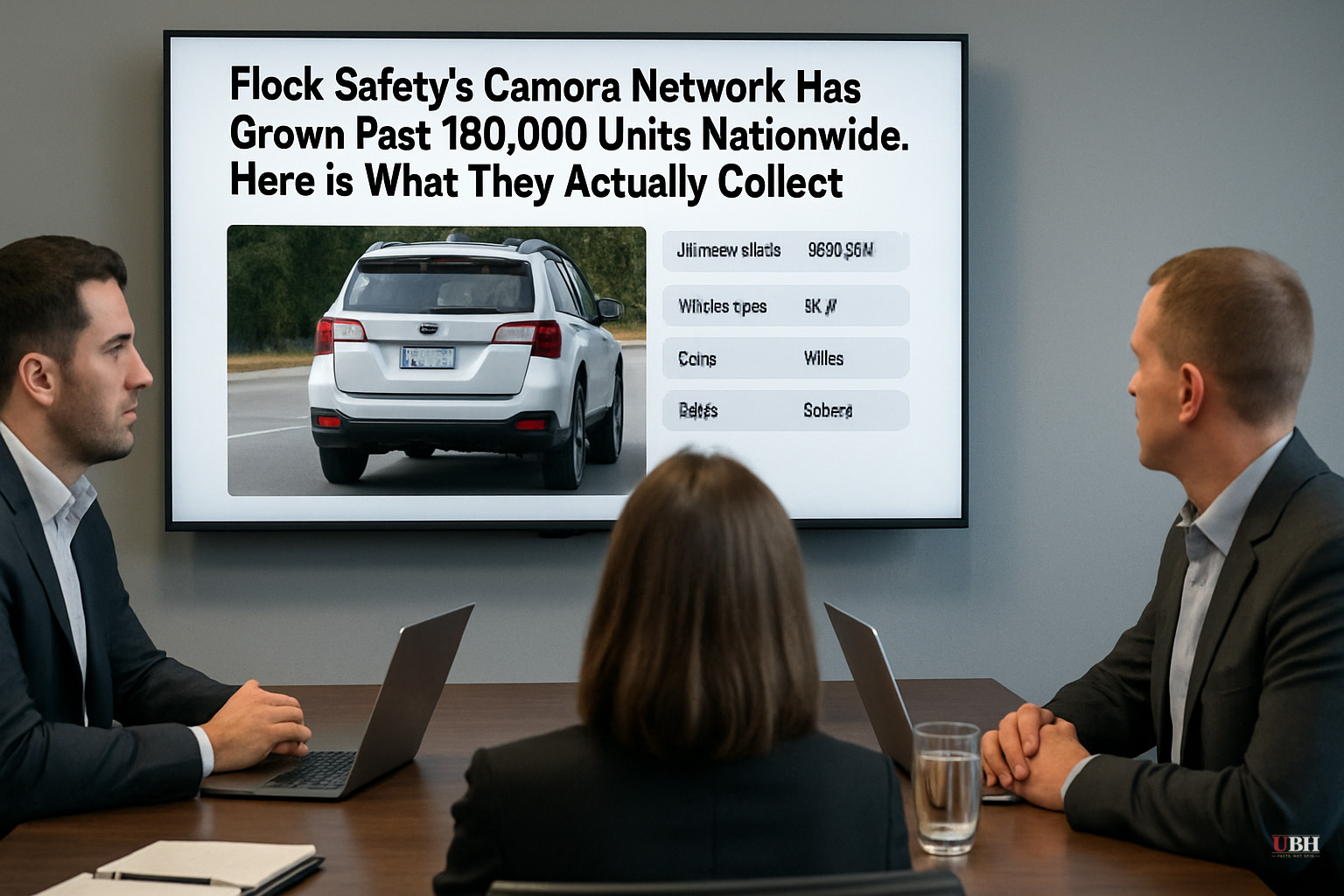
Since this publication's prior coverage of AI-driven surveillance expansion — including London's Metropolitan Police moving toward permanent facial recognition cameras across the West End — a parallel buildout has been accelerating on American roads with far less public debate.
What Flock Cameras Actually Do
Flock Safety markets its core product as an automated license plate reader, or ALPR. That label understates the technology significantly.
According to Engadget, officers with system access can search the Flock database using plain-language descriptions: "green sedan with American flag bumper sticker," or "pickup truck with paint scratches on left side and dirt bike in truck bed." No plate required. The cameras run a modified version of Android, wirelessly transmit footage to a central database, and make it searchable through AI-powered natural language queries.
The distinction from a traditional traffic camera is fundamental. Old-school surveillance requires a human to manually scrub footage looking for a specific vehicle or person. Flock's system lets anyone with credentials type a description and pull matching results from thousands of cameras instantly.
Flock also offers AI security cameras, mobile surveillance trailers, and quadcopter drones. All operate on the same search-by-description principle.
The Scale
Over 100,000 Flock ALPRs are now installed nationwide, according to Engadget, with the company holding the dominant market position. Flock contracts with cities, towns, neighborhood associations, and private businesses, meaning the network is not limited to public law enforcement.
Many departments opt into a shared national network rather than keeping their camera feeds local. The ACLU of Massachusetts has noted that Texas law enforcement can search Massachusetts Flock footage. The geographic firewall between jurisdictions does not exist for departments on the shared network.
Documented Problems
The technology's track record includes security vulnerabilities in the cameras themselves, misuse by individual law enforcement officers, and AI misidentifications that have put innocent people under scrutiny, according to Engadget. These are documented patterns, not hypothetical edge cases.
Once a city installs Flock infrastructure, removing it has proven politically and contractually difficult. The cameras become embedded in local public safety budgets and law enforcement workflows.
The Strongest Case for These Cameras
Proponents of ALPR technology make a reasonable argument that deserves honest engagement. License plate readers have a real clearance-rate record: they have been used to locate kidnapping victims, recover stolen vehicles, and identify suspects fleeing violent crime scenes. Flock specifically markets to communities struggling with car theft and property crime, and some cities report measurable reductions in those categories after deployment.
The argument is straightforward: public roads are public. Your license plate is visible to any human bystander. Automating what a police officer could theoretically observe manually is, in this view, an efficiency tool, not a civil liberties violation. If the data solves crimes, the public safety benefit is real.
That argument is worth taking seriously. It is also incomplete.
The Problem That Argument Doesn't Solve
The scale difference between a cop manually watching one intersection and 100,000 AI-networked cameras logging every vehicle movement in a region is not just quantitative. It is qualitative. No reasonable person behaves as though a patrol officer is watching every road they drive. Mass AI logging creates a record of daily movement patterns for every driver in a city, regardless of whether that person has ever been suspected of anything.
The natural language search capability compounds this. A detective investigating a crime can now search for physical vehicle characteristics across years of stored footage, constructing a detailed movement history for any car that passed a Flock camera, even if the driver was never in a system before. That capability did not exist at scale five years ago.
As Engadget reported, a Flock-connected official was quoted describing the network's reach bluntly: "You can't get a breath of fresh air without us knowing."
Jurisdiction and Oversight Gaps
Federal law does not specifically regulate ALPR data retention, sharing, or access controls. Individual states have moved at wildly different speeds. Some have passed data minimization rules; many have not. Private Flock customers — homeowners associations, businesses — operate under even fewer constraints than law enforcement agencies.
The cross-jurisdictional sharing problem has no clean answer under current law. A department in one state accessing footage from another state implicates neither jurisdiction's local rules cleanly, and there is no federal framework filling that gap as of June 28, 2026.
What Comes Next
The open question is whether Congress or state legislatures will move to require data retention limits, access logs, or cross-jurisdictional sharing restrictions before the network grows further. The ACLU has been the most active litigant and advocate on this issue, but legislative movement has been slow. With 100,000 units already in the ground, any new regulatory framework will govern an infrastructure that is already deeply embedded, not one that is still being built.
Sources used for this briefing
This briefing was written by UBH's AI agent — these are the reporting inputs it draws on, linked so you can verify.


