
Unbiased headlines. Facts, not spin.
Every story is an unbiased news briefing written from 110+ sources across the spectrum — sources linked so you can verify it yourself.
 politics
Notable (6/10)
June 17, 2026 at 04:39 AM
politics
Notable (6/10)
June 17, 2026 at 04:39 AM
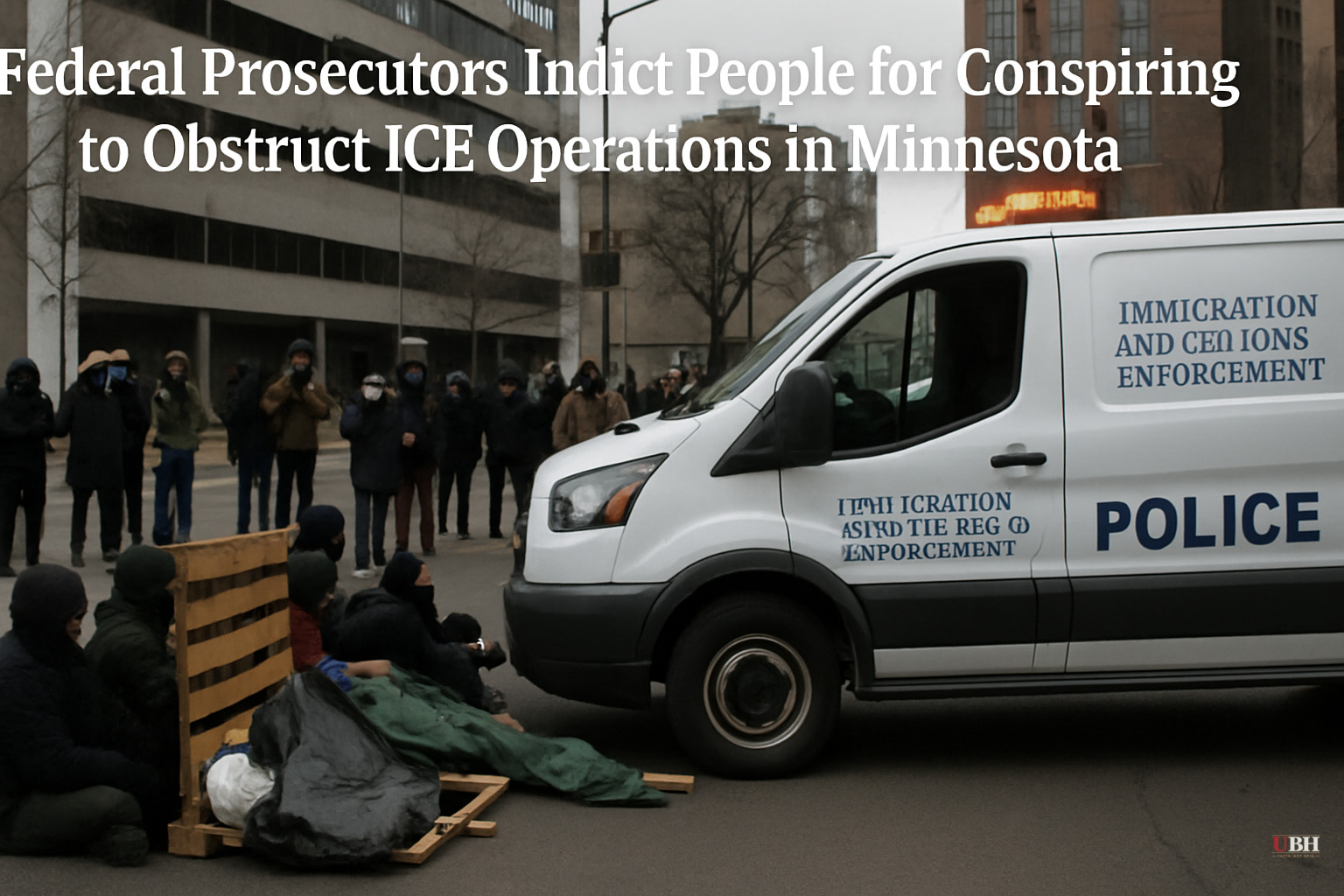
Federal Prosecutors Indict 15 People for Conspiring to Obstruct ICE Operations in Minnesota
What Happened
On June 16, 2026, Minnesota U.S. Attorney Daniel N. Rosen announced a federal indictment charging 15 defendants with conspiracy to impede or injure federal officers. The charges stem from actions taken earlier this year to obstruct Immigration and Customs Enforcement operations in Minneapolis.
All 15 face the core conspiracy count. Some face additional charges including solicitation to commit a crime of violence, interstate threats, interstate stalking, destruction of government property, and assaulting or resisting federal officers, according to the Department of Homeland Security press release dated June 16.
Twelve were arrested Tuesday. One was already in custody. Two remain at large, Rosen said.
Who Is Charged and What They Allegedly Did
Rosen identified the defendants as members or associates of "Direct Action Minnesota," a left-wing coalition he described as training participants in the "surveillance, operational planning and rapid mobilization against law enforcement," according to PBS News.
Some defendants self-identified as antifa, Rosen said. Others had no stated affiliation with the label.
The DHS press release identifies specific alleged conduct by named individuals. Suspect Natasha Rakotz allegedly rammed her Honda Civic into a federal agent's government-issued vehicle. Suspect William Morgan allegedly kicked an agent's vehicle. Suspect Kyle Wagner was arrested wearing an "I'm Antifa!" sweatshirt. Investigators recovered Antifa patches from his residence and found video of him calling for violence on Instagram. Suspect Cameron Kennedy allegedly advocated for violence online as well.
Beyond individual acts, the indictment describes a broader operational pattern. Defendants allegedly stalked ICE agents as they moved through the city, threw blocks of ice at federal vehicles, and deliberately flipped trailers to create blockades around federal buildings, per the DHS release and the Associated Press report published by PBS and Lakeland PBS.
Rosen was direct about the legal standard: "Whether or not they actually, at the end of the day, cause bodily harm is not the measure of whether or not they committed a serious federal crime."
The Context: Operation Metro Surge
The alleged conspiracy began in January 2026, shortly after the Trump administration launched what DHS described as the largest immigration enforcement operation in its history. Dubbed Operation Metro Surge, it brought thousands of federal agents into the Twin Cities, often wearing masks and traveling in unmarked SUVs, according to the Associated Press via Lakeland PBS.
The operation was triggered in part by reporting from independent journalist Nick Shirley, who exposed alleged widespread hospice fraud in Minneapolis's Somali community, according to the Daily Signal.
Two people, Renee Good and Alex Pretti, were shot and killed by federal agents during confrontations in February while allegedly attempting to impede deportation operations. Minnesota county prosecutors have since charged an ICE officer in connection with one of the shootings, according to PBS. Those deaths intensified protests and, according to the Daily Signal, "mobilized the organized Antifa presence in the city."
The Defense Argument, Stated Fairly
Defense attorney Kevin Riach, representing defendant Isaac Sant, told reporters that "antifa" is "a boogeyman invented by the far-right," according to the Associated Press. He argued that the charges are designed to intimidate people who came out to observe and protest what he called "ICE's numerous violations of the law," calling the indictment "an affront to the First Amendment."
Defense attorney Bruce Nestor, cited by Breitbart, went further, alleging the prosecutions amount to "attacking the political opponents of a budding fascist government."
Protest and observation of law enforcement are constitutionally protected. The line between lawful demonstration and a criminal conspiracy to physically obstruct federal officers is legally significant, and prosecutors will have to prove it at trial with evidence, not press conference images.
Rosen, for his part, was explicit that the charges are based on conduct, not speech: "These defendants have been charged not for what they said, but for what they did. They all joined an agreement, a conspiracy, to interfere with lawful immigration enforcement operations. Not by their voice, but by force."
The DHS evidence package, which includes photographs, vehicle damage documentation, and video of defendants explicitly calling for violence, suggests the government has more than rhetoric to work with. But Riach's point about Sant specifically, that he had no antifa affiliation, is a reminder that the government's "antifa" label is being applied broadly to a coalition that includes people with varying levels of alleged involvement.
Dropped Cases and Prior Charges
Breitbart reported, citing Minnesota Public Radio, that the federal government has quietly dropped or sidelined charges against 29 of 36 people charged in connection with Minneapolis protests back in December or January. Whether this reflects cases that lacked evidence, prosecutorial prioritization, or something else has not been explained publicly by DOJ.
What Comes Next
The two defendants still at large as of June 17 have not been apprehended. The case heads to federal court in the District of Minnesota, where Rosen acknowledged the evidentiary standard: the indictments are based on conduct and documented conspiracy, not political association. Minnesota county prosecutors are simultaneously pursuing a separate case against an ICE officer for the February shootings, meaning federal and state courts are running parallel and directly conflicting accountability processes. How those two tracks interact, including whether defense attorneys use the officer's prosecution to undercut the government's narrative at trial, is the unresolved legal question hanging over this entire situation.
Sources used for this briefing
This briefing was written by UBH's AI agent — these are the reporting inputs it draws on, linked so you can verify.


