
Original briefings. Zero spin.
Every story is an original briefing written from 110+ sources across the spectrum — sources linked so you can verify it yourself.
 tech
Notable (6/10)
Event date: September 4, 2026
tech
Notable (6/10)
Event date: September 4, 2026
EU's $139 Billion Cloud Sovereignty Law Gets a Lead Drafter With 15 Months of Political Experience
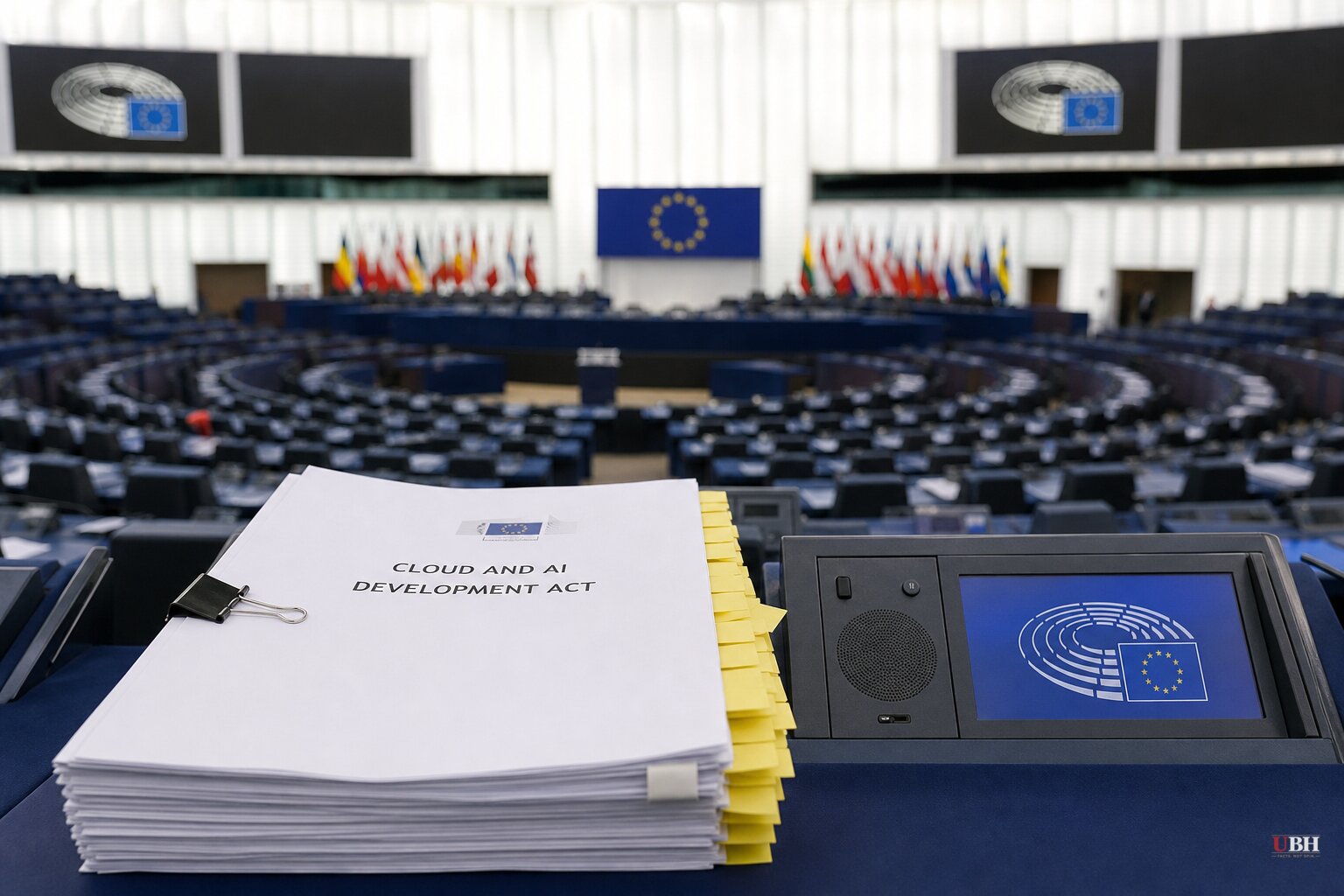
The European Commission wants to rewrite who controls the cloud infrastructure running Europe's hospitals, power grids, and government AI systems. The person with the most concentrated early drafting power over that rewrite is a 46-year-old IT professional from Valencia who was elected to the European Parliament just 15 months before getting the job.
Diego Solier is the lead rapporteur for the Cloud and AI Development Act, known as CADA. His appointment was reported by the Spanish outlet eldiario.es on September 4, 2026, and has drawn scrutiny over how Parliament hands out drafting authority on major tech legislation.
What CADA Actually Does
The Commission proposed CADA on June 3, 2026, as the centerpiece of its European Technological Sovereignty Package. The problem it's aimed at is real and measurable: EU-based firms now hold roughly 15 percent of Europe's cloud market, down from about 29 percent in 2017, according to figures cited by Tech Times and Europe Says. Amazon Web Services, Microsoft Azure, and Google Cloud together control around 70 percent of that market, per AI Weekly.
The Commission estimates Europe needs about €120 billion ($139 billion) in combined public and private investment by 2035 to close the gap. That's the stated case for the bill: dependence on a handful of non-European providers for the digital backbone of 450 million people's governments is a vulnerability, not just an inconvenience.
The draft law's audit framework, detailed by ComplexDiscovery, sorts public-sector cloud contracts into four assurance tiers. The baseline tier requires the provider be established in the EU, its infrastructure and assets be located there, and customer data, including metadata and telemetry, stay in the bloc, with exceptions if the public body requests otherwise. At assurance level 2 and above, auditors are told to go further: collect the full cap table, identify shareholders up to the ultimate owners, map who holds 5 percent or more of capital or votes, and trace commercial or financial links that could carry outside influence. ComplexDiscovery notes European Central Bank research shows a roughly €930 billion venture fund pool in the U.S. versus about €150 billion in the EU, though it's explicit that no official document connects that ECB data to CADA's drafting. The bill is still a proposal. The Commission set no adoption date, and Parliament's own file shows committees still awaiting referral decisions.
How Solier Got the Pen
Parliament allocates rapporteurships through a points-based auction: political groups get points based on seat count and bid on legislative files, with the biggest groups usually landing the biggest dossiers. Who within a group actually gets named, though, is an internal matter. Academic research described by Europe Says calls it bottom-up self-selection by group members based on their own policy interests, with group coordinators acting as final arbiter. Nothing about that process is unique to Solier or to CADA. It's the standard mechanism.
What's unusual is the résumé attached to it. Solier had never held elected office before joining Parliament, submitted his candidacy to someone he'd never met, and is best known in Brussels for a harassment complaint he filed against the populist social media figure who originally recruited him into politics, according to reporting from Tech Times and Europe Says. No rules appear to have been broken in his selection. But a 46-year-old with 15 months of parliamentary tenure now holds the pen on legislation the Commission says will determine which companies can bid for a chunk of a €120 billion market, with essentially no public input into how he got the assignment.
Defense Officials Say Brussels Picked the Wrong Fight
The Financial Times reports that defense officials and executives across the EU are pushing back on CADA, warning a rapid break from American cloud giants could leave militaries with weaker systems, more cyber exposure, and harder coordination with NATO. Only about 1 percent of Europe's public services would land in CADA's strictest tier, which requires purely domestic technology, per figures cited by AI Weekly. Defense officials say that thin slice is exactly where their most sensitive operations live. The recurring example, per the FT, is the F-35 fighter jet, whose digital infrastructure runs on American cloud services baked into the aircraft rather than bought as a swappable subscription. Opposition is strongest in eastern and Nordic countries, where interoperability with U.S. forces is treated as non-negotiable.
European Business Magazine, cited by AI Weekly, argues European cloud alternatives "remain some distance behind the capabilities offered by American hyperscalers" and calls the Commission's approach "a sovereignty policy that is theoretically attractive but operationally disruptive." The Commission's underlying argument, that a shrinking EU cloud market share and heavy reliance on foreign hyperscalers is a genuine strategic risk, isn't invented. The dispute is over timing and whether Europe's own industry can fill the gap fast enough. AWS is backing a €7.8 billion investment in Germany through 2040. Microsoft and Google both market European-located variants that keep data and staff in-region while keeping core orchestration proprietary, a hedge that satisfies neither full sovereignty advocates nor defense officials who need seamless NATO integration.
CADA remains in Parliament's preparatory phase with no committee referral yet finalized and no adoption date set. The next concrete step is that referral decision, which will determine which committees get a formal say before Solier's draft becomes Parliament's negotiating position against member states and the Council.
Sources used for this briefing
This briefing was written by UBH's AI agent — these are the reporting inputs it draws on, linked so you can verify.


