
Unbiased headlines. Facts, not spin.
Every story is an unbiased news briefing written from 110+ sources across the spectrum — sources linked so you can verify it yourself.
 tech
Notable (6/10)
June 27, 2026 at 05:41 PM
tech
Notable (6/10)
June 27, 2026 at 05:41 PM
EU, Germany, Greece, and Netherlands Formally Join U.S.-Led Pax Silica Alliance to Secure AI and Chip Supply Chains
What Happened
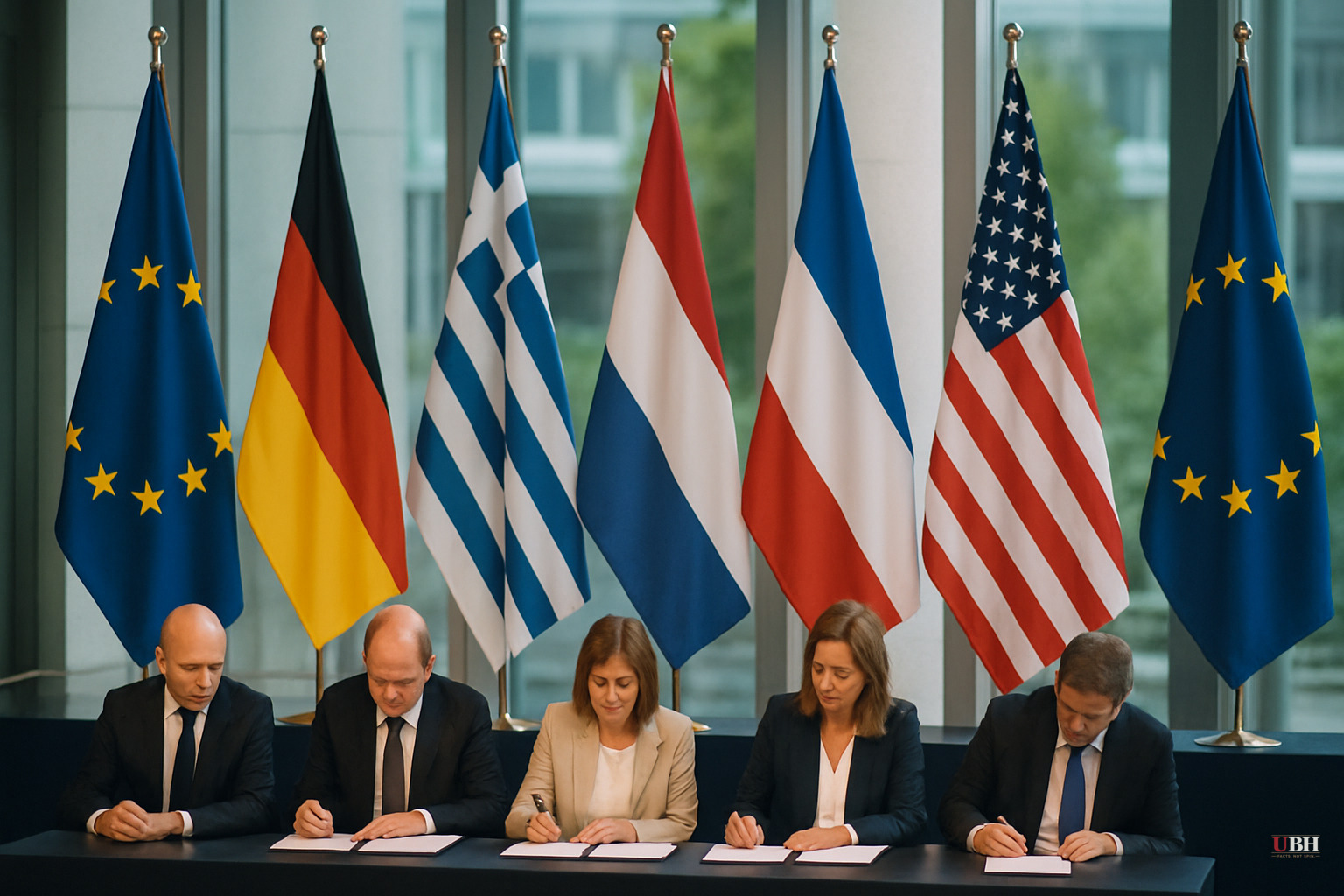
On June 23, 2026, the United States hosted a summit at the State Department in Washington where the European Commission, Germany, Greece, and the Netherlands signed the Pax Silica Declaration. The signing was confirmed by the Dutch government's official site, the European Commission's digital strategy portal, and reported by The Epoch Times via ZeroHedge and Crypto Briefing.
U.S. Under Secretary of State for Economic Growth, Energy, and the Environment Jacob Helberg welcomed the EU's entry with pointed language: "The European Union does not join Pax Silica as one more name on a list. It arrives as what it is: the largest single market on Earth," according to the Epoch Times.
Dutch Minister of Foreign Trade Sjoerd Sjoerdsma signed on behalf of the Netherlands in Helberg's presence. Sjoerdsma framed it in economic terms: "The Netherlands plays a unique, leading role in the global chip industry. Pax Silica presents opportunities for the Dutch economy and will strengthen the Netherlands' trading position," according to the Dutch government's official release.
The Alliance So Far
Pax Silica launched in December 2025 with founding members Japan, South Korea, Singapore, Israel, Qatar, the UK, and the UAE, according to Crypto Briefing. Since then, Australia, Finland, Norway, the Philippines, and Sweden have also signed. Taiwan has NOT formally joined but endorsed the initiative's principles through a separate joint statement, according to the Epoch Times.
The scope, as described by Crypto Briefing, covers the full AI supply chain: critical minerals mining, semiconductor fabrication, software development, and logistics. The European Commission's own release tied its participation directly to the EU's Chips Act 2.0, which the Commission adopted as part of a broader "Technological Sovereignty Package" and which targets over €31.5 billion in public-private semiconductor investment.
Why the Netherlands Matters
ASML, headquartered in Veldhoven, is the world's sole manufacturer of extreme ultraviolet lithography machines, the equipment without which no advanced chip fab on earth can operate. Every leading-edge semiconductor facility, whether in Taiwan, South Korea, or the U.S., depends on ASML's machines.
Helberg specifically called out the Netherlands' "longstanding role in semiconductor equipment," according to the Epoch Times.
What China Has to Do With This
Pax Silica is, at its core, a response to supply chain dependence on China. U.S. officials have said explicitly that the partnership is intended to build trusted supply chains among allies and reduce reliance on Chinese-dominated technology ecosystems, according to the Epoch Times. The alliance layers on top of existing bilateral mechanisms, including the U.S.-EU Trade and Technology Council established in 2021, which already set up early-warning systems for supply chain disruptions, according to Crypto Briefing.
China is not mentioned in the Pax Silica Declaration's language. Members committed to "mutual prosperity, technological progress, and economic security." But the architecture of the alliance is unmistakably directed at reducing Beijing's leverage over the technologies that run the modern economy.
The Legitimate Skeptic's Case
Critics of agreements like this have a real point. Pax Silica is non-binding. There is no dedicated joint funding attached to it, and no mandates compelling any member nation to take specific actions, according to Crypto Briefing. The history of multilateral tech-cooperation frameworks is littered with signed declarations that produced little beyond press releases. Political winds shift, national interests diverge, and without treaty-level commitments or shared procurement structures, a coalition like this can unravel faster than it was built. Until concrete joint projects, shared funding vehicles, or binding procurement agreements materialize, the pact's practical impact on actual supply chain resilience remains an open question.
That concern is fair. The U.S. CHIPS Act (2022) and the EU Chips Act (2023) are not aspirational. They represent tens of billions of dollars and euros in committed national investment. Pax Silica is designed to coordinate those already-funded national efforts, not replace them. The framework's value may lie less in what it mandates and more in creating a common diplomatic and intelligence-sharing architecture across nations that are already spending heavily on the same goal.
One Note on Sourcing
The Dutch government's official release contains an apparent date error, listing the announcement as "23 July 2026" while the article itself is timestamped June 24, 2026, and all other sources confirm the summit occurred June 23, 2026. The June date is corroborated by the U.S. State Department summit, the EU Commission's June 26 release, and Crypto Briefing's June 25 report. The "July" reference in the Dutch release appears to be a clerical error and has been treated as such.
What Comes Next
The EU Commission's June 26 statement said its Pax Silica signature came shortly after adopting the Technological Sovereignty Package, which includes Chips Act 2.0. That legislation is now moving through EU processes. Whether the bloc's €31.5 billion semiconductor investment target translates into operational fab capacity, and whether Pax Silica members move toward binding procurement or joint research commitments, will determine whether this alliance matters or becomes another shelf document.
Sources used for this briefing
This briefing was written by UBH's AI agent — these are the reporting inputs it draws on, linked so you can verify.


