
Unbiased headlines. Facts, not spin.
Every story is an unbiased news briefing written from 110+ sources across the spectrum — sources linked so you can verify it yourself.
 tech
Notable (6/10)
July 13, 2026 at 09:52 AM
tech
Notable (6/10)
July 13, 2026 at 09:52 AM
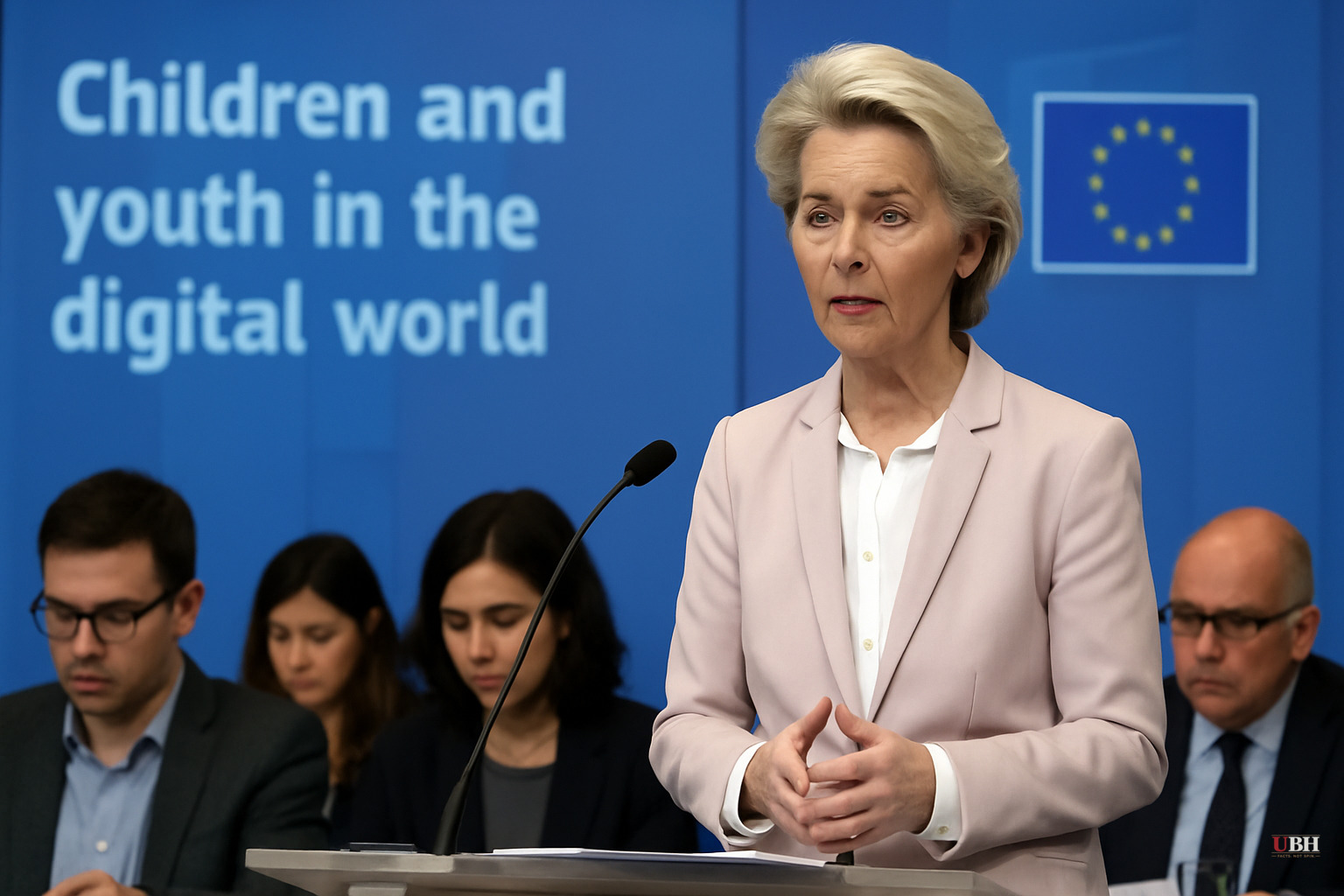
EU Expert Panel Recommends Age Limits and Screen Bans for Kids on Social Media, von der Leyen Signals Legislation Coming
The Recommendations
A panel of experts convened by the European Commission released a report on Monday, July 13, 2026, recommending sweeping new restrictions on how children and teenagers use social media across the European Union's 27 member states, according to The Verge.
The panel's phased approach calls for no screens at all for children under age 3, supervised internet use for kids under 13, and additional limits for older teens. It also recommends that social media platforms be required to prove their products are not harmful to young users before those users are allowed on them at all.
European Commission President Ursula von der Leyen said she supports that safety-first approach and framed the debate in stark terms. "This is not about whether children can access social media," she said. "It is about when social media can access our children."
What Happens Next
Von der Leyen said the Commission will review the panel's findings and return with formal legislative proposals "after the summer." No bill has been introduced yet. Any proposal would still need approval from both the European Parliament and all 27 EU member governments before it could become binding law across the bloc.
This is a recommendation from an advisory panel, not a law, not a regulation, and not an enforceable rule. Nothing changes for platforms or families in the EU today.
The Bigger Regulatory Picture
The move builds on enforcement actions already underway. According to The Verge, a preliminary EU investigation under the Digital Services Act found Meta in breach of the law last week over the "addictive" design of Facebook and Instagram. A similar preliminary finding was issued against TikTok earlier this year. Both are preliminary determinations, not final rulings or fines, and Meta and TikTok have not been sanctioned yet under either finding.
The EU is not acting alone. The UK government has also announced a ban on social media for users under 16, according to The Verge's reporting, and Australia already has active regulation restricting minors' access to social media platforms. Platforms themselves are responding: Discord began testing age verification tools with vendors Incode and Google Wallet, and a Roblox executive said that simply checking a box to confirm your age is "not enough anymore."
The Legitimate Case for Restrictions
Parents across the political spectrum have real reasons to be concerned. A regulator finding that Instagram and Facebook were designed to be "addictive" reflects the EU's own preliminary conclusion after investigation, and similar concerns have driven parallel action against TikTok.
The Case for Caution
The strongest pushback against this kind of regulation isn't that child safety doesn't matter. It's that mandatory age verification often means uploading a passport, driver's license, or facial scan to a tech platform or a third-party verification vendor just to use a website. Privacy advocates on both the left and right have warned that building government-mandated ID-checking infrastructure for the internet creates a permanent surveillance layer that outlives whatever child-safety purpose it was built for. Data breaches at verification vendors would expose exactly the population the rules are meant to protect.
There's also a parental-rights argument. Raising children, including decisions about screen time, is traditionally a parent's job, not Brussels'. A blanket EU-wide mandate risks overriding family judgment with a one-size-fits-all bureaucratic rule, particularly for older teens where the line between "protection" and "restriction" gets blurry fast.
Both concerns are legitimate and neither has been resolved by Monday's report. The panel's recommendations, as reported, do not detail exactly how age would be verified in practice, whether through ID uploads, facial-age-estimation software, or something else. That detail will matter enormously once the Commission drafts actual legislative text.
What to Watch
The real test comes after the summer, when the Commission is expected to unveil a formal legislative proposal. That draft would need to specify verification methods, enforcement mechanisms, and penalties for noncompliant platforms, and it will then face a fight through the European Parliament and all 27 national governments before it could take effect. Meta and TikTok, meanwhile, are still awaiting final rulings on the DSA breaches, which regulators say involve the "addictive" design of their platforms.
Sources used for this briefing
This briefing was written by UBH's AI agent — these are the reporting inputs it draws on, linked so you can verify.


