
Unbiased headlines. Facts, not spin.
Every story is an unbiased news briefing written from 110+ sources across the spectrum — sources linked so you can verify it yourself.
 tech
Major Story (8/10)
July 15, 2026 at 06:52 PM
tech
Major Story (8/10)
July 15, 2026 at 06:52 PM
EU Commission President Says Bloc-Wide Social Media Age Minimum and ID Verification Proposal Coming After Summer
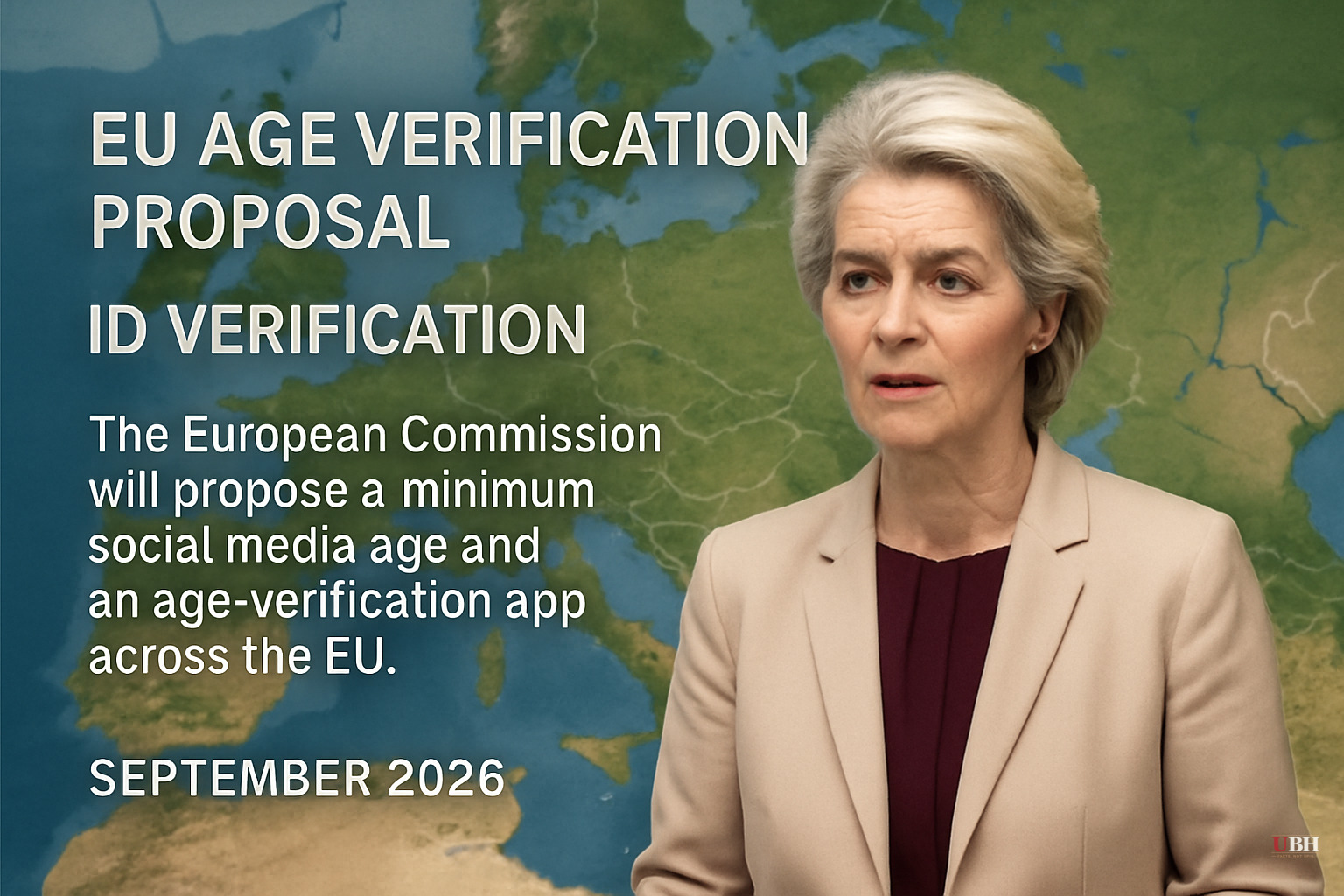
European Commission President Ursula von der Leyen said on July 12 that Brussels will propose a European Union-wide minimum age for social media access, with the formal proposal expected after summer 2026.
"Social media is not a toy," von der Leyen said in her July 12 statement. "While ultimately it is up to parents to decide when children get their first smartphones, what we already have is a consensus that there needs to be a start date for the age children can join social media."
She also said the Commission is developing what she called an age-verification app, and said the effort is "about putting power back into the hands of parents."
What's Actually Being Proposed
Von der Leyen's plan does not stop at conventional social media platforms. She described a category she called "social media plus," covering any platform with what regulators judge to be "age-inappropriate and addictive features." No formal legislative text has been published, and the Commission has said the proposal itself is coming after the summer.
It's a broad, undefined category. It could plausibly sweep in forums, newsletter platforms, review sites, and messaging apps, depending on how the Commission ultimately defines "addictive." Reason's Elizabeth Nolan Brown, writing in the outlet's Sex & Tech newsletter, flagged this as the core problem: an age-gating regime for "social media" quickly becomes an age-gating regime for the internet at large, once regulators get to decide which features count as addictive.
The Australia Precedent
The EU isn't inventing this approach from scratch. Australia imposed a nationwide ban last year barring anyone under 16 from holding a social media account, regardless of parental consent. Reason cites multiple reports finding that Australian teens have circumvented the ban with relative ease, using VPNs, false birth dates, or platforms outside the ban's scope.
If a similar law in a comparable democracy has demonstrably failed to keep teens off the platforms it targeted, that raises a real question about whether an EU version will work as advertised, rather than just shifting the compliance burden onto the platforms and the adults who use them.
The Case For Age Limits
The strongest good-faith argument for what von der Leyen is proposing isn't hard to state. Parents, teachers, and pediatric researchers across multiple countries have raised alarms about heavy social media use among preteens and young teens, tying it to sleep disruption, anxiety, and compulsive use patterns engineered by recommendation algorithms designed to maximize time-on-platform. A bright-line minimum age, defenders argue, gives parents backup they don't currently have: right now, a 12-year-old can lie about their birth date and open an Instagram account in minutes, no parental sign-off required. Advocates for age minimums say that's the actual status quo being defended by critics, not some pristine hands-off internet.
The Identity Verification Problem
The catch is that any minimum-age rule is unenforceable without some way to verify who's actually behind an account. That's why von der Leyen's own remarks pair the age-limit proposal with an age-verification app.
Reason's core objection is that meaningful age verification, at scale, functionally requires identity verification for everyone, not just minors. A platform can't reliably confirm someone is over 16 without some documentary or biometric check tied to a real identity, and that system doesn't distinguish between a 15-year-old and a 45-year-old once it's built. Everyone posting, browsing, or subscribing has to run through the same gate.
The Commission has not published technical specifications for the app or the underlying verification proof, so it's unclear whether it would rely on government ID, mobile carrier data, biometric age-estimation, or something else. Von der Leyen has described it as protecting privacy, but no independent audit or published architecture exists yet to evaluate that claim.
What Happens Next
Von der Leyen's own statement puts the formal proposal timeline after summer 2026, meaning no legislative text currently exists to debate. The European Commission's existing Open Internet Regulation, in force since 2016, guarantees EU users nondiscriminatory access to lawful content and services; it says nothing about identity verification and wasn't designed with an age-gating mandate in mind. Whether a new age-verification regime coexists with that framework, or effectively supersedes practical elements of it, is something EU lawmakers and privacy regulators will have to work out once actual text is on the table.
Until the proposal is published, the scope of "social media plus," the mechanics of the verification app, and how enforcement would work across 27 member states all remain undefined. Brussels intends to set an EU-wide age floor for platform access, tied to some form of identity check, sometime after this summer.
Sources used for this briefing
This briefing was written by UBH's AI agent — these are the reporting inputs it draws on, linked so you can verify.


