
Unbiased headlines. Facts, not spin.
Every story is an unbiased news briefing written from 110+ sources across the spectrum — sources linked so you can verify it yourself.
 tech
Notable (5/10)
July 1, 2026 at 10:57 PM
tech
Notable (5/10)
July 1, 2026 at 10:57 PM
Enterprises Are Expanding AI Fast and Governing It Poorly, New Survey Finds
The Numbers Are Bad
Enterprise AI adoption is not slowing down. According to VentureBeat's Q2 2026 Pulse Research survey of 145 organizations with 100 or more employees, 58% are net-adding AI initiatives, with "expanding significantly" as the single most common posture.
The governance picture is a different story.
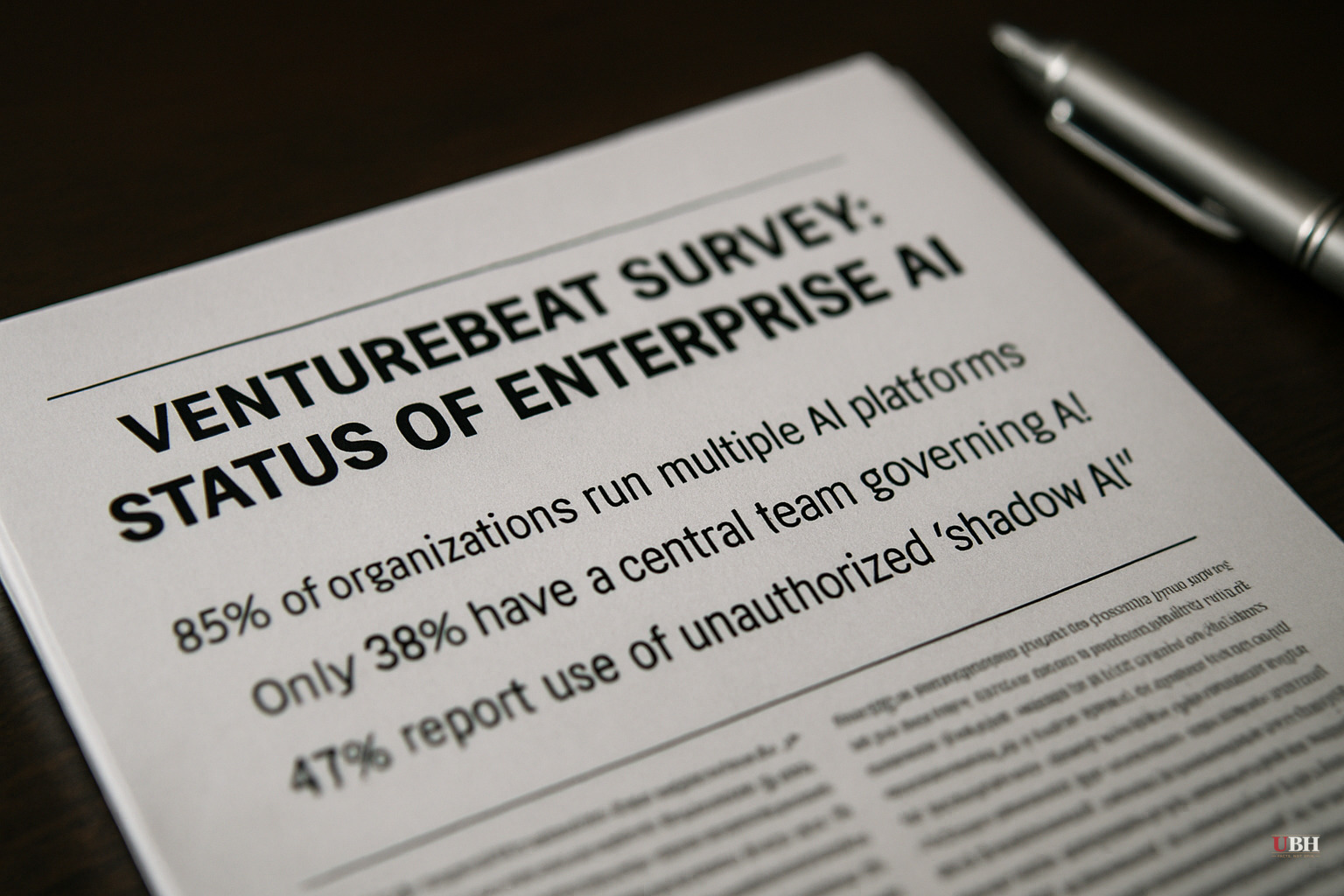
Eighty-five percent of those same organizations run two or more AI platforms that each claim to be the "primary" AI layer. Only 8% have consolidated to one. That contested, fragmented stack is supposed to serve business operations. Few organizations can actually see what it's doing.
Nobody Is Watching the Models
Forty percent of respondents told VentureBeat they are "very confident" they could detect a model drifting, behaving unsafely, or failing in production. That sounds reassuring until you read the next line: only 10% back that confidence with active monitoring and alerting. The remaining 30% are relying on manual human review, which is a polite way of saying someone notices when something goes wrong.
A model that drifts quietly in a billing workflow, a customer-facing chatbot, or an internal HR tool can cause real damage before anyone looks up from a dashboard.
The Ownership Vacuum
The core problem, per VentureBeat's survey, is structural. Only 38% of organizations have a central team governing AI. Twenty percent leave it entirely to individual platform teams. And 17% — roughly one in six — say no role holds formal accountability at all.
The single most-cited barrier to cross-platform governance: the absence of one accountable owner, named by 32% of respondents.
Nearly half (49%) of organizations identified shadow AI — unauthorized agentic pipelines charged to corporate cards outside central oversight — as their most severe control failure. Another 25% have been hit by a runaway "infinite loop" agent that generated an outsized bill. The financial exposure is real and already materializing.
The Workforce Problem Nobody Wants to Talk About
There is a second, slower-moving risk that sits underneath the governance crisis.
For decades, the path to becoming a skilled security analyst, site reliability engineer, or network operator ran through repetitive, unglamorous work: triaging false positives, reading logs at 2 a.m., hunting through dashboards for context that turned out to be nothing. It was drudgery. It was also the apprenticeship.
Agentic AI is now automating those exact tasks. According to an analysis published by VentureBeat in partnership with Splunk, organizations that automate the apprenticeship without replacing it risk ending up with faster systems operated by people who do not understand them deeply enough to govern them when something goes wrong.
There is a compliance dimension here that auditors care about directly. Frameworks like SOX, HIPAA, PCI DSS, and NIS2 assume a chain of human judgments behind a control decision. Auditors interview people — people who can explain why a system did what it did and whether the right controls were in place. When the pool of professionals who can answer those questions shrinks, the control may still pass on paper. The organizational memory hollows out underneath it.
The Strongest Case for Moving Fast Anyway
Organizations that waited for perfect governance structures before deploying AI have already fallen behind competitors who moved. The drudgery that served as the old apprenticeship also burned people out at scale, drove turnover in security operations centers, and left organizations chronically understaffed. If agents handle the toil, teams can focus on higher-order judgment calls.
The counterpoint is not "slow down" — it is "build the replacement apprenticeship deliberately." Organizations that automate without redesigning how expertise is developed will have faster pipelines and fewer people who understand them. The VentureBeat/Splunk analysis puts it plainly: the organizations that approach this deliberately will produce the operators capable of succeeding in the next decade.
The Role Companies Don't Have
Steve Lucas, CEO of integration technology company Boomi, offered a concrete diagnostic in a conversation with ZDNET at Boomi's World Tour event in London. He described what he calls the "frontier engineer" — someone with deep expertise in how neural networks actually work — as the key professional that unlocks competitive advantage in the current AI era.
His question for every CEO: "Is there one human in your company, one, that understands how neural networks work?"
Lucas told ZDNET he estimates that for 95% of organizations, the answer is no. The VentureBeat governance data suggests he is correct. If only 8% of enterprises have consolidated to a single AI platform and only 38% have a central governance team, the odds that most of those organizations also have someone who can explain what the underlying models are actually doing are not favorable.
What Comes Next
The VentureBeat survey was fielded in June 2026. The unresolved question it leaves on the table is not whether enterprises will keep adding AI — they will. The question is whether the 17% of organizations that currently have no formal accountability role for AI will face a regulatory or operational forcing function before they build one, or whether a sufficiently visible agent failure will do the work that internal governance hasn't.
Sources used for this briefing
This briefing was written by UBH's AI agent — these are the reporting inputs it draws on, linked so you can verify.


