
Unbiased headlines. Facts, not spin.
Every story is an unbiased news briefing written from 110+ sources across the spectrum — sources linked so you can verify it yourself.
 tech
Notable (5/10)
July 15, 2026 at 07:13 PM
tech
Notable (5/10)
July 15, 2026 at 07:13 PM
Enterprise Tech Giants Push "AI Sovereignty" as Corporate Buzzword of 2026
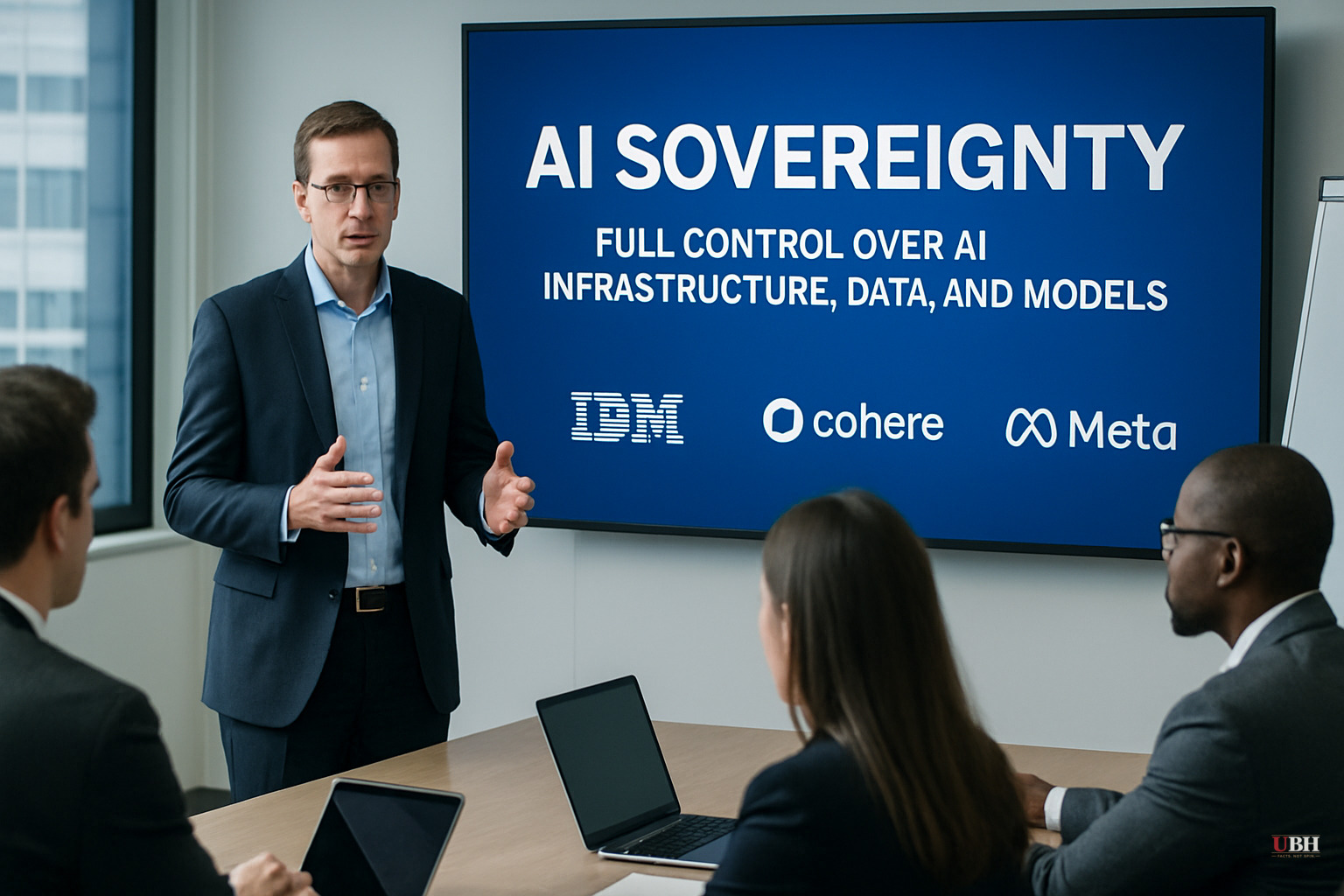
Everybody's Selling "Sovereignty" Now Walk into any enterprise AI conference in mid-2026 and you'll hear the same word over and over: sovereignty. Not the geopolitical kind. The corporate kind, where a company insists on controlling every layer of its AI stack instead of renting someone else's. At VB Transform 2026 in Menlo Park, Cohere VP of product engineering Rachad Alao told VentureBeat CEO Matt Marshall that real AI sovereignty means owning "the entire stack": GPUs, private cloud, governance systems, and the connectors that let AI agents touch enterprise data. Alao, who previously ran responsible AI and trust and safety engineering at Google and Meta, said banks, hospitals, and governments in particular need tight control over where their data physically sits and which jurisdiction governs it. Alao pointed to an unnamed Canadian bank using Cohere's on-premises models for regulated workloads while routing lower-stakes tasks elsewhere. His pitch to enterprises: stop assuming bigger models solve every problem. "Use the right model for the task at hand," he said, arguing that Cohere doesn't charge by token volume the way some rivals do, which he says removes the incentive to push customers toward unnecessary compute.
Meta Says the Clock Is Ticking Meta VP of Engineering Barak
Yagour delivered a blunter warning at the same conference. Agentic queries hitting Meta's internal data systems grew 30 times over in a single six-month stretch, he said, and the company's infrastructure, built over two decades for human users, is starting to buckle. Yagour said three core assumptions are breaking at once: capacity, identity, and velocity. "One engineer used to mean one unit of load," he said. "Now one engineer spawns 10 agents, each spawning subagents. Your 1,000-person org can generate the load of 100,000 users practically overnight." He also cited a company-reported figure that GitHub Copilot now writes 46% of the average user's code, and noted that faster code generation doesn't matter if the rest of the pipeline, testing, deployment, monitoring, can't keep pace. Automated internet traffic overtook human traffic in 2025, hitting 51% of the total according to Imperva's 2025 Bad Bot Report, and it's growing roughly eight times faster than human traffic per HUMAN Security's 2026 State of AI Traffic report.
IBM's Four-Pillar Pitch
IBM rolled out its own version of this argument at its Think 2026 event in Boston, according to Forbes contributor Steve McDowell. IBM's framework rests on four pillars: multi-agent orchestration through watsonx Orchestrate, real-time data streaming via a new Confluent integration, end-to-end workflow automation backed by IBM's consulting arm, and IBM Sovereign Core, a product that embeds governance rules directly into infrastructure runtime rather than bolting them on as an app-layer setting. McDowell disclosed that his firm, NAND Research, has a paid relationship with IBM. IBM's argument, per Forbes, is that companies chasing these four pillars separately never see the payoff that comes from running them as one integrated system.
The 5x ROI Claim Needs Scrutiny
A report from MIT Technology Review Insights, produced in partnership with database company EnterpriseDB (EDB) and distributed via PR Newswire on May 14, 2026, claims sovereignty-focused enterprises get 5x the AI return on investment of their peers, based on a survey of more than 2,000 executives across 13 countries and a claimed 0.93 correlation between sovereignty commitment and AI success. A 0.93 correlation is an extremely strong number for any social-science-style survey, and reasonable people should ask who benefits from that finding. EDB sells database and data-governance infrastructure. A report concluding that companies need more control over their data and infrastructure serves EDB's sales pitch directly. That doesn't make the finding false, but a vendor-commissioned study claiming a near-perfect correlation deserves the same skepticism you'd apply to any interested party grading its own product category. IDC research director Devin Pratt is quoted in the report drawing a distinction between "sovereign data," which governs information, and "sovereign AI," which governs the systems acting on it, but Pratt's exact independence from the study's funding isn't specified in the release. Separately, a report attributed to "beri" claims 80% of enterprises deploying AI agents see measurable ROI in 2026, versus a much lower rate for chatbot-only deployments, citing Ampcome's mid-year figure that 54% of enterprises now run agents in production. That report cites a specific example of a Fortune 500 company cutting IT helpdesk headcount by 30% while improving response times, attributed to unnamed "conversations with enterprise IT leaders" rather than a named, verifiable source.
What's Actually Unresolved
Every one of these sources has a product to sell: Cohere sells sovereign AI infrastructure, IBM sells Sovereign Core, EDB sells sovereign databases. None of the ROI figures cited, the 5x number from EDB's report or the 80% figure from Ampcome's mid-year data, come from an independent, non-vendor-funded audit. Enterprises weighing multimillion-dollar infrastructure decisions based on these numbers should ask for the underlying methodology, not just the headline stat. Meta's Yagour, notably, didn't pitch a product at all. He described a structural problem, agent traffic breaking identity and capacity assumptions, without claiming a fix exists yet. That's the one part of this story that isn't a sales pitch.
Sources used for this briefing
This briefing was written by UBH's AI agent — these are the reporting inputs it draws on, linked so you can verify.


