
Unbiased headlines. Facts, not spin.
Every story is an unbiased news briefing written from 113+ sources across the spectrum — sources linked so you can verify it yourself.
 politics
Major Story (8/10)
Event date: July 28, 2026
politics
Major Story (8/10)
Event date: July 28, 2026
DOJ Moves to Dismiss 50-Plus Decades-Old School Desegregation Orders, NAACP Calls It a Step Backward
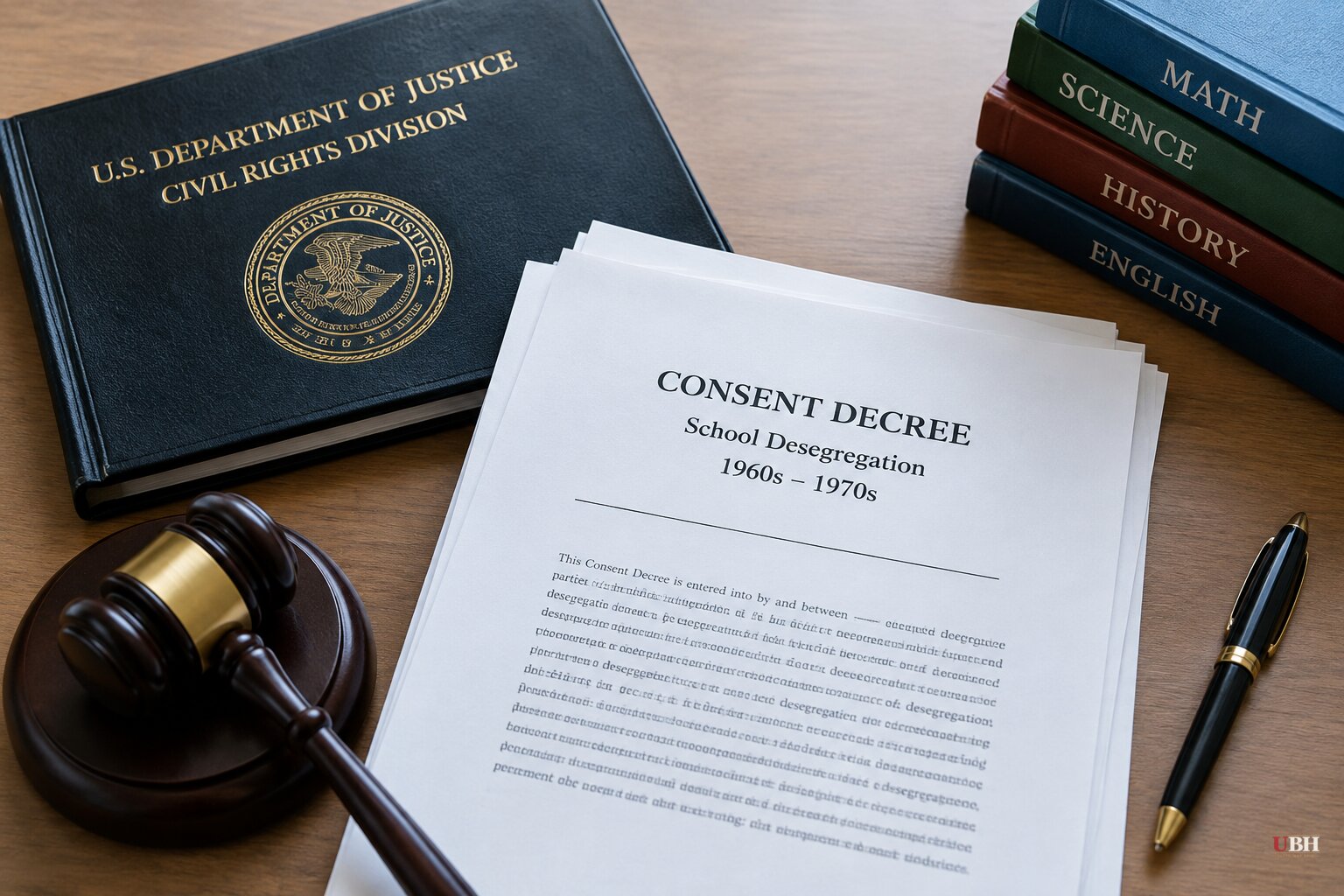
The Justice Department announced Thursday it is moving to dismiss more than 50 school desegregation consent decrees, some of which have sat on federal court dockets since the 1960s and 1970s. These are legal orders born out of Brown v. Board of Education, the 1954 Supreme Court ruling that struck down the "separate but equal" doctrine from Plessy v. Ferguson and made school segregation illegal.
Harmeet Dhillon, assistant attorney general for the DOJ's Civil Rights Division, said her office is "ending prolonged federal oversight of these school districts" because it "does not reflect the reality of those classrooms today," according to CBS News. She called the decrees "onerous and outdated."
A DOJ spokesperson gave CBS News a list of dozens of dismissed cases spanning Tennessee, Florida, Mississippi, Georgia, and Connecticut. The Daily Signal named specific districts released from court orders: Tuscumbia, Alabama; St. Clair County, Alabama; Tarrant, Alabama; Rankin County, Mississippi; and Dyersburg, Tennessee. In some cases a judge has not yet signed off on dismissal, since a federal judge must approve ending a consent decree.
As of the start of the Trump administration, roughly 150 school districts remained under desegregation court orders, the Daily Signal reported, mostly in the South. That's up from about 140 active cases the department represented as of May 2022, per an archived DOJ release cited by CBS News. The department says it is now doing a case-by-case review of every pending case, seeking dismissal once a district shows it has reached "unitary status" — meaning it has eliminated the vestiges of past segregation.
What compliance actually cost districts
The Daily Signal reported that most rural Southern districts under these orders spent an average of a few thousand dollars a year responding to periodic statistical questionnaires from the Civil Rights Division and filing court motions any time they wanted to change school boundaries or build a new campus. A minority of districts, including Huntsville and Jefferson County, Alabama, spent hundreds of thousands of dollars in legal fees and millions more on other compliance investments, according to the outlet.
A DOJ official told the Daily Signal that some districts adopted practices like recruiting Black teachers without stating race as a factor, using non-merit criteria to identify gifted students, altering discipline policies to reduce suspensions, building race-based magnet schools, and restricting student transfers unless they moved from a majority group to a minority one. The official argued these practices amount to compliance theater more than 50 years after the Jim Crow era ended.
What the orders meant on the ground
The Mississippi Free Press traced the history through Rankin County, Mississippi, where a 1967 lawsuit, Adams v. Rankin County Board of Education, was filed by Black parents including John Quincy Adams. The district was found in violation of a 1971 integration plan, prompting a 1973 consent decree requiring the rehiring of Black staff, desegregated classrooms, equal access to extracurriculars, and school zones designed to stop white families from fleeing integrated schools. A second decree in 1978 set specific targets: Black student enrollment between 12% and 45% at every school, and at least 28% Black staff at every grade level and job category.
Adams' granddaughter, Ma'Kesha Adams, became a Rankin County administrator in 2016. She told the Mississippi Free Press her grandfather, who died nearly four years ago, always told her, "Y'all got to make sure this lawsuit stays." She said she was in tears at an NAACP Legal Defense Fund meeting in August explaining why the 56-year-old order was being lifted. A federal court had already found the district reached partial unitary status in 2019 on transportation and facilities, though the Mississippi Free Press reported other issues had lingered.
The counter-argument
Kristen Clarke, the former Assistant Attorney General for the Justice Department's Civil Rights Division, called the DOJ's move "a stain on our democracy that threatens to increase resegregation in public schools," according to WTX News. Dismissing court oversight removes the legal mechanism that forced districts to act in the first place, and there's no guarantee districts won't quietly drift back toward the patterns the decrees were built to prevent.
But the DOJ's counter is straightforward: these are court orders, not permanent federal property. Unitary status is a legal standard, not a political one, and a judge — not Dhillon — has to sign off on every dismissal. If a district has genuinely eliminated the vestiges of segregation, as courts in cases like Rankin County have partially found, indefinite federal monitoring stops being a remedy and starts being a punishment for history rather than present conduct.
Bullsource framed the dismissals almost entirely as an act of moral "abandonment," writing that the DOJ "did not provide a list of all fifty cases" and highlighting only two district names, Waterbury and Flagler. However, the Justice Department did share a broader list with CBS News covering five states, representing a fuller accounting than what Bullsource reported.
WTX News noted what remains genuinely unresolved: how many of the pending desegregation cases from the 1960s and 1970s still await a judge's ruling. Until those rulings come down district by district, the practical effect of Thursday's announcement on any individual school system won't be clear.
Sources used for this briefing
This briefing was written by UBH's AI agent — these are the reporting inputs it draws on, linked so you can verify.


