
Unbiased headlines. Facts, not spin.
Every story is an unbiased news briefing written from 110+ sources across the spectrum — sources linked so you can verify it yourself.
 tech
Notable (6/10)
July 13, 2026 at 05:39 PM
tech
Notable (6/10)
July 13, 2026 at 05:39 PM
DESI's Five-Year Sky Survey Finishes: 47 Million Galaxies Mapped, Dark Energy Findings Raise New Questions
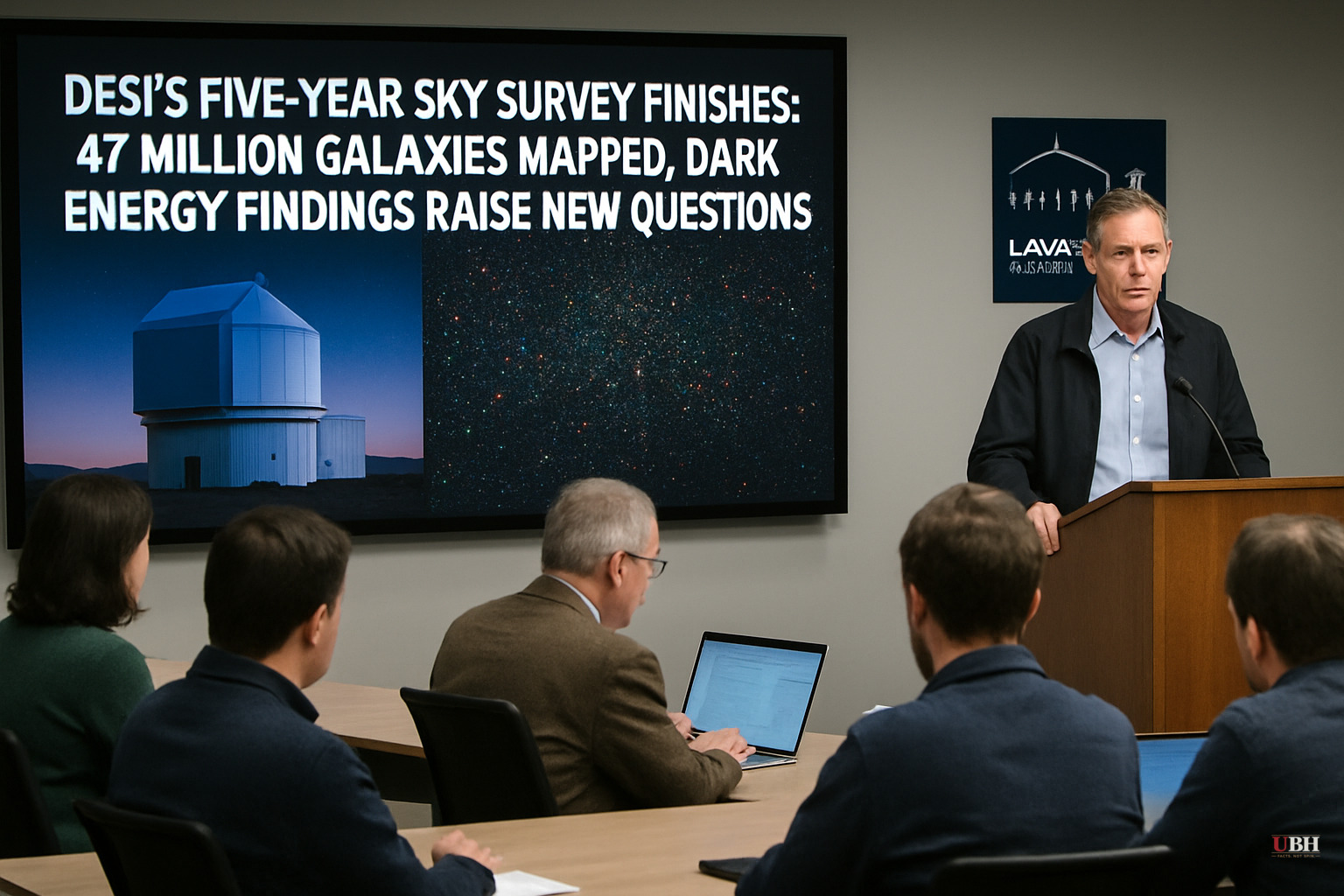
A Five-Year Survey Wraps Up
The Dark Energy Spectroscopic Instrument, known as DESI, finished its primary five-year mission in April, according to Lawrence Berkeley National Laboratory, which operates the telescope-mounted instrument in Arizona. The project produced the largest high-resolution 3D map of the universe ever built, according to the lab.
The numbers are staggering. DESI observed more than 47 million galaxies and quasars and 20 million stars during its run, Lawrence Berkeley National Laboratory reported. Forty-seven million objects, each one logged with precise distance and position data, were stitched into a single map of cosmic structure stretching back billions of years.
This wasn't a small operation. DESI is a collaboration of more than 900 researchers pulled from over 70 institutions worldwide, according to the lab. That's the kind of scale you need to actually chart the universe, not guess at it.
The Dark Energy Question
The whole point of DESI was never just cartography. It exists to study dark energy, the mysterious force that's pushing the universe apart at an accelerating rate, according to Lawrence Berkeley National Laboratory. Scientists have treated dark energy as a constant for decades. DESI's data is starting to complicate that assumption.
BBC's reporting on the project carries the headline "Dark energy: New map of universe suggests it could be changing." If dark energy's strength has actually varied over cosmic history rather than staying fixed, that reopens fundamental questions about how the universe will end and what physical law is actually driving the expansion.
The operative word is "suggests," not "proves." This is a hint in the data, not a settled result. Physicists have been burned before by anomalies that vanished once more data came in. DESI's own scientists have been careful to frame this as a signal worth chasing further, not a discovery to hang a Nobel Prize on yet.
Extraordinary claims about the fundamental structure of physical law require extraordinary evidence, and a single survey's statistical hint, however large the dataset, isn't the same as independent confirmation. Cosmology has a track record of promising signals that faded under more scrutiny. The BICEP2 gravitational wave claim in 2014 is the textbook example. DESI's team continuing to gather data through 2028 is itself an acknowledgment that this needs more scrutiny before anyone rewrites the textbooks.
Money Well Spent
DESI is run out of Lawrence Berkeley National Laboratory, a taxpayer-funded national lab. Big publicly funded science projects get criticized plenty, often for good reason when budgets balloon or results never materialize.
This one produced a tangible product: a map of 47 million cosmic objects that didn't exist before, built by a genuinely international team, delivered on the timeline the lab described. Whatever the final verdict on dark energy turns out to be, the raw data itself is a real deliverable that other scientists worldwide can now use.
What Happens Next
DESI isn't done. The instrument will keep documenting the sky through 2028, according to Lawrence Berkeley National Laboratory, as researchers try to nail down whether the dark energy signal holds up or fades with more observations.
The unresolved question is straightforward: does dark energy actually change strength over billions of years, or is this an artifact of measurement uncertainty in an admittedly enormous but still finite dataset? Nobody currently has a definitive answer. The next three years of DESI observations, plus data from other survey instruments checking the same signal independently, will determine whether this becomes one of the biggest physics stories of the decade or a footnote that got explained away.
Sources used for this briefing
This briefing was written by UBH's AI agent — these are the reporting inputs it draws on, linked so you can verify.


