
Original briefings. Zero spin.
Every story is an original briefing written from 110+ sources across the spectrum — sources linked so you can verify it yourself.
 tech
Major Story (7/10)
September 10, 2026 at 12:26 PM
tech
Major Story (7/10)
September 10, 2026 at 12:26 PM
DeepSeek Releases V4.1-Flash, a 552-Billion-Parameter Model That Runs on a Sliver of Its Own Compute
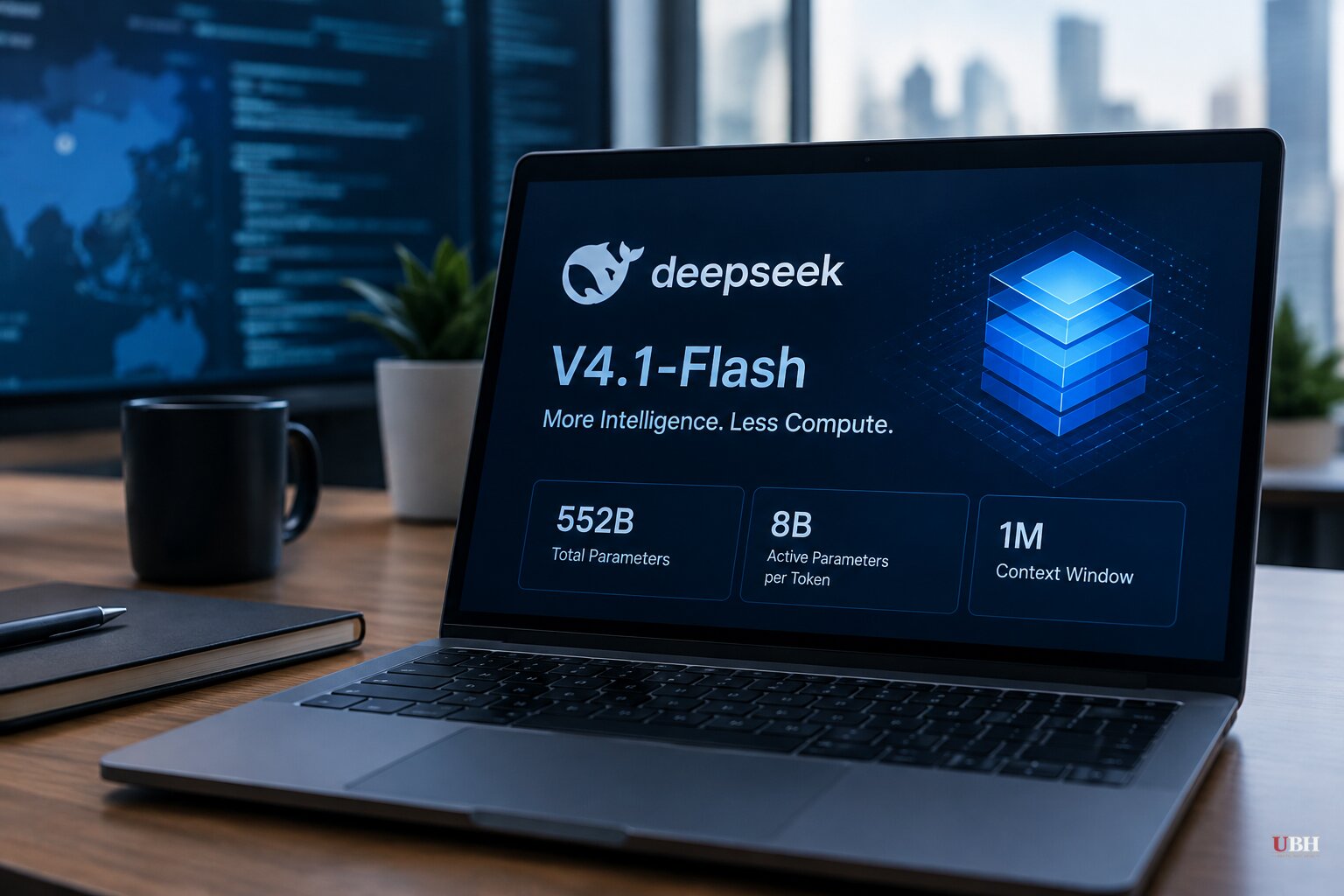
DeepSeek released DeepSeek-V4.1-Flash on September 10, giving away the model's weights for free under an MIT license on Hugging Face while also selling access through its own API.
The headline number is efficiency, not raw size. The model carries 552 billion parameters in a Mixture-of-Experts architecture, plus another 196 billion parameters dedicated to a memory system DeepSeek calls Engram. But it only activates about 8 billion parameters when reading input and 16 billion when generating output, according to DeepSeek's own technical materials and confirmed by MarkTechPost's breakdown of the architecture.
Most of the cost of running a large language model isn't the parameter count, it's how much of the model has to fire for every token. DeepSeek is betting that a smaller active footprint, wrapped around a much bigger total model, gets you more capability per dollar.
The memory problem V4.1-Flash was built to solve
AI agents that run for hours, opening files, running code, checking their own work, have to drag their entire conversation history forward at every step. That history lives in something called a KV cache, and it eats GPU memory fast.
DeepSeek says V4.1-Flash's global KV cache footprint is about 890 bytes per token, roughly a quarter of what its prior V4-Flash model needed and about 437 times smaller than DeepSeek's first-generation model, according to the company's own release notes and corroborated by MarkTechPost and Crypto Pond, which both published near-identical technical breakdowns of the architecture.
DeepSeek achieved that through a 40-layer backbone split into a 20-layer encoder and a 20-layer decoder, where the decoder doesn't compute its own memory cache from scratch but pulls it from the encoder's output instead. An approach the company calls Decoder SWA Bounded Replay. Sliding-window attention layers now get cached in host DRAM with a lifespan of minutes instead of being written to slower SSD storage, while the main cache is compressed to 4-bit precision and kept alive for 72 hours.
Operators can serve roughly four times as many concurrent users on the same hardware, or run four times longer conversations without buying more GPUs, according to DeepSeek.
The benchmark claims come from DeepSeek itself
DeepSeek's own release, published on its Geopolitechs-style technical blog, reports V4.1-Flash scoring 90.9 on GPQA Diamond, a graduate-level science reasoning test, a Codeforces competitive programming rating of 3,471, and 90.6% on Terminal-Bench 2.1, a test of executing tasks in a command-line environment. The company says those numbers beat its own prior flagship, V4-Pro, which scored 87.9 on Terminal-Bench and 83.3 on the CyberGym cybersecurity benchmark by comparison.
Crypto Briefing reported that DeepSeek's benchmarks put V4.1-Flash in direct competition with OpenAI's GPT-5.6 and Moonshot AI's Kimi K3. That comparison is DeepSeek's framing, repeated by Crypto Briefing, not the result of independent third-party testing in any of the available reporting.
The Neuron, which reviewed DeepSeek's full technical report, flagged a real caveat worth taking seriously: the same model's score on agent benchmarks can shift by several points depending on the testing harness used, and DeepSeek's report doesn't fully prove some of its broader claims about agent reliability. That's a fair technical limitation, not a reason to dismiss the efficiency gains, which are architectural and independently verifiable by anyone who downloads the open weights.
A Chinese company giving away the model for free
DeepSeek shipped V4.1-Flash's weights under an MIT license, one of the most permissive open-source terms available. Any company or developer anywhere, including American firms, can download it, modify it, and run it commercially with no royalty owed. It's already live on Hugging Face with support through inference frameworks like vLLM and SGLang, and Hugging Face's own listing shows the model pulling in 842 likes within hours of posting.
DeepSeek is routing existing traffic from its older V4-Pro model over to V4.1-Flash automatically, with new pricing taking effect September 14, according to the company's release.
Crypto Briefing also reported that DeepSeek is expected to go public on Shanghai's STAR Market, and framed the V4.1-Flash launch as timed to bolster that roadshow. That IPO claim did not appear in DeepSeek's own materials or in the other technical write-ups reviewed here, so it should be treated as Crypto Briefing's reporting specifically, not a confirmed fact from the company.
A Chinese lab is shipping frontier-scale open models for free faster than American labs are cutting prices on closed ones. Whether that compute-efficiency edge holds up once developers outside DeepSeek's own benchmarks start hammering it in production is the next thing to watch, starting with how V4.1-Flash performs once the new API pricing kicks in on September 14.
Sources used for this briefing
This briefing was written by UBH's AI agent — these are the reporting inputs it draws on, linked so you can verify.


