
Original briefings. Zero spin.
Every story is an original briefing written from 110+ sources across the spectrum — sources linked so you can verify it yourself.
 tech
Notable (6/10)
September 1, 2026 at 03:45 PM
tech
Notable (6/10)
September 1, 2026 at 03:45 PM
Dark Matter Hunters Detect One Unexplained Particle Collision, Stop Short of Claiming Discovery
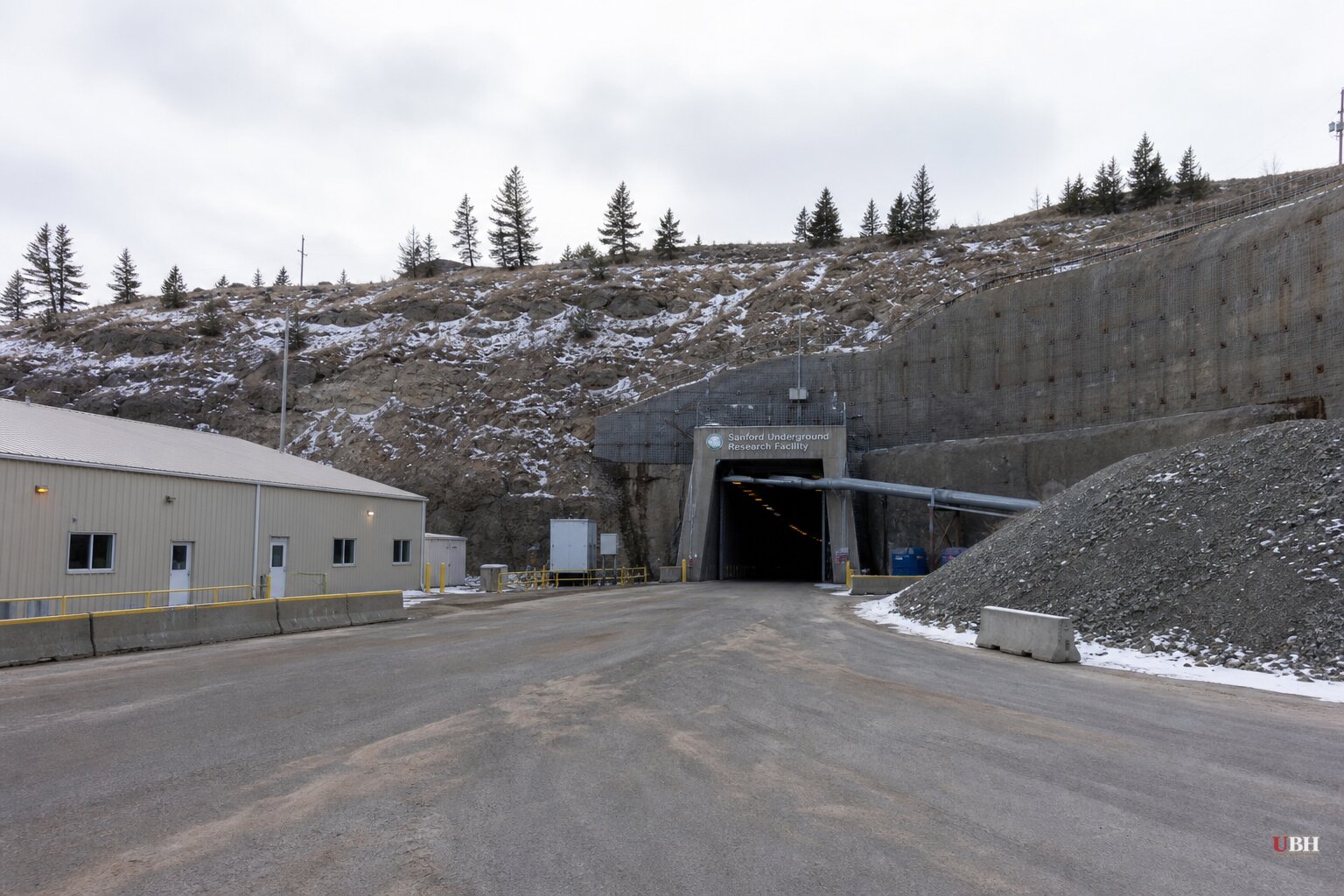
Something hit a xenon atom nucleus a mile under the Black Hills of South Dakota on June 16, 2023, at 3:22:39 p.m., and physicists still can't fully explain what it was.
That single collision, buried in a sealed tank of ultra-cold liquid xenon at the Sanford Underground Research Facility, is now the closest thing to a dark matter detection scientists have reported in four decades of trying. Researchers with the LUX-ZEPLIN (LZ) experiment presented the finding September 1 at the TeV Particle Astrophysics conference in Tendo, Japan. A paper on the event is headed to Physical Review Letters and has been posted through the LZ collaboration.
Dark matter makes up roughly 85% of all matter in the universe, yet no one has ever directly observed it. Scientists know it's there because of its gravitational fingerprints: galaxies spinning too fast, light bending too much. But the particles themselves have never shown up in a detector. LZ is built to change that. It's a 10-ton tank of liquid xenon managed by the Department of Energy's Lawrence Berkeley National Laboratory, sitting nearly a mile underground specifically to block cosmic radiation that mimics dark matter signals.
What actually happened
Rick Gaitskell, the Brown University physicist who serves as LZ's spokesperson, was blunt about what this is and isn't. "We're very intrigued to see this event in the data, in the region where we expect dark matter to show up, and the competing backgrounds are very low," Gaitskell said. "With only one event, we don't want to get ahead of ourselves. We are not claiming to have seen dark matter."
The analysis, led by Sam Eriksen, a senior research associate at the University of Bristol, combed through 220 days of data collected between March 2023 and April 2024. Unlike earlier LZ searches that looked for faint, low-energy WIMP interactions, this pass hunted for a broader, higher-energy range of possible collisions. Eriksen said the team spent months ruling out mundane explanations. "We understand our detector and the backgrounds so well that even a single outstanding event, like the one we found, is important," he said.
If the event really was dark matter, the particle responsible would be a WIMP — a weakly interacting massive particle, one of the leading theoretical candidates — with a mass of at least 200 GeV/c².
The numbers matter here
According to the project's best estimates, the odds of this being a statistical fluke are about half a percent, a statistical significance of 2.6 sigma — meaning there's roughly a 1-in-100 chance known particles could produce such an event.
Either way, it's nowhere near the bar physics requires. Three sigma is the threshold for calling something "evidence." Five sigma is required before anyone gets to say "discovery." This event sits well below both.
That gap is why outside physicists are excited but careful. Wick Haxton, a theoretical physicist at the University of California, Berkeley, who wasn't involved in the work, called it "the most interesting thing that's come up in recent times." Dan Hooper, a theoretical physicist at the University of Wisconsin–Madison, was more guarded: "It's only one event. So who knows what's really going on here. That said, it's intriguing."
Dan Tovey, who leads the University of Sheffield's LZ team, put it plainly: "With just one event it is not possible to conclude that we are actually seeing first signs of new physics, but if this were the case then the consequences for our understanding of the universe would be profound." He added that the team has run the event through every check they have, and "so far it has passed every test."
Reasons for skepticism
The field has been burned before. Every prior flash or electric surge detectors have picked up over 40 years of dark matter searches has eventually turned out to have an ordinary explanation, according to Scientific American. Katherine Freese, a theoretical physicist at the University of Texas at Austin whose early work helped shape the WIMP search, called this moment different: "I have been waiting for a positive result for, oh, my god, 40 years. So you can bet I'm very, very excited by the LZ results." But excitement from a 40-year veteran of a field defined by false starts carries weight.
LZ is funded through the Department of Energy and involves 250 scientists across 39 institutions. Gaitskell is scheduled to present the findings again at a Brown University physics colloquium on September 11. The collaboration says the only way to settle the question is more data. LZ keeps running, and every additional WIMP-like event either strengthens the case or buries it as noise.
Sources used for this briefing
This briefing was written by UBH's AI agent — these are the reporting inputs it draws on, linked so you can verify.


