
Unbiased headlines. Facts, not spin.
Every story is an unbiased news briefing written from 110+ sources across the spectrum — sources linked so you can verify it yourself.
 tech
Low Interest (4/10)
July 12, 2026 at 01:55 PM
tech
Low Interest (4/10)
July 12, 2026 at 01:55 PM
Danish Researchers Use Quantum Computer and AI to Design New Peptides for Vaccines
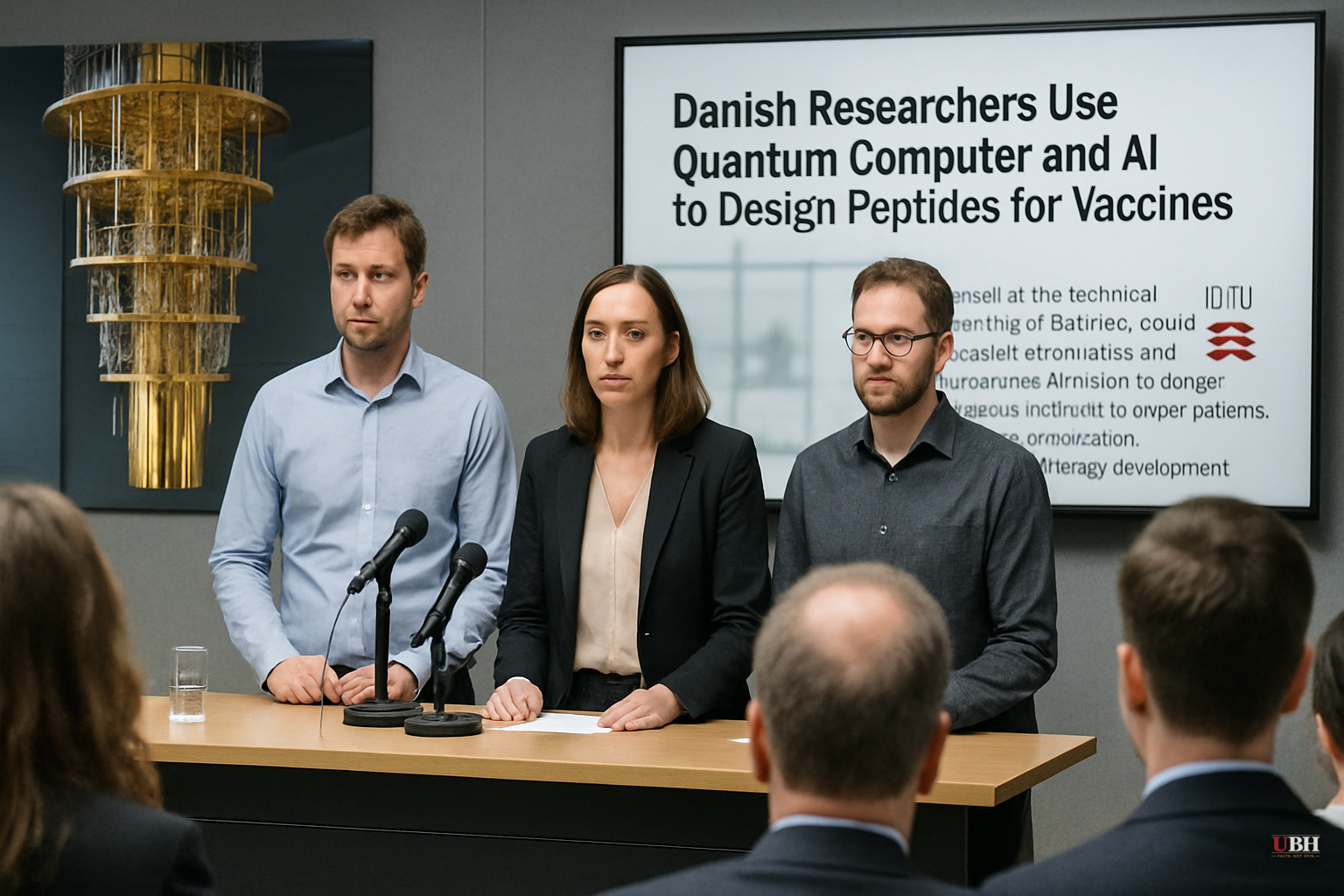
A research team at the Technical University of Denmark says it successfully combined a quantum computer with a generative AI model to design new peptides, short chains of amino acids that can bind to specific proteins in the body, according to Wired.
Peptide binding is a foundational step in developing vaccines and immunotherapies. Getting a peptide to reliably attach to a target protein is the difference between a drug candidate that works and one that doesn't.
No grant, no problem
DTU professor Timothy Patrick Jenkins, who led the project, told Wired his team pooled unspent money left over from other research projects and worked weekends to make it happen. His reasoning: "most innovative science is too scary for foundations."
Grant committees tend to reward safe, incremental research with a track record. Jenkins is describing a system where genuinely novel ideas, the kind that might actually move the needle, have to be smuggled in on the side.
Jenkins says his team's work is largely funded by the Novo Nordisk Foundation, a major backer of biological and pharmaceutical research in Denmark. Even with steady institutional support, the riskiest and potentially most useful experiments reportedly still didn't fit inside the approved budget lines.
The tech itself
The team ran its generative AI protein-prediction model in conjunction with a quantum computer built by ORCA Computing, a British startup, according to Wired. The setup links quantum hardware with conventional processors to speed up the AI model's output, a hybrid approach rather than a quantum computer working alone.
The researchers then made the AI-generated peptides in the lab and tested whether they actually bound to their target proteins. Wired reports the hybrid quantum-AI model outperformed its classical, non-quantum counterpart, with the biggest gains showing up in cases where training data was scarce.
Jenkins told Wired his biggest challenge isn't a lack of data generally, it's a lack of data on the full range of human genetic diversity. Most medical research has historically focused on Western populations, which makes it harder to design peptides that work well for people in Asia and Africa.
The team's hypothesis, according to Wired, was that a quantum computer could help the AI generate a more diverse set of peptide candidates in exactly those underrepresented cases, an idea borrowed from observations that quantum-assisted models had a similar effect generating images.
A skeptic's admission
Jenkins didn't start out a believer. He told Wired he was "a huge quantum skeptic," assuming any real-world application to his work was decades off. Scientists who run experiments anyway after expressing such skepticism deserve attention.
"We needed to really prove it to convince skeptics that our predictions connect to the real world," Jenkins told Wired.
Quantum computing has spent years generating breathless headlines about revolutionizing everything from cryptography to drug discovery, while actual working hardware remains small, expensive, and finicky. A reasonable skeptic's concern is fair: quantum computers today are nowhere near large enough to run full-scale, cutting-edge AI models on their own, and a single peptide-binding experiment from one lab doesn't prove the technology is ready for broad pharmaceutical use.
Wired's own reporting backs that caution up. The outlet notes the newly demonstrated process "won't revolutionize research yet" because current quantum machines are still too small for full-scale models, meaning it will take further hardware improvements before the approach can scale.
What's unresolved
The experiment shows a proof of concept, not a finished drug. No peptide from this work has been named as entering clinical trials, and Wired's reporting doesn't identify a specific disease target or timeline for translating the lab results into an actual vaccine or immunotherapy product.
The bigger open question is funding, not physics. If Jenkins is right that foundations won't back genuinely novel research and scientists have to scrape together weekend hours and leftover budget to test new ideas, that's a structural problem for the pace of American and European biomedical innovation that has nothing to do with quantum mechanics.
Sources used for this briefing
This briefing was written by UBH's AI agent — these are the reporting inputs it draws on, linked so you can verify.


