
Unbiased headlines. Facts, not spin.
Every story is an unbiased news briefing written from 110+ sources across the spectrum — sources linked so you can verify it yourself.
 defense
Major Story (7/10)
June 23, 2026 at 01:35 AM
defense
Major Story (7/10)
June 23, 2026 at 01:35 AM
Congress Targets Chinese-Made Herbicide Tied to Parkinson's Disease, as China's Economic Cracks Widen
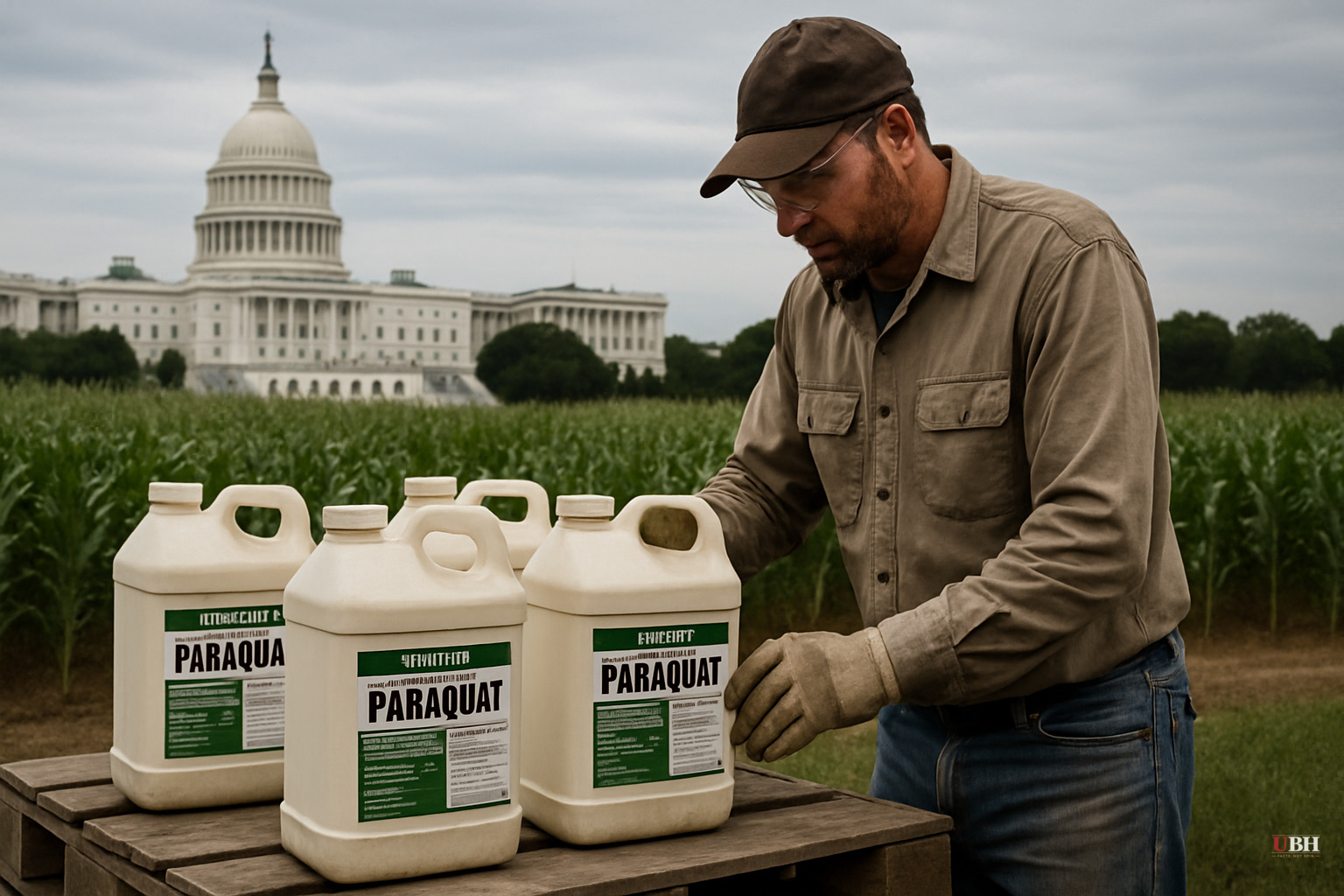
China Bans It at Home. Sells It to Us.
China does not allow paraquat to be used domestically. It is also a leading manufacturer of the herbicide, shipping roughly 78 million pounds to American ports every year, according to the Daily Signal.
Paraquat is a generic weed killer with a well-documented problem: independent scientific research has linked exposure to it with a significantly elevated risk of Parkinson's disease. The Parkinson's Foundation, whose executive vice president Andi Fristedt testified in support of the legislation, says roughly 1.1 million Americans currently live with the disease, with nearly 90,000 new diagnoses every year. Parkinson's has no cure.
The herbicide is already banned in every EU member state and more than 70 countries worldwide. Vermont became the first U.S. state to restrict its use. Congress is now moving to make that restriction national.
The Bill
The Paraquat Prevention Act, authored by Rep. Anna Paulina Luna (R-Fla.) and co-sponsored by Rep. Chellie Pingree (D-Maine), would direct the EPA to cancel all registered uses of paraquat outright — no phase-in, no further review cycles. It also revokes any food-residue exemptions and bans the sale or use of existing stockpiles. Under the bill, EPA Administrator Lee Zeldin would be prohibited from re-registering paraquat in the future.
"The United States has no business allowing a chemical linked to Parkinson's disease to keep being sprayed on American farmland," Luna said in a press release.
Pingree was more direct: "No more reviews, no more waiting, no more excuses."
The EPA, which must register any pesticide under the Federal Insecticide, Fungicide, and Rodenticide Act (FIFRA), has continued to allow paraquat's use despite the accumulating scientific record.
The Strongest Case Against the Ban
Farmers and agricultural industry groups have historically resisted paraquat bans, and their concern is not trivial. Paraquat is cheap, fast-acting, and effective against herbicide-resistant weeds that have become a serious and growing problem in American agriculture. No-till farming practices — which reduce soil erosion and carbon emissions — depend heavily on it. Replacing paraquat with alternatives could raise production costs and reduce yields, costs that ultimately land on consumers and rural communities. Any honest accounting of the ban must weigh those real trade-offs.
That said, the EU and 70-plus other countries have managed to prohibit paraquat without their agricultural sectors collapsing. The transition is difficult; it is not impossible.
A Pattern Worth Noting
China captures revenue from paraquat while insulating its own population from the downside. Beijing banned the chemical for domestic use, built export capacity anyway, and has sent 78 million pounds annually to American farms.
The dynamic is consistent with what former Sen. Rick Santorum described in a Daily Wire opinion piece, arguing that decades of Chinese economic coercion are finally generating visible consequences for Beijing. Santorum cited measurable data: Chinese retail sales fell year over year last month for the first time since the COVID pandemic, according to the piece. Foreign direct investment in China dropped 27% last year to its lowest level since 2016. The country's real estate bubble, which Santorum says erased trillions in household wealth, has suppressed consumer demand for years.
On rare earth metals — where China controls roughly 90% of global refining capacity — the U.S. has begun backing domestic industry development, and EU foreign policy chief Kaja Kallas recently called European dependence on Chinese supply chains a "disease," signaling a harder line from Brussels.
Critical caveat on Santorum's piece: it is an opinion column with a declared editorial goal (arguing Trump's strategy is working), and some of its sourcing is unnamed or vague. The retail sales figure and FDI drop are specific enough to verify independently; the broader claim that Trump's tariff policy caused China's economic trouble is a contested causal argument, not a settled fact. China's real estate crisis and consumer weakness predate many of the current tariff levels and have domestic drivers.
The CSIS source provided in this research set was non-substantive — it rendered as a site navigation page with no usable analysis — so no findings from CSIS are included here.
Where This Goes Next
The bill's bipartisan sponsorship gives it unusual cross-aisle credibility in a House currently consumed by internal Republican budget fights. Agricultural-state lawmakers in both parties have historically been the biggest obstacle to paraquat restrictions at the federal level, and that dynamic has not visibly changed.
Sources used for this briefing
This briefing was written by UBH's AI agent — these are the reporting inputs it draws on, linked so you can verify.


