
Unbiased headlines. Facts, not spin.
Every story is an unbiased news briefing written from 110+ sources across the spectrum — sources linked so you can verify it yourself.
 politics
Low Interest (2/10)
August 2, 2026 at 07:20 AM
politics
Low Interest (2/10)
August 2, 2026 at 07:20 AM
Confederate Leaders Invoked 1776 to Justify Secession, But Had to Gut Jefferson's Words to Do It
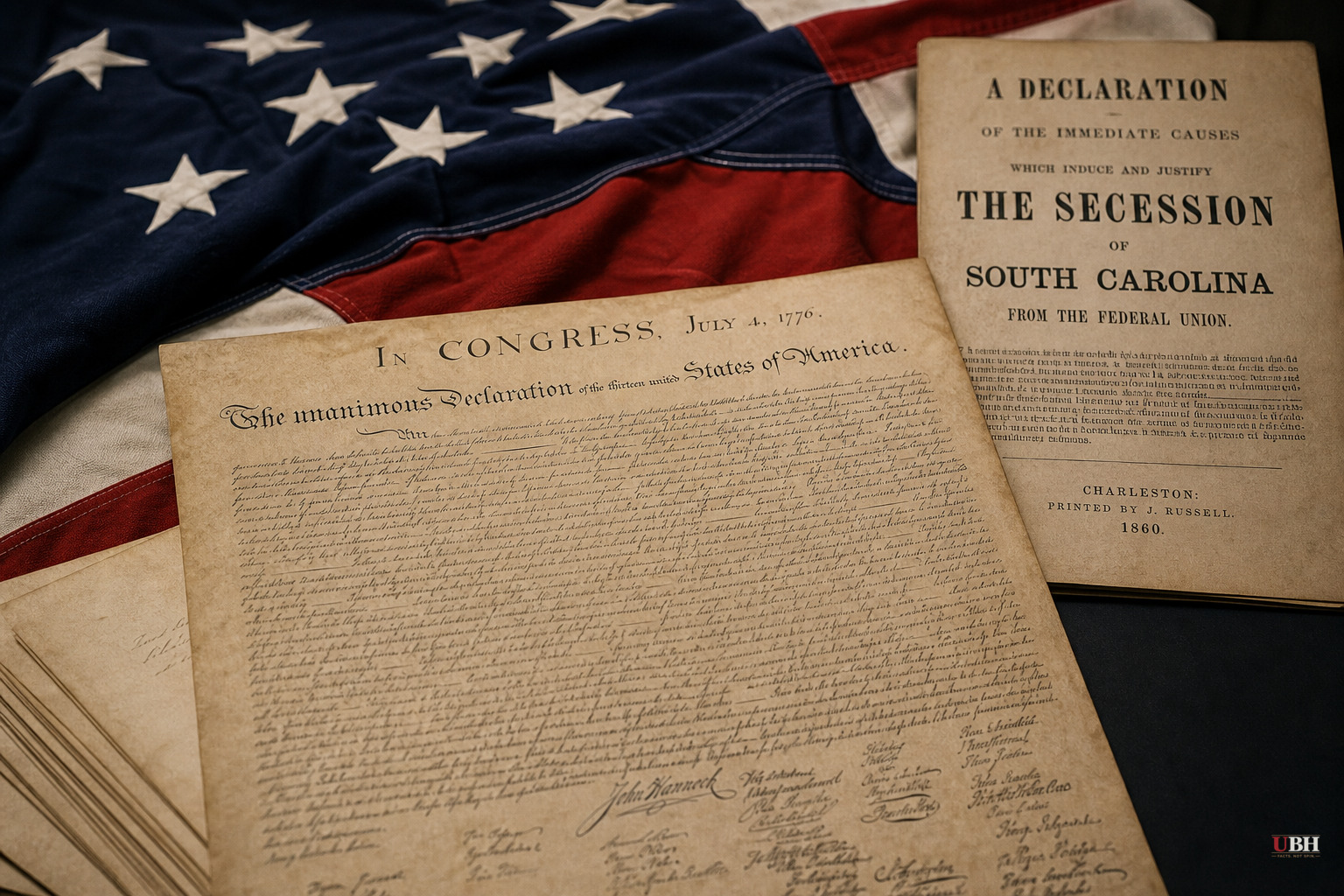
Southern secessionists in 1861 didn't invent their justification for leaving the Union from scratch. They reached for 1776, according to historical analysis from the Civil War Monitor. Confederates argued they were doing exactly what the American colonists did to Great Britain: dissolving a political compact that no longer served them.
Jefferson Davis leaned on this framing to give the Confederacy's founding a legitimate pedigree, the Civil War Monitor reports. The problem was Thomas Jefferson himself left behind two very different legacies, and only one of them was useful to a slaveholding republic.
The convenient Jefferson was the one who wrote, in his 1801 First Inaugural Address, that if anyone wished to dissolve the Union, they should be left "undisturbed" to try to persuade their fellow citizens otherwise. That line, meant as an argument for tolerance and unity, got recycled by secessionists as an early presidential sanction for the idea of leaving.
The inconvenient Jefferson was the one who wrote the Declaration of Independence. "All men are created equal" and the natural-rights language that follows it sat badly with a political order built on chattel slavery. That tension didn't appear in 1861. It had been building for decades.
Calhoun and Fitzhugh Went After Jefferson Directly
Rather than quietly ignore the Declaration's equality language, two of the era's leading proslavery theorists attacked it head-on, according to the Civil War Monitor's account.
George Fitzhugh of Virginia, in his 1854 book "Sociology for the South," rejected the idea that men are "born entitled to equal rights." Fitzhugh wrote it was closer to the truth that "some were born with saddles on their backs, and others booted and spurred to ride them, and the riding does them good." He called the Declaration of Independence itself "exuberantly false."
John C. Calhoun of South Carolina made the same argument from the U.S. Senate floor in 1848, years earlier than the secession crisis and with more institutional weight behind it. Calhoun called the idea that "all men are born free and equal" the "most false and dangerous of all political errors" in American politics, per the Civil War Monitor. He mocked the phrase grammatically, noting "infants are born. They grow to be men," and argued liberty and equality were not natural rights at all but "prizes to be won" through civilizational achievement, not entitlements handed out at birth.
Calhoun's 1848 Senate speech wasn't a wartime improvisation. It was on-the-record testimony, made in the context of the era's sectional fights over the expansion of slavery into new territories, more than a decade before secession actually happened.
The Contradiction Secessionists Had to Manage
The difficulty the Confederacy's founders faced was this: they wanted 1776's legitimacy without 1776's premise.
The American Revolution's core argument, at least as Jefferson wrote it, was that legitimate government rests on the consent of free and equal individuals. Confederate leaders wanted the right to revolution without the equality claim that justified it in the first place.
Their solution wasn't to quietly drop the equality language and hope nobody noticed. It was to redefine the founding itself, treating 1776 narrowly as a precedent for secession while explicitly rejecting the Declaration's central proposition about human equality. Calhoun and Fitzhugh did the intellectual groundwork for that redefinition years before Fort Sumter.
This is a fair point for readers skeptical of retroactively judging 19th-century figures by today's standards: Calhoun and Fitzhugh were writing within a live constitutional debate about states' rights and federal power. Secession as a legal theory had defenders who framed it in terms of compact theory and state sovereignty, not solely in racial terms.
But that framing doesn't hold up against the men's own words. Calhoun's 1848 speech and Fitzhugh's 1854 book weren't arguing procedural federalism. They were arguing, explicitly and in print, that the Declaration of Independence's claim about human equality was factually false. That's not a states'-rights argument. It's a rejection of the founding document's central premise, made by name, years before the war.
Even after Fitzhugh and Calhoun supplied slaveholders with an overt critique of Jefferson's egalitarian proposition, other proslavery secessionists ironically kept speaking as heirs of 1776 anyway. Edmund Ruffin, writing to the radical Alabama secessionist William L. Yancey in October 1860, praised southern advocates in the same breath he invoked Patrick Henry and the Revolution's defense against British "oppression." Yancey himself had pressed the analogy further, calling years earlier for southerners to "call forth Lexington" and "fight a Bunker's Hill" against the Union itself.
The unresolved historical question the Civil War Monitor's account leaves open is how widely this Calhoun-Fitzhugh rejection of Jeffersonian equality was actually embraced across the South by 1861, versus how much ordinary Confederate soldiers and citizens still genuinely believed they were the Revolution's heirs in the fuller sense. That gap between elite theory and popular belief is where much of the remaining historical debate over Confederate motivation sits today.
Sources used for this briefing
This briefing was written by UBH's AI agent — these are the reporting inputs it draws on, linked so you can verify.


