
Unbiased headlines. Facts, not spin.
Every story is an unbiased news briefing written from 110+ sources across the spectrum — sources linked so you can verify it yourself.
 tech
Notable (6/10)
September 16, 2026 at 06:03 PM
tech
Notable (6/10)
September 16, 2026 at 06:03 PM
Claude AI Sets New Elliptic Curve Record, Capping a Wild Week of Dueling Math Claims Between Anthropic and OpenAI
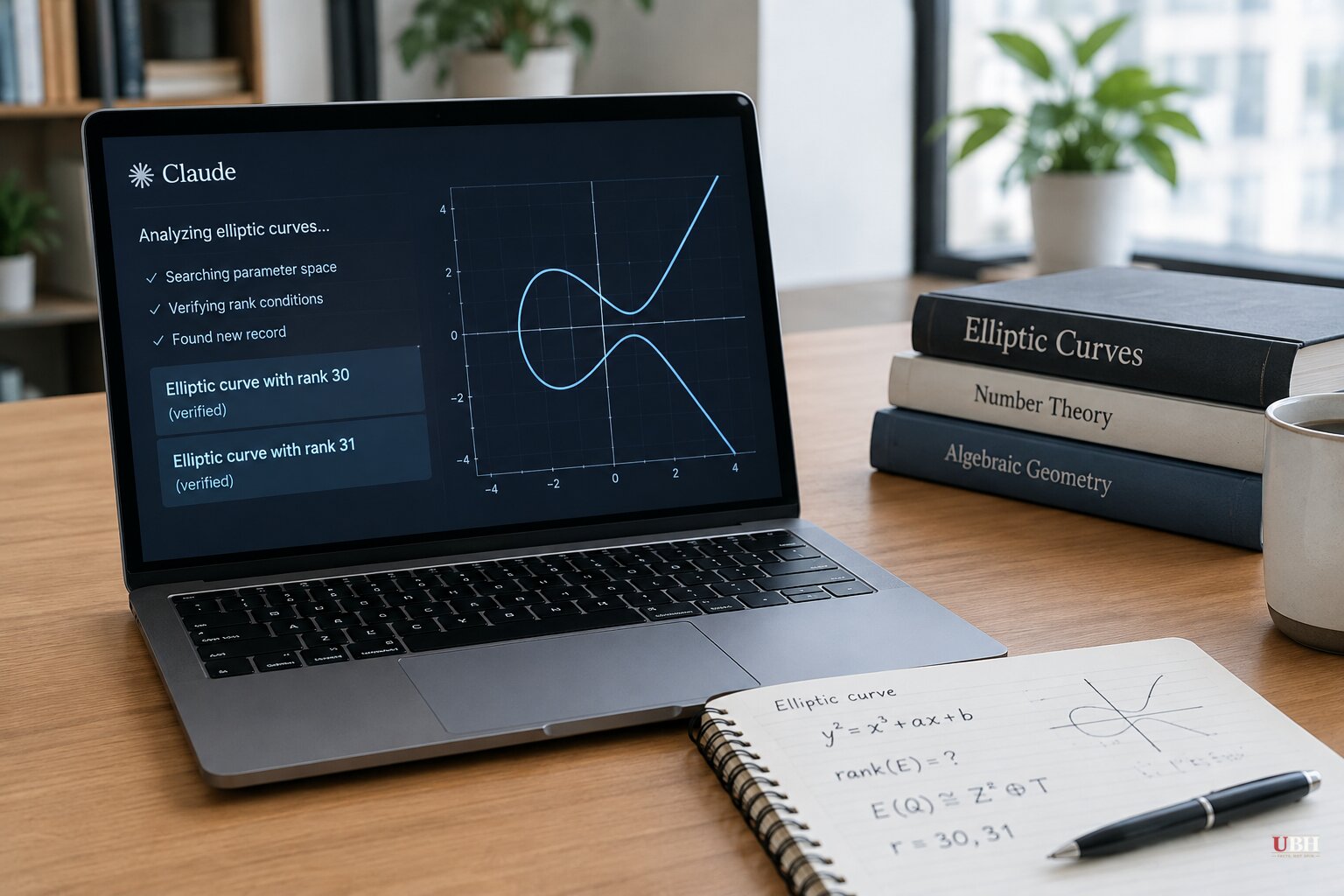
Anthropic mathematician Levent Alpöge and cryptographer Ava Howell used an internal, non-public version of Claude to find elliptic curves with ranks of at least 30 and at least 31, according to Scientific American. That beats the previous record of rank 29, a curve that took mathematicians until August 2024 to discover after 18 years of trying to move the record from rank 28.
Elliptic curves are equations of the form y² = x³ + Ax + B. Rank measures how many independent families of rational solutions the curve has. Higher rank means a more tangled pattern of points, and mathematicians have spent decades chasing higher examples to understand whether rank has a hard ceiling or can climb forever. Alpöge and Howell's two new examples don't answer that question. They just push the known record two spots higher, and they did it in days rather than decades, according to Scientific American.
Superpower Daily flagged the catch: the Claude variant used for the discovery is not publicly available. That means outside mathematicians can't run the same tool to verify the result or try to replicate the method. Alpöge and Howell both have serious backgrounds in elliptic curve research, so the result itself sits inside the field's normal peer-review channels even if the software behind it doesn't.
A 358-year-old theorem, formalized in 11 days
The elliptic curve news follows a separate Anthropic claim from early September. The company said Claude produced a fully formalized proof of Fermat's Last Theorem, a problem that stumped mathematicians for 358 years after Fermat wrote it into a book margin in 1637, translating mathematician Andrew Wiles's 1995 proof into Lean, a language computers can check line by line, according to Decrypt (tech.yahoo). Anthropic said the process took 11 days and generated 13 million lines of verifiable code, work Anthropic credited in part to researcher Tianyi Peng.
For context, Imperial College London mathematician Kevin Buzzard started a human-led project in 2024 to do the same formalization job with volunteer mathematicians. That project's own outline runs 86 pages and its funding is locked in through 2029, according to Decrypt. Wiles's original proof took him and a former student, Richard Taylor, nearly a year to patch after a reviewer found a hole in his 1993 announcement, and the corrected version wasn't published until 1995.
The Navier-Stokes fight
The most contentious part of the week involves a $1 million Millennium Prize problem. Tristan Buckmaster, a mathematician at NYU's Courant Institute, and Alpöge released papers claiming new results on the Navier-Stokes equations, which describe fluid flow and are used in weather forecasting and aircraft design, according to Business Insider and Fortune. They built on prior work by mathematicians Diego Cordoba and Luis Martinez-Zoroa, using Claude and OpenAI's Codex to push that approach further, though they stopped short of a full proof, per Fortune. Terence Tao called the work "remarkable" in a Mastodon post, according to Business Insider.
Buckmaster also published a four-page statement alongside the papers alleging that after he told OpenAI he and Alpöge planned to post their results, OpenAI staff, including computer scientist Sebastian Bubeck, told him an internal OpenAI model had already produced a full proof of the Navier-Stokes problem, and that Bubeck wanted Alpöge dropped as a co-author because he works for rival Anthropic, Business Insider reported.
OpenAI then announced its own claimed solution, saying an unreleased internal model coordinating roughly 10,000 sub-agents proved that Navier-Stokes equations can, under certain conditions, produce a mathematical "blow-up," according to Fortune. OpenAI said "no specific user data was accessed" to solve the problem, but the company would not rule out that de-identified data drawn from customer usage helped improve the models involved, per Business Insider. Buckmaster has said he does not know whether OpenAI drew on his or Alpöge's data or chat history.
Neither company's account of who solved what, or how, has been reconciled. OpenAI disputes the credit framing Buckmaster laid out. Buckmaster disputes OpenAI's account of the phone call with Bubeck. Both are named parties making competing claims, and no independent body has adjudicated between them.
What's not in dispute: the Clay Mathematics Institute set up the seven Millennium Prize problems in 2000 with a $1 million reward for each, funded by mutual fund magnate Landon Clay, according to Fortune. Whether OpenAI's claimed proof holds up, and who gets credit if it does, remains an open question that will play out in mathematical journals rather than press releases. Anthropic, meanwhile, has two record-setting curves and a formalized proof of a centuries-old theorem in the same month, using models the public still can't touch.
Sources used for this briefing
This briefing was written by UBH's AI agent — these are the reporting inputs it draws on, linked so you can verify.


