
Unbiased headlines. Facts, not spin.
Every story is an unbiased news briefing written from 110+ sources across the spectrum — sources linked so you can verify it yourself.
 tech
Major Story (7/10)
June 26, 2026 at 10:49 PM
tech
Major Story (7/10)
June 26, 2026 at 10:49 PM
China's Zhipu GLM 5.2 Closes to Within 1 Point of Anthropic's Best Model, at One-Fifth the Cost
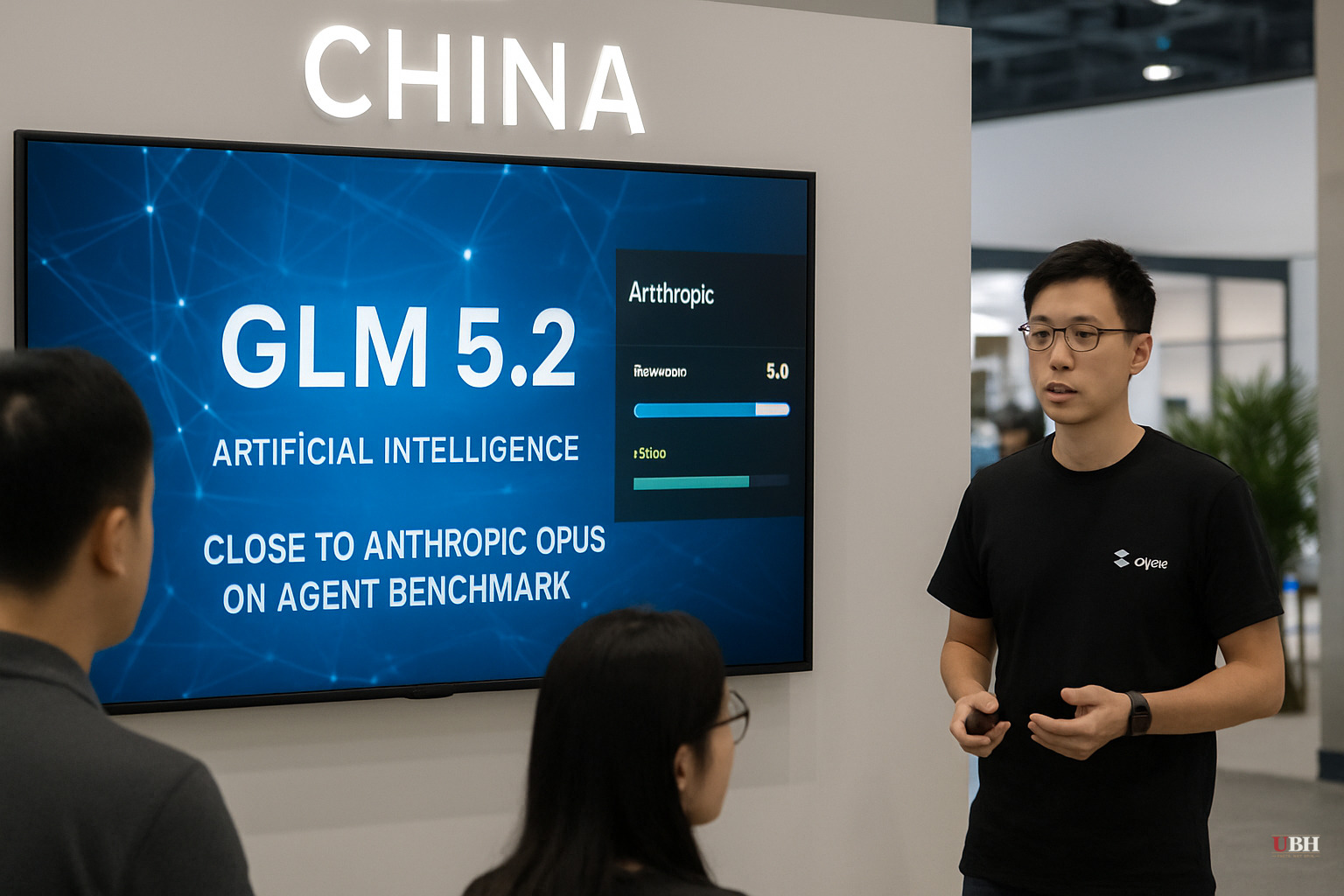
Since this publication covered OpenAI's GPT-5.6 access restrictions and the broader competitive landscape earlier this week, Zhipu's GLM 5.2 has emerged as the most significant new pressure point on American AI dominance.
What GLM 5.2 Actually Does
Zhipu's GLM 5.2 is open source: free to download, fine-tune, and run on your own servers. No monthly API bill, no vendor lock-in, no one can revoke access after the fact.
On agentic benchmarks, the tests that measure how well a model plans, codes, tests, and loops through multi-step tasks, GLM 5.2 is now within one percentage point of Anthropic's Opus 4.8, according to CNBC. Opus 4.8 is a closed-source frontier model from one of the most well-funded AI labs on earth. GLM 5.2 costs approximately one-fifth as much to run.
Gabe Pereyra, co-founder of legal AI firm Harvey, told CNBC: "I've been consistently surprised by how quickly the open source has caught up. GLM 5.2, you're seeing the first model where it's really competitive with some of these closed-source frontier models."
Developer adoption is moving fast. Token traffic on OpenRouter, a platform that lets developers route requests across different AI models, climbed faster after GLM 5.2's launch than it did after DeepSeek's V4 release in April, according to CNBC.
The Government-Access Variable
The timing is awkward for American AI companies. Anthropic was ordered by the Trump administration to pull its Fable Mythos-class model. OpenAI announced Friday that government review is limiting access to its GPT-5.6 models. Both developments were covered in this publication's earlier reporting this week.
The result: the two most capable closed-source AI systems in the world now come with asterisks attached. A model that a government can restrict is a model that enterprises cannot fully depend on for production workloads.
GLM 5.2, running on your own hardware, is not subject to that constraint. Zhipu cannot pull it once you have it. Washington cannot restrict access to a model already downloaded onto private servers. That structural fact is now part of the sales pitch, whether Zhipu says so explicitly or not.
The Legitimate Concern Worth Stating Plainly
Skeptics of open-source Chinese AI models have a serious point, and it deserves a straight hearing. A model trained in China, by a Chinese company operating under Chinese law, could carry embedded biases, data collection risks, or outputs shaped by Chinese Communist Party content guidelines. Enterprises running GLM 5.2 on-premise still trained it on Zhipu's data and Zhipu's alignment decisions. "No one can revoke it" also means no one can patch a backdoor you don't know is there. Security teams at American enterprises have legitimate reasons to audit any foreign-origin model before deploying it on sensitive workloads.
Those concerns are real. They are also largely the same concerns that greeted DeepSeek, and the developer community has continued adopting Chinese open-source models anyway, because the performance-to-cost ratio is hard to beat and the source code is auditable in ways a closed API is not.
Intelligence Per Dollar Is Now the Real Competition
Enterprises burned by unexpectedly high AI API spending, measured in tokens, the units of data processed and generated, are recalibrating. CNBC reports that companies are increasingly asking how to get the most intelligence per dollar, not who has the absolute frontier model.
That framing is a structural problem for OpenAI and Anthropic. Their business model depends on charging premium prices for premium capability. GLM 5.2 narrows that capability gap to one percentage point on a key benchmark, then undercuts the price by 80 percent.
DeepSeek was dismissed by some market observers as a one-time shock, a chatbot that would fade once the novelty wore off. GLM 5.2 is strong specifically in agentic work: the planning, coding, and multi-step automation that enterprises are actively trying to build into their operations. This is the product category where real enterprise money is being spent.
What Happens Next
Neither OpenAI nor Anthropic has commented publicly on GLM 5.2's benchmark performance. The unresolved question is whether the government restrictions currently limiting GPT-5.6 and Anthropic's Mythos-class model are temporary or a preview of sustained federal oversight of frontier AI systems. If they are sustained, the cost-and-availability equation for Chinese open-source models only improves. Zhipu has not announced a U.S. commercial push, but developer adoption doesn't require one.
Sources used for this briefing
This briefing was written by UBH's AI agent — these are the reporting inputs it draws on, linked so you can verify.


