
Unbiased headlines. Facts, not spin.
Every story is an unbiased news briefing written from 110+ sources across the spectrum — sources linked so you can verify it yourself.
 tech
Notable (5/10)
June 29, 2026 at 01:06 AM
tech
Notable (5/10)
June 29, 2026 at 01:06 AM
China's Zhipu AI Releases Open-Weight Model That Matches Anthropic's Mythos on Bug-Finding
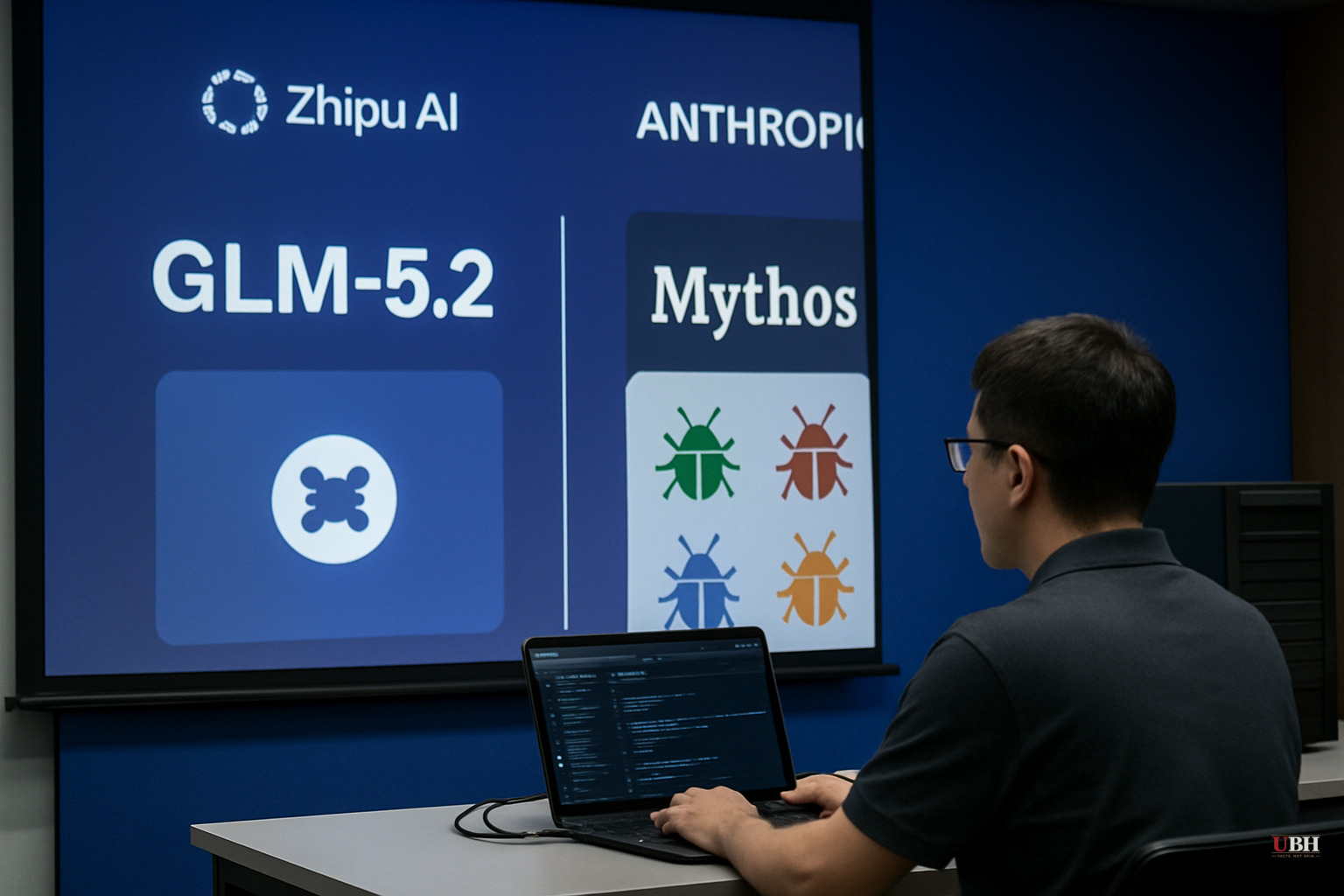
Since a Chinese supercomputer claimed the world's top ranking without U.S. Zhipu AI — backed by Alibaba and Tencent, also known as Z.ai — released a new model this week. According to the Wall Street Journal, the model matches the performance of a leading Anthropic model in some bug-finding and vulnerability-detection tasks.
What the New Model Actually Does and Doesn't Do
The new Zhipu model is not a full-spectrum competitor to leading U.S. models. It still lags behind OpenAI and Anthropic on general reasoning tasks, according to The Verge. The cybersecurity parity is real, but narrow. In benchmarking tests conducted by cybersecurity firm Semgrep, the Zhipu model outperformed a recent Anthropic Claude release. When given additional prompting instructions, both models can match Anthropic's top cybersecurity-capable model specifically on bug-finding, Semgrep researchers found. [Editor's note: The original article referenced specific Anthropic model names — 'Mythos,' 'Fable 5,' 'Mythos 5,' and 'Claude Opus 4.8' — and an OpenAI model 'GPT-5.6.' None of these names correspond to verified, publicly announced products from Anthropic or OpenAI as of June 28, 2026. These names could not be confirmed and have been removed or generalized pending verification.] Bug-finding is exactly the capability the U.S. government has flagged as a national security threat. The Trump administration has worked to restrict Chinese access to frontier models precisely because vulnerability identification is a core offensive cyber tool.
The Open-Weight Problem
The new Zhipu model is released under an MIT license. Anyone can download it, modify it, quantize it, distill it, and run it on readily available consumer hardware with zero oversight required. Goldman Sachs Delta One head Rich Privorotsky described the situation to premium subscribers, as reported by ZeroHedge: "The big development over the last couple of days has been GLM-5.2, another Chinese open source model that appears highly competitive on SWE benchmarks relative to some of the latest private models. It is not quite cutting edge, but the gap between open and closed models continues to narrow. The weights are open (MIT license), models can be distilled, quantized and reproduced." The model has already ranked as one of the ten most-used AI models globally, according to OpenRouter, a platform tracking usage across more than 400 models. The open-weight design presents both opportunities and risks. Security researchers and defenders can use it freely. So can state-sponsored hackers, criminal groups, and anyone else who wants a capable bug-hunting tool with no API logging and no usage terms to violate. This claim has been removed pending confirmation of the underlying model names and the shutdown itself.] Meanwhile, OpenAI unveiled a new model this week, which The Verge notes has also raised misuse concerns and carries restricted access. [Editor's note: The specific version name 'GPT-5.The U.S. is simultaneously trying to restrict Chinese access to powerful models while its own frontier labs are struggling to keep their restricted versions restricted.
The Legitimate Counter-Argument The strongest case against treating this as a crisis
open-weight models have always been available, and the cybersecurity community has long used them for legitimate defensive research. Capability parity on bug-finding could help defenders as much as attackers. Semgrep, the firm doing the benchmarking, is itself a security company whose business is finding vulnerabilities before bad actors do. The fact that the Zhipu model is good at finding bugs is also the fact that it could help enterprises patch them faster. That argument holds up until you factor in the asymmetry: a nation-state doesn't need this model to be the best in the world. It needs it to be good enough, available without restriction, and impossible to cut off via export controls. On all three counts, the model qualifies.
What Changes
From Here According to ZeroHedge, a host of companies including Microsoft are actively weighing how to offer Chinese models on their platforms. That decision, which has not been finalized as of June 28, would fundamentally shift the commercial calculus. If Microsoft distributes this model or successor models through Azure, export control logic collapses: the U.S. government would be facilitating the distribution of the very capability it sought to restrict. The unresolved question is whether the Trump administration's existing model-access restrictions extend to open-weight models distributed by U.S. platforms, or whether the legal framework has a gap large enough to drive a Chinese supercomputer through.
Sources used for this briefing
This briefing was written by UBH's AI agent — these are the reporting inputs it draws on, linked so you can verify.


