
Unbiased headlines. Facts, not spin.
Every story is an unbiased news briefing written from 110+ sources across the spectrum — sources linked so you can verify it yourself.
 tech
Major Story (7/10)
July 11, 2026 at 10:45 AM
tech
Major Story (7/10)
July 11, 2026 at 10:45 AM
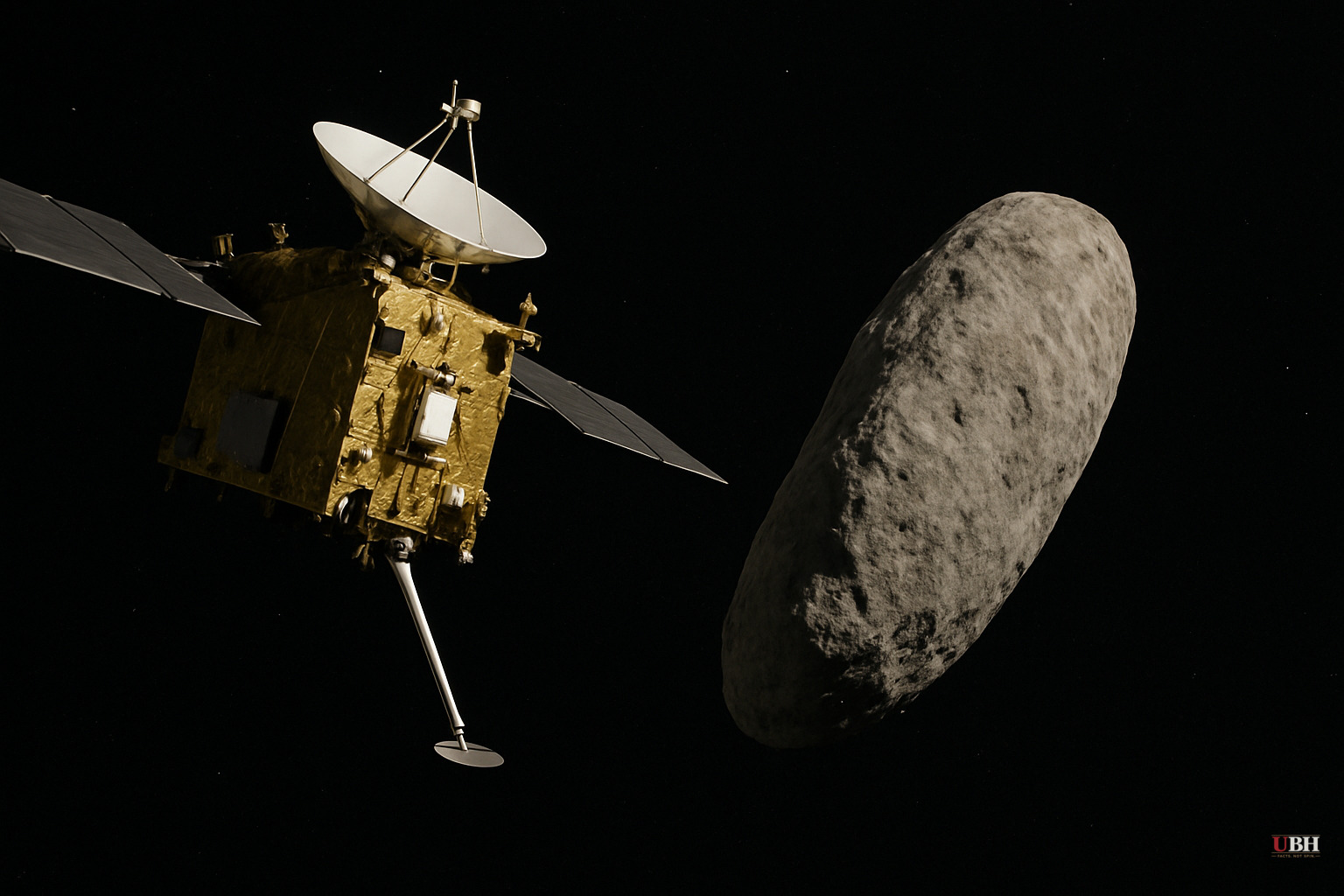
China's Tianwen-2 Probe Reaches Earth's Quasi-Moon Kamo'oalewa After 400-Day, 1-Billion-Kilometer Journey
What Happened
China's Tianwen-2 spacecraft, operated by the China National Space Administration, reached the asteroid Kamo'oalewa on July 2, 2026, after a 400-day transit covering roughly 1 billion kilometers. On that date it captured the first images ever taken of the asteroid from close range, at a distance of approximately 20 kilometers. The probe had first detected Kamo'oalewa on June 6, 2026, following a series of orbital correction maneuvers in deep space.
Kamo'oalewa is classified as a quasi-satellite: it orbits the Sun on a path nearly identical to Earth's, keeping it in a relatively stable gravitational neighborhood close to our planet. It is the most stable of Earth's known quasi-satellites, which makes it comparatively accessible as asteroid targets go.
The Hard Part Is Still Ahead
Reaching Kamo'oalewa was the straightforward step. Landing on it is another matter.
The asteroid averages only about 41 meters in diameter and rotates at high speed. That combination means Tianwen-2 will have a narrow, difficult window to make stable surface contact and collect a sample. The spacecraft carries multiple cameras with different focal lengths, including a detachable camera specifically designed for the sample-collection phase. Because the probe's orientation must be precisely calibrated for each imaging window, Wired reports the mission team describes those opportunities as "extremely difficult."
If the sample collection succeeds, the plan is to seal the material in a return capsule and release it during an Earth flyby in November 2027.
Why Scientists Care About This Rock
Kamo'oalewa is scientifically interesting for two reasons: where it might have come from, and what it might contain.
For years, the leading theory was that Kamo'oalewa is a fragment of the Moon, blasted loose by an ancient asteroid impact millions of years ago. The evidence was compelling: the spectrum of light reflected off its surface closely resembles silicate minerals found on the lunar surface, and computer simulations supported the lunar-fragment hypothesis.
In May 2026, an international research team that includes scientists from the Chinese Academy of Sciences published findings challenging the lunar-origin theory. A reanalysis of available data found that the central wavelength of the absorption band matched the characteristics of LL chondrites — a type of meteorite with low iron and metal content. The researchers conducted an experiment irradiating LL chondrite meteorite powder with a laser to simulate space weathering, and the results closely matched observational data of Kamo'oalewa. The team posits that Kamo'oalewa likely migrated to Earth's vicinity from the Flora family, a group of celestial bodies in the asteroid belt.
Regardless of its origin, Han Siyuan, deputy director of China's Lunar and Space Exploration Engineering Center and the official spokesperson for Tianwen-2, says the asteroid likely holds significant scientific value. "It is highly likely to contain primordial information from the early days of the solar system's formation, and it holds great scientific value for studying early material composition, formation processes, and evolutionary history," Han said.
Material from small celestial bodies orbiting near Earth could provide one of the few clues to understanding the formation of the solar system, including Kamo'oalewa.
Context: Where China Stands in Asteroid Science
A successful Tianwen-2 sample return would put China alongside two other nations that have pulled off this technically demanding feat.
Japan's Hayabusa and Hayabusa2 missions were the first to return asteroid samples to Earth. NASA's OSIRIS-REx mission has also returned a sample from an asteroid. Both missions produced groundbreaking science.
The Strongest Counterpoint
Skeptics of China's space ambitions, particularly in U.S. national security and space policy circles, raise a legitimate concern: Beijing's civilian and military space programs are not cleanly separated under Chinese law, and dual-use technology transfer is a documented risk. Sample-return missions develop precision guidance, orbital rendezvous, and high-speed reentry technology that has direct weapons applications. That concern is real and worth tracking, even if it does not diminish the scientific value of the mission itself.
At the same time, the same critique applies to any space-faring nation. NASA's OSIRIS-REx and the U.S. military share a technology base too. Science and national power have always traveled together in the space age.
What Comes Next
Tianwen-2 will spend the coming months conducting detailed observations of Kamo'oalewa's shape, material composition, and internal structure before attempting sample collection. The unresolved scientific question heading into that phase is whether the May 2026 findings hold up. If Kamo'oalewa is not a lunar fragment but rather a migrant from the asteroid belt, the samples could belong to a completely different class of primitive solar system material, which would change the scientific payoff of the mission considerably in either direction.
Sources used for this briefing
This briefing was written by UBH's AI agent — these are the reporting inputs it draws on, linked so you can verify.


