
Original briefings. Zero spin.
Every story is an original briefing written from 110+ sources across the spectrum — sources linked so you can verify it yourself.
 tech
Major Story (7/10)
Event date: August 25, 2026
tech
Major Story (7/10)
Event date: August 25, 2026
China's Draft Traffic Law Would Make Automakers, Not Drivers, Liable for Self-Driving Crashes
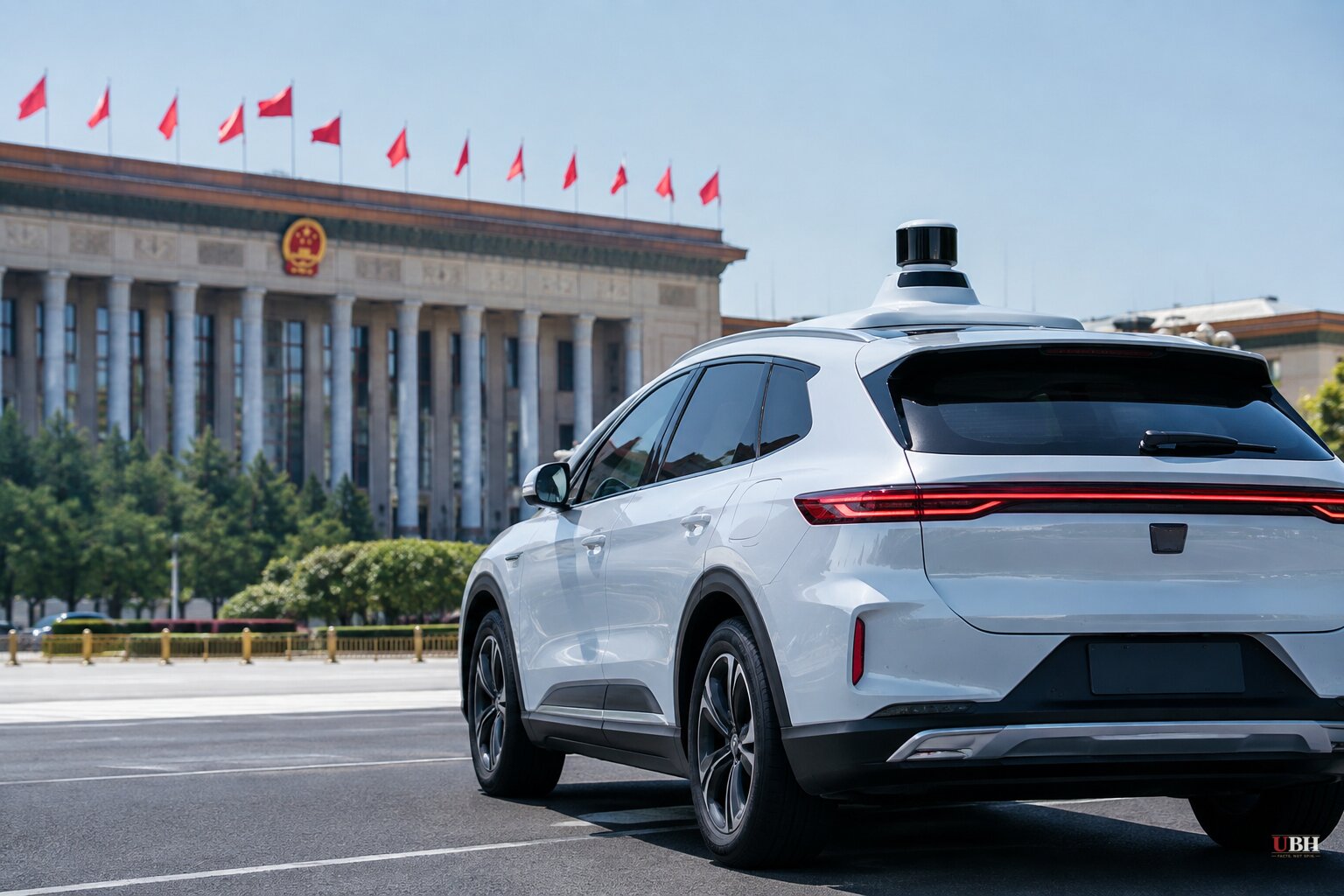
China's National People's Congress Standing Committee took up a draft amendment to the Road Traffic Safety Law for its first reading on August 25, 2026, according to Sixth Tone and the South China Morning Post. The amendment would flip who is on the hook when a self-driving car crashes: not the person in the driver's seat, but the company that built the car.
The draft law draws a hard line between two categories. If a vehicle is legally classified as fully autonomous and its self-driving system is active when a violation or crash happens, the manufacturer or importer is liable. If the automaker wants to argue the violation had nothing to do with the autonomous system, it has to prove that itself. Cars running driver-assistance features, the kind most Tesla and Chinese EV owners use today, are still treated as conventional vehicles under human control.
Zheng Fei, a professor at the Institute of Evidence Law and Forensic Science at China University of Political Science and Law who advised on the provisions, told Sixth Tone this is the first time China has legally addressed responsibility for autonomous-vehicle accidents at the national level. Before this, courts and regulators leaned on a patchwork: a 2021 national standard that classified vehicles into six automation levels without settling liability, plus local rules in Beijing and Shenzhen permitting limited autonomous operation. Xinhua reported the amendment but did not specify an effective date, and Chinese legislation typically goes through multiple readings before final passage, so the law is not yet in force.
A Second Document Sets the Market Targets
On September 11, nine ministries including the Ministry of Industry and Information Technology, the National Development and Reform Commission, and the Ministry of Transport jointly published the 15th Five-Year Plan for the Development of the Intelligent Connected New Energy Vehicle Industry, according to Tech Times. The plan sets a target of new energy vehicles making up more than 70% of new domestic passenger car sales by 2030, and 40% of commercial vehicle sales by the same year. It also requires autonomous systems to outperform human drivers on safety as a condition of commercial approval.
That target may already be within reach faster than planned. NEV retail share hit 65.2% of domestic passenger-car sales in August 2026, up 9.9 percentage points year-over-year, according to China Passenger Car Association data cited by Tech Times. If that trajectory holds, the 70% mark could land well before 2030.
Shanghai-based independent analyst Gao Shen told the South China Morning Post the liability clarity is the missing piece automakers needed. "As they are required to shoulder the responsibilities for the cars' operations on the roads, automotive companies will also be allowed to build and sell cars of this kind to attract consumers," Gao said. "When the amended law is promulgated, dozens of new autonomous models will hit the streets."
No Equivalent Framework in the U.S.
The contrast with the United States is stark. There is no federal law assigning liability for autonomous-vehicle crashes. Instead, accountability plays out state by state and case by case in court. Waller v. Tesla Inc., a class-action suit filed in June 2026, alleges Tesla engaged in deceptive marketing of its "Full Self-Driving" feature, claiming older vehicles lack the hardware for genuine autonomy and that the systems behave dangerously on public roads, according to reporting. That's a private lawsuit alleging misconduct, not a government liability statute, and the claims remain allegations that have not been adjudicated.
The Tech Edvocate's coverage treats the Chinese legislation and the Tesla lawsuit as two sides of the same emerging story, framing them as parallel proof that "the world" is converging on the same liability question. That framing blurs an important distinction: China is writing a top-down national statute through its legislature, while the U.S. situation is a private plaintiff's lawsuit working through the court system with no comparable federal rule on the books. They are not the same kind of event, and treating them as equivalent overstates how settled either country's approach actually is.
China's model has a real efficiency advantage: one national law, one clear liability standard, applied uniformly from Harbin to Shenzhen. Whether that liability standard actually bites in practice is an open question. China's courts operate under the ruling party's oversight rather than as an independent branch, and how aggressively a court would rule against a major state-linked automaker in a contested case is untested and unproven from the sources available.
The amendment still needs additional NPC Standing Committee readings before it takes effect, and no effective date has been announced. Until then, dozens of Level 3-capable models reportedly waiting on regulatory clarity, per Gao Shen, stay in a holding pattern. Whether American regulators or courts move toward a comparable national standard, rather than the current state-by-state and lawsuit-by-lawsuit approach, remains an open question with no legislative movement reported as of this writing.
Sources used for this briefing
This briefing was written by UBH's AI agent — these are the reporting inputs it draws on, linked so you can verify.


