
Unbiased headlines. Facts, not spin.
Every story is an unbiased news briefing written from 110+ sources across the spectrum — sources linked so you can verify it yourself.
 tech
Major Story (7/10)
July 10, 2026 at 01:34 AM
tech
Major Story (7/10)
July 10, 2026 at 01:34 AM
China Ran an AI Influence Op Targeting U.S. Data Centers. Senator Cotton Wants DOJ to Investigate.
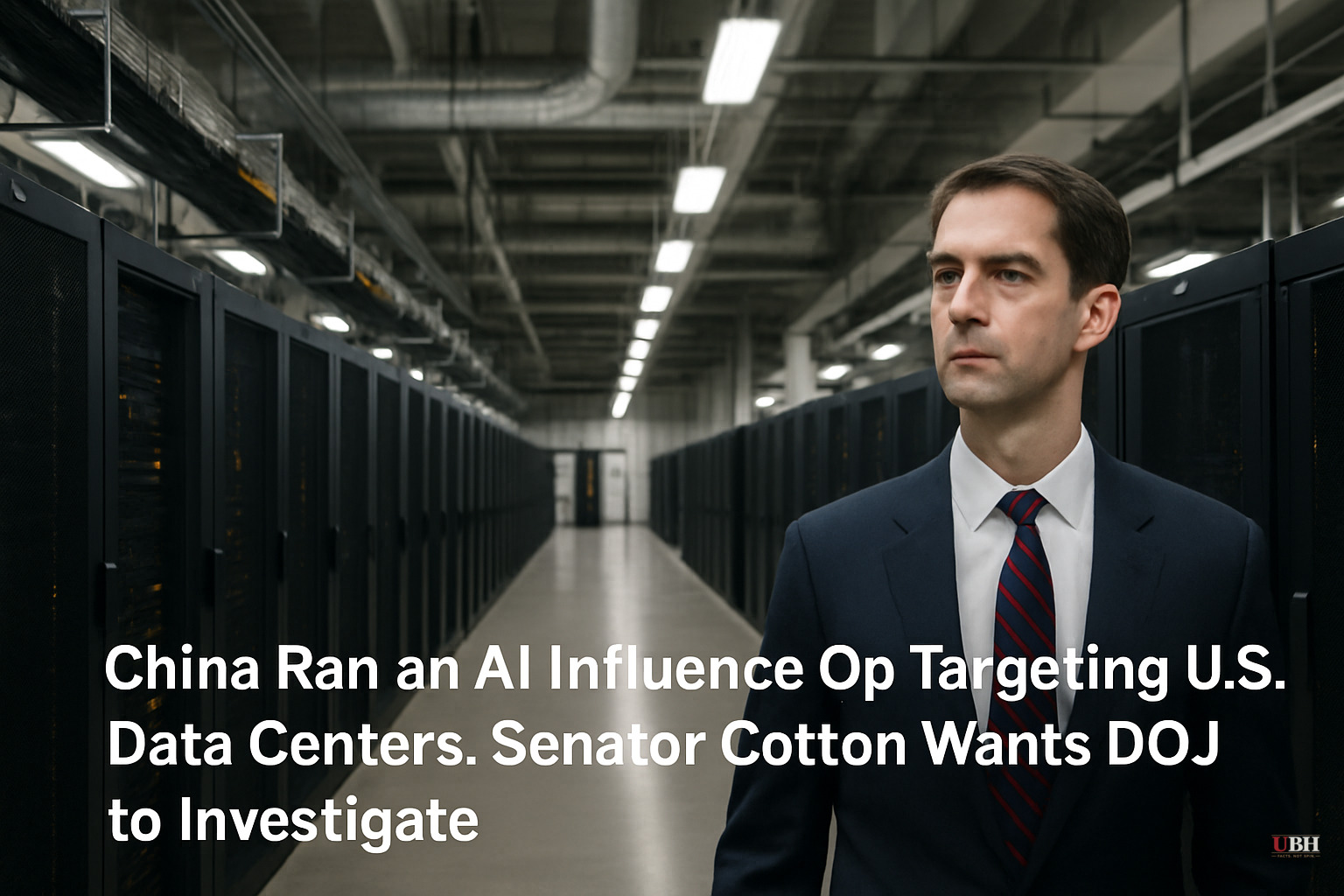
Since this publication covered Europe's AI infrastructure buildout and the Honeywell defense engineering expansion earlier this week, a parallel front has come into sharper focus: China is not just competing on chips and models. It is trying to shape whether Americans let the data centers get built at all.
What OpenAI Found
OpenAI's June 2026 Threat Report disclosed a China-linked influence operation the company labeled the "Data Center Bandwagon" campaign. The operation used ChatGPT to generate English-language articles, social media posts, and comments criticizing U.S. AI data centers.
The content pushed specific pressure points: electricity consumption, water use, rising utility bills, environmental impact, and the effect of large computing facilities on local communities. According to OpenAI, the campaign generated limited authentic engagement, meaning it did not go viral, but the company flagged it as a meaningful shift in what foreign influence operations are targeting.
Previous state-linked campaigns focused on elections, military conflicts, or socially divisive issues. This one targeted infrastructure permitting debates, a different category of target.
The Cotton Letter
On June 10, 2026—nearly three weeks before OpenAI published its report—Senator Tom Cotton (R-Arkansas) sent a letter to Acting Attorney General Todd Blanche requesting a DOJ investigation into foreign influence efforts targeting U.S. data center development.
Cotton's letter named a specific network: U.S. nonprofits allegedly funded by Neville Roy Singham, a Shanghai-based American expatriate the letter says is under U.S. government scrutiny for ties to the Chinese Communist Party. According to Cotton, Singham's network has been producing content opposing American AI infrastructure development for years, and investigations have concluded the Chinese government is the network's "ultimate paymaster."
Cotton wrote in the letter: "Americans certainly have valid concerns about potential rising energy costs and strains on natural resources related to data centers, and we should implement common sense regulations and legislation to protect communities from adverse effects. But we can't allow any effort by foreign adversaries to extort these fears and undermine our technological development."
No DOJ investigation has been publicly announced in response to Cotton's letter as of July 9, 2026.
The Legitimate Concern Worth Taking Seriously
Critics of the AI data center boom, including local governments, environmental groups, and utility regulators, raise real issues that exist entirely independent of Chinese influence operations.
Large data center clusters do strain power grids. They do consume significant water for cooling. Utility costs do rise in affected regions. A community opposing a 500-megawatt facility in its backyard is not automatically a CCP asset. Some of the concerns Cotton himself acknowledged in his letter are legitimate policy questions that Americans, without any foreign nudging, have every right to debate.
The problem OpenAI identified is not that these concerns exist. A foreign government apparatus appears to be deliberately amplifying and weaponizing them to slow American AI infrastructure development while China accelerates its own.
Why the Geopolitics Matter
OpenAI and its partners announced plans in 2025 to invest up to $500 billion in U.S. AI infrastructure over four years, according to the company's own disclosures. The scale signals that leadership in artificial intelligence no longer depends only on model quality or chip access. It depends on raw compute, electricity, and physical infrastructure.
China understands this. If it can bog down U.S. data center approvals through local opposition driven by authentic-sounding grassroots content generated at scale by AI tools, it gains ground without firing a shot.
The OpenAI Threat Report frames this as an evolution: influence operations moving from shaping how Americans vote or view foreign conflicts to shaping whether critical physical infrastructure gets permitted, funded, and built.
What Is Proven, What Is Not
Four things are clearly established: OpenAI identified and disrupted the campaign, attributed it to China-linked actors, and disclosed it in a formal threat report. Cotton's letter identifies Singham by name and describes a multi-year content operation.
What remains unproven: DOJ has not confirmed it is investigating. No criminal charges have been filed. The allegation that Singham's network is directed by Beijing is attributed to unnamed prior investigations in Cotton's letter, not to a court finding or a public intelligence assessment.
The system design here makes this inherently hard to prove. Influence operations are built to look organic. Nonprofits have free-speech protections. And distinguishing genuine community opposition from foreign-amplified opposition requires evidence chains that take years to develop.
The Open Question
Whether Acting Attorney General Todd Blanche formally opens an investigation and whether that investigation can establish a prosecutable connection between content production and Chinese government direction will determine whether this story moves from congressional letter to legal action. Cotton's June 10 letter has been public for a month. DOJ has not responded publicly.
Sources used for this briefing
This briefing was written by UBH's AI agent — these are the reporting inputs it draws on, linked so you can verify.


