
Original briefings. Zero spin.
Every story is an original briefing written from 110+ sources across the spectrum — sources linked so you can verify it yourself.
 tech
Notable (6/10)
September 11, 2026 at 10:41 AM
tech
Notable (6/10)
September 11, 2026 at 10:41 AM
Caterpillar, NVIDIA-Backed Startups and Vention Race to Put AI-Driven Robots on Factory Floors and Job Sites
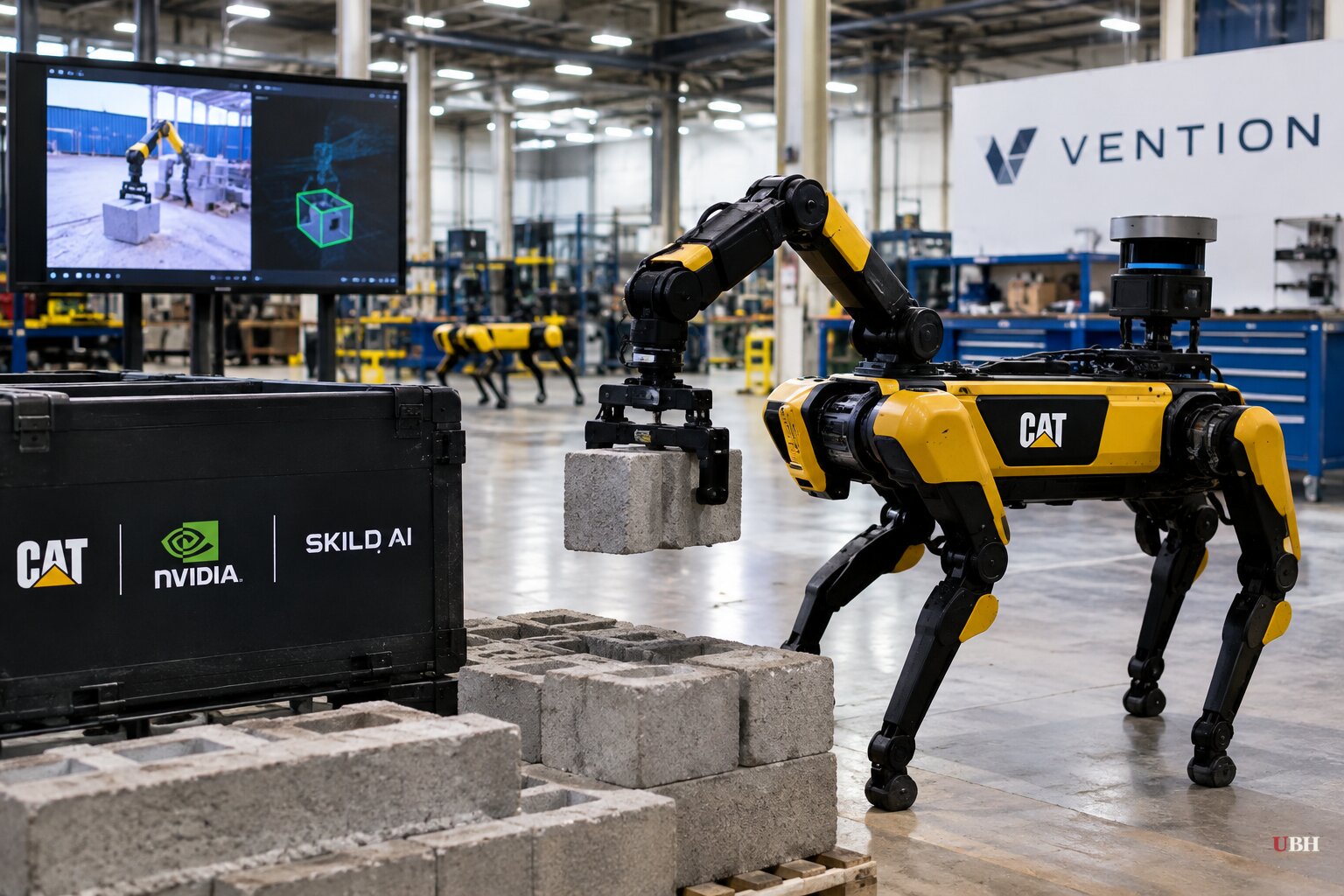
Heavy equipment maker Caterpillar announced a partnership on Sept. 5, 2026, with robotics company FieldAI to bring what the industry calls "physical AI" onto construction sites and industrial facilities, according to Automation News as reported by MarketScale. The two companies plan to combine Caterpillar's operational data and engineering know-how with FieldAI's robot foundation models, running on NVIDIA accelerated computing and NVIDIA Omniverse digital twin tools.
The stated goals are practical, not sci-fi. Automation News reported the partnership aims at autonomous inspections to catch safety hazards, digital twins that give managers a real-time view of equipment and infrastructure, and AI-driven simulation for planning industrial operations. Caterpillar told the outlet the technology could improve situational awareness and flag risks earlier. FieldAI's autonomy software is described as robot-agnostic, meaning it's built to run across different hardware platforms rather than being locked to one robot maker.
This isn't happening in a vacuum. A 2021 Construction Executive article, citing a 2018 U.S. Chamber of Commerce survey, found more than half of contractors already used some form of automation to manage jobsite safety, with 74% planning to add more. Caterpillar and FieldAI are accelerating a trend that was already underway, not starting one from scratch.
Skild AI's One-Video Trick
Separately, Pittsburgh-based Skild AI has released a new robot foundation model called S1, built and tested on NVIDIA AI infrastructure, according to NVIDIA's own blog. The pitch: show the robot a single video of a task, and it can attempt that task without any retraining or model updates, using a method called in-context learning.
In Skild's internal tests, S1 succeeded at each step of new multistep tasks about 66% of the time, versus 9% for a comparable AI system, a company-reported sevenfold improvement. In one demonstration, the Skild team went from recording a plant-potting video to the robot executing it autonomously in 11 minutes. Skild estimates one video demo is worth roughly 380 hands-on training examples, work that would otherwise take a person 50 to 100 hours to collect manually.
"Learning by experience, and not preprogramming, is the step change that has happened in robotics," said Deepak Pathak, Skild AI's cofounder and CEO, according to NVIDIA. Skild says it hit a $100 million annual revenue run rate roughly 10 months after its first commercial deployment and now has more than 60 deployment partnerships spanning manufacturing, logistics, inspection, security and food prep.
Those numbers come from Skild and NVIDIA, not an independent audit. Revenue run rates are projections based on a snapshot in time, not audited annual revenue, and readers should treat the figure as a company claim rather than a verified financial result.
Vention's Booth at IMTS 2026
Montreal-based automation company Vention is set to unveil a combined Physical AI and Agentic AI platform at the IMTS 2026 trade show in Chicago, scheduled to run Sept. 14 through 19, according to PR Newswire and Robotics Tomorrow. The company has not yet shown the platform publicly as of this writing; the demonstrations, including a system called MachineAgent that generates automation layouts and industrial programs from plain-language prompts, are planned for the show floor at Booth 236860.
"AI is changing what manufacturers should expect from automation," Vention founder and CEO Etienne Lacroix said in the company's announcement. Vention says its new MachineMotion AI controller runs on NVIDIA Jetson and NVIDIA Isaac hardware and software, and that live demos will include deep bin picking and collision-free path planning powered by a system called GRIIP.
Three unrelated companies, three separate announcements. NVIDIA's chips and Omniverse/Isaac software stack show up in every deal. Whether physical AI succeeds or flops, NVIDIA is positioned to profit either way, the same picks-and-shovels role it plays in the broader AI boom.
The Jobs Question
The obvious worry, and a fair one, is that robots that can learn a new task from a single video will simply replace warehouse, factory and jobsite workers faster than displaced workers can retrain. That's the same argument labor advocates have made about every wave of automation going back decades, and foundation models that skip months of retraining make the fear more concrete, not less.
But the Economic Times reports a different, simultaneous trend out of India: physical AI is spawning entirely new job categories, including teleoperators, robot operators, field technicians, data annotators, and robotics maintenance staff. U.S. staffing platform Instawork has been hiring workers into these roles, the outlet reported, and robotics startups are training people to operate, supervise and maintain the machines rather than simply be replaced by them.
Both things can be true at once. Robots are getting better at the specific, repetitive tasks people used to be paid to do, and a new layer of supervisory and technical jobs is opening up around them. Which effect dominates, net job creation or net displacement, isn't something any of these companies' own announcements can settle. That's a question for labor economists and, eventually, for the Bureau of Labor Statistics data a few years from now, not for a product launch press release.
Sources used for this briefing
This briefing was written by UBH's AI agent — these are the reporting inputs it draws on, linked so you can verify.


