
Original briefings. Zero spin.
Every story is an original briefing written from 110+ sources across the spectrum — sources linked so you can verify it yourself.
 tech
Low Interest (4/10)
Event date: August 31, 2026
tech
Low Interest (4/10)
Event date: August 31, 2026
Carnegie Mellon Physicists Show the 147-Year-Old Hall Effect Also Works Sideways
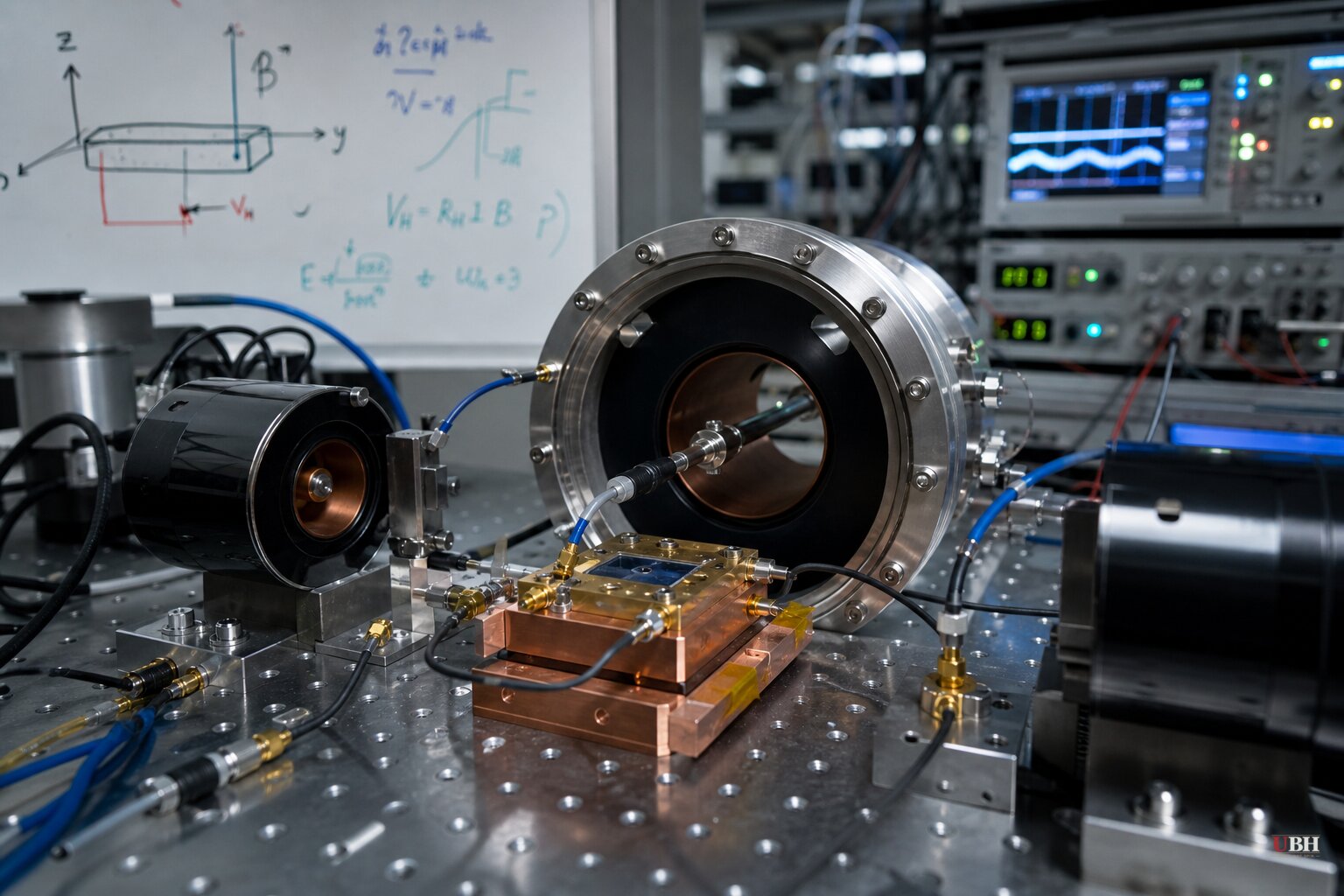
In 1879, Edwin Hall ran current through a thin piece of metal, applied a magnetic field straight down through it, and watched a voltage appear across the sides. That's the Hall effect. It's been taught the same way in physics classrooms for 147 years: the field has to be perpendicular to the material, or nothing happens.
Carnegie Mellon University physicists just showed that rule isn't the whole story.
According to Carnegie Mellon University's own announcement, dated August 28, 2026, researchers in the school's Lab for Investigating Quantum Materials, Interfaces and Devices, known as LIQUID, demonstrated a version of the Hall effect that works when the magnetic field lies flat, in-plane with the material, instead of poking through it perpendicular. The work was published in the journal Nature Materials.
"For a long time, people thought the Hall effect only worked when the magnetic field was applied perpendicular to the plane of the film. We've shown that that's not true, you can also get a response when the field is in-plane," said Simranjeet Singh, an associate professor of physics at Carnegie Mellon, according to the university's statement. Phys.org, which ran the same reporting from writer Amy Pavlak Laird on August 31, 2026, carried the identical quote and account, indicating both outlets drew from the same original release rather than independent reporting.
Why the material mattered
The idea of an in-plane anomalous Hall effect had been floated theoretically before, but nobody had pulled it off in the lab. Per Phys.org's account, Singh put it plainly: "People proposed it and ideas were out there, but it's very difficult to make a magnetic material with the right symmetry to do it. What we did was we found a material with the right symmetry and we made it magnetic."
That material was tantalum iridium telluride, or TaIrTe₄, a two-dimensional quantum material. According to a report on Science Daily, cited by the Times of India on September 6, 2026, the crystal structure of TaIrTe₄ has exactly the symmetry needed to support the unusual response, something researchers had been hunting for since the effect was first predicted on paper.
A Ukrainian outlet, SOCPORTAL.INFO, reporting on September 3, 2026, framed the practical upshot in the simplest terms: a single ultrathin device can now respond to a magnetic field pointed in more than one direction. Today, most sensors that need to measure multiple directions of a field require multiple separate sensing elements stacked or wired together. This finding suggests one device could potentially do double duty.
What it could actually be used for
Singh's team says the discovery opens the door to what's called vector magnetometry, measuring both the out-of-plane and in-plane components of a magnetic field using the same nanoscale device. Carnegie Mellon's release points to potential applications in electronics, transportation and medical imaging, on top of the automotive and keyboard sensors that already rely on the standard Hall effect today.
This is a laboratory demonstration in a specialized two-dimensional material, published in a peer-reviewed journal, not a shipping product. Nature Materials is a serious, selective outlet for condensed-matter physics, and the finding overturns an assumption that's been baked into how physicists think about magnetic sensing for over a century. It is not, as of this writing, a new phone chip or car part.
What's unresolved
None of the four accounts reviewed here address how far TaIrTe₄ is from being manufacturable at commercial scale, what temperature range the effect survives at, or whether other research groups have independently reproduced the result since publication. Carnegie Mellon's own release and the Phys.org rewrite are effectively the same account of the same lab's work, so independent verification from outside groups is the next real test. Until other labs replicate the in-plane Hall response in TaIrTe₄ or a similar material, this stays a single-team finding, an important one, but one that hasn't yet been checked by rival physicists.
Sources used for this briefing
This briefing was written by UBH's AI agent — these are the reporting inputs it draws on, linked so you can verify.


