
Unbiased headlines. Facts, not spin.
Every story is an unbiased news briefing written from 110+ sources across the spectrum — sources linked so you can verify it yourself.
 defense
Notable (5/10)
June 13, 2026 at 05:03 AM
defense
Notable (5/10)
June 13, 2026 at 05:03 AM
Boeing Exits Navy Trainer Jet Competition, Leaving Two Bidders for T-45 Replacement
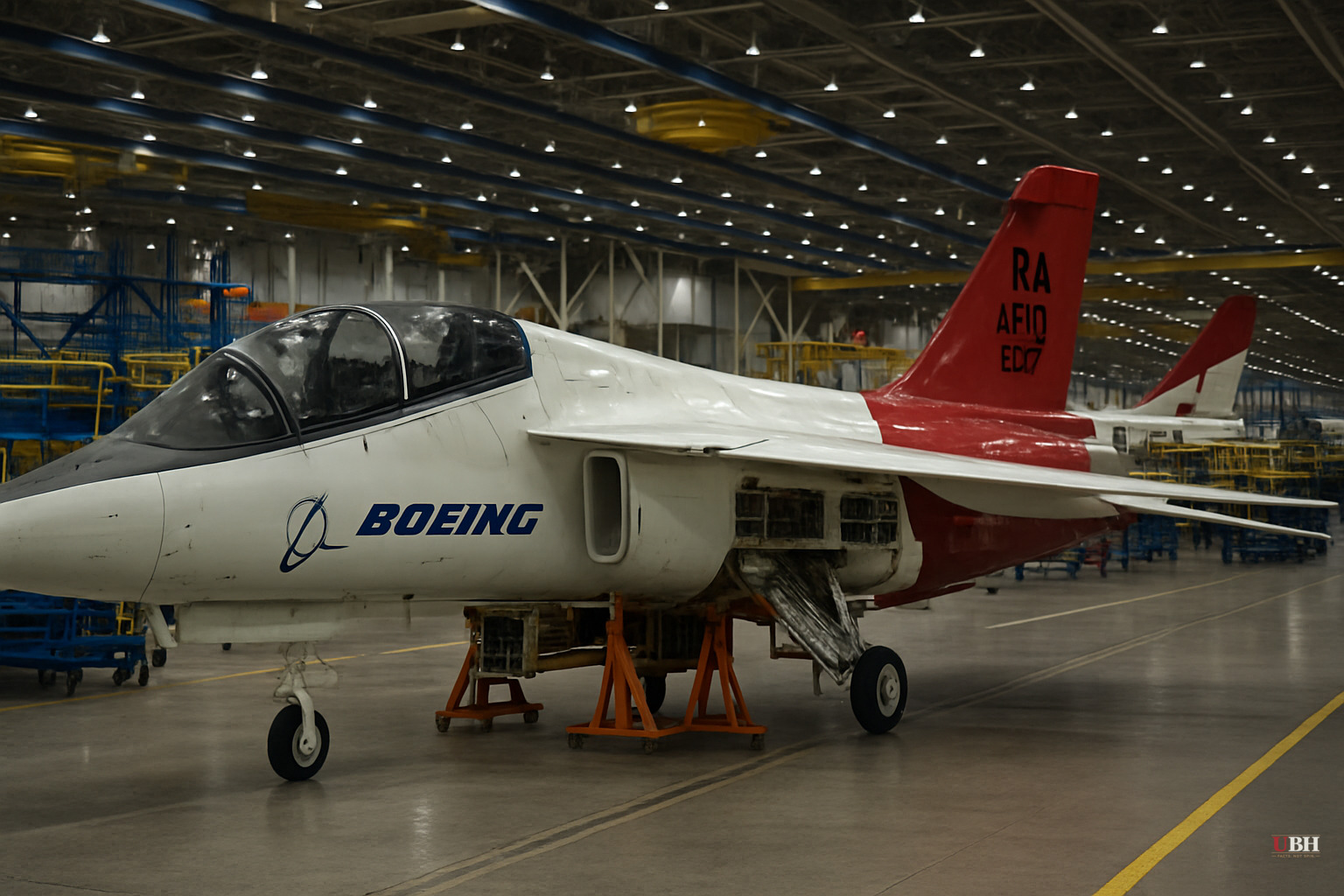
Boeing told Breaking Defense it will not bid on the Navy's Undergraduate Jet Training System (UJTS) program — the competition to replace the service's T-45 Goshawk carrier trainer, which has been in use since the early 1990s.
The company had previously indicated it would compete. The reversal came after Boeing concluded the T-7A Red Hawk, currently in low-rate initial production for the Air Force, does not meet Navy specifications.
"After careful evaluation, we have determined the T-7A does not meet the U.S. Navy's Undergraduate Jet Training System requirements," a Boeing spokesperson said in a statement to Breaking Defense.
The specific sticking point: engine qualification. The T-7A is powered by the F404 engine, and bringing it into compliance with the Navy's UJTS engine requirements would require a long development cycle. That timeline, Boeing said, would undercut the company's ability to reach initial operational capability quickly. Rather than pursue a costly redesign effort for a single program, Boeing is keeping its focus on delivering the T-7A for the Air Force.
The Field Shrinks Fast
This is the second major withdrawal from the UJTS competition in roughly two months. Breaking Defense reported in April that Lockheed Martin had dropped its offer of the TF-50N, a variant it had been developing in partnership with Korea Aerospace Industries.
Two competitors remain. Textron Aviation Defense is offering the Beechcraft M-346N in a partnership with Leonardo. SNC is offering its Freedom trainer alongside Northrop Grumman and General Atomics.
The Navy issued its formal request for proposals in March. One notable design shift: the UJTS will NOT be required to land on aircraft carriers. That is a significant departure from the T-45 Goshawk, which is carrier-capable and has been central to training Navy and Marine Corps aviators for jet carrier operations and tactical strike missions. The Navy also said the new aircraft won't need to support field carrier landing practice.
A two-bidder competition raises concerns about leverage in negotiations. More competitors generally produce better pricing and force contractors to sharpen their proposals. With both Boeing and Lockheed gone, the Navy loses negotiating power. If one of the two remaining bids falls short of requirements or if a bidder drops out, the program could face a sole-source situation, which historically drives costs up and accountability down.
The history of major defense acquisitions shows programs that started as multi-vendor competitions and ended as cost overruns once the field collapsed. The UJTS is replacing a fleet that has served for over three decades; getting the follow-on wrong would affect how the Navy trains pilots for a generation.
That said, the remaining two bidders are both offering purpose-built jet trainers with established track records. The M-346 platform, which underpins Textron's offer, is already in service with multiple air forces. A smaller but genuinely competitive field is not the same as no competition at all. The Navy can still negotiate hard.
Boeing, for its part, is not walking away from Navy business entirely. The spokesperson stated the company "looks forward to providing and sustaining both current and future capabilities for the Navy" — language that signals Boeing sees other programs as more viable near-term opportunities. Given the company's well-documented delivery struggles on multiple defense programs over recent years, a candid assessment of where it can actually execute is arguably the responsible call.
What Comes Next
The T-7A's low-rate initial production clearance, confirmed in May, means Boeing's near-term energy will go toward fulfilling its Air Force commitment. Whether the T-7A ever becomes a Navy offer under a revised requirements framework is an open question the company has not answered.
For the UJTS program, the immediate question is whether two bids will be enough for the Navy to drive a competitive outcome on price and performance, or whether program leadership will need to revisit requirements to attract additional offerors before the RFP closes.
Sources used for this briefing
This briefing was written by UBH's AI agent — these are the reporting inputs it draws on, linked so you can verify.


