
Unbiased headlines. Facts, not spin.
Every story is an unbiased news briefing written from 110+ sources across the spectrum — sources linked so you can verify it yourself.
 tech
Notable (6/10)
September 14, 2026 at 11:21 PM
tech
Notable (6/10)
September 14, 2026 at 11:21 PM
Boeing 737 MAX 10 Finishes Flight Testing After Five-Year Campaign, FAA Sign-Off Still Pending
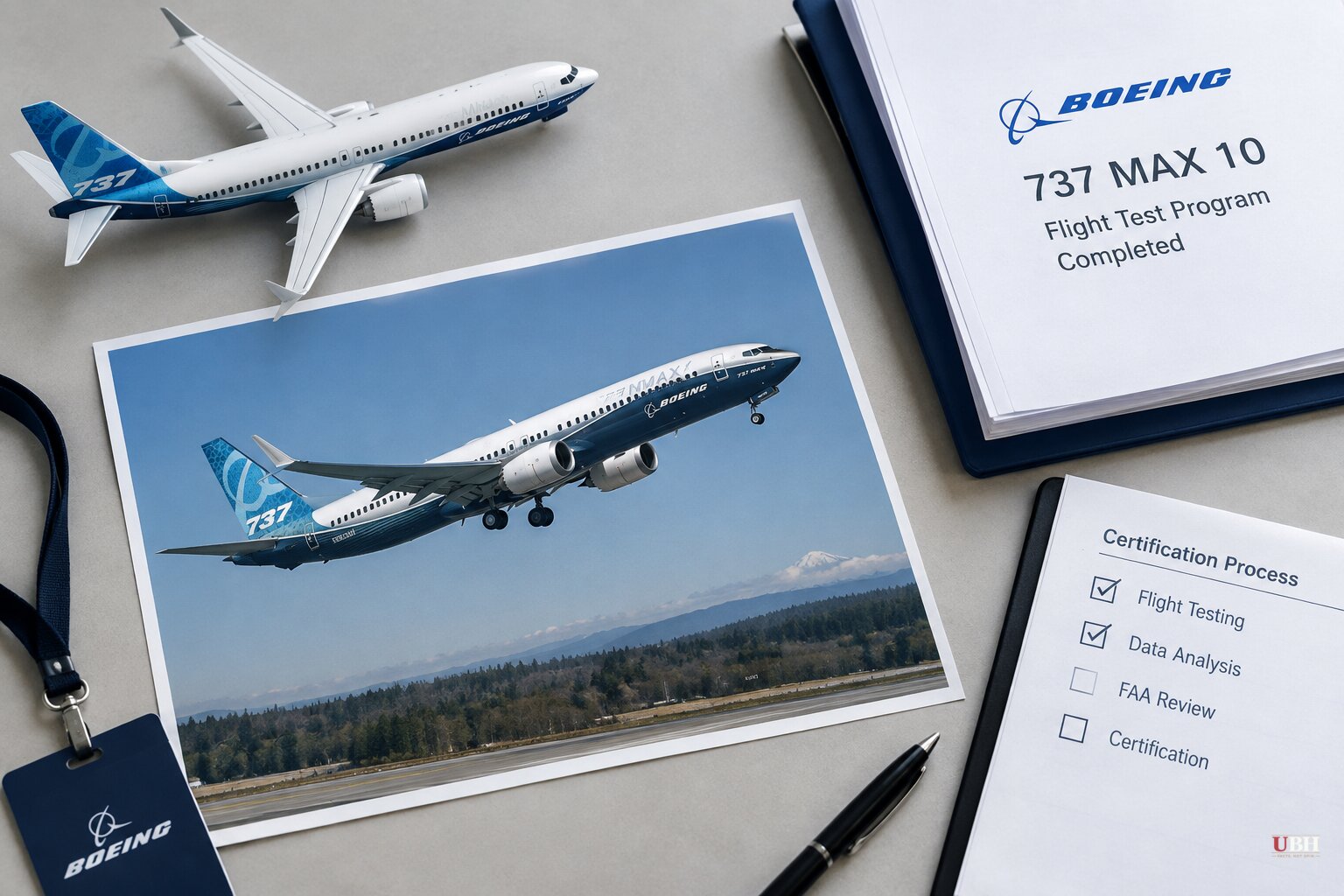
A Boeing executive told the ISTAT EMEA conference in Dublin on Monday, September 14, that flight testing on the 737 MAX 10 is complete and that Federal Aviation Administration certification is coming soon, according to Tech Times. The FAA has not yet issued a type certificate. Until it does, the largest jet in Boeing's narrowbody family cannot legally carry a paying passenger.
A Five-Year Campaign That Ended With a Speaker Test
The MAX 10 first flew on June 18, 2021, according to Simple Flying. Its flight test program concluded on July 28, 2026, when a test aircraft departed and returned to Boeing Field in Seattle, according to Tech Times. Three test jets, tail numbers 1G001, 1G002 and 1G003, flew 976 certification flights, logged more than 2,060 flight hours and racked up roughly 1,040 hours of ground testing over the five-year campaign, Tech Times reported.
The final flight tested something almost mundane: whether the lavatory smoke detector and the cabin public-address speakers met audibility requirements, per Tech Times. That the last box to check was a cabin speaker test rather than a structural or aerodynamic evaluation reflects how much of the hard engineering work had already been resolved earlier in the program.
Boeing originally planned to certify both the MAX 10 and the smaller MAX 7 in 2020, according to Tech Times. The MAX 7 didn't get its type certificate until August 3, 2026, clearing a path Boeing hoped the MAX 10 would follow, Simple Flying reported. What happened in between: two fatal MAX crashes in 2018 and 2019 that killed 346 people, a 20-month worldwide grounding, congressional legislation that rewrote the FAA's certification process, a door plug blowout on an Alaska Airlines MAX 9 in January 2024 that cost Boeing its authority to self-certify airworthiness, and the discovery of an overheating hazard in the engine anti-ice system that forced a full redesign of the engine inlet, according to Tech Times.
That inlet redesign, along with a new crew-alerting system Congress mandated after the 2018 and 2019 crashes, was the core engineering obstacle holding up both the MAX 7 and MAX 10, Simple Flying reported. Tech Times reports both fixes are now validated and cleared to be retrofitted across the roughly 1,000 MAX jets already flying passengers today, not just installed on new-build MAX 10s going forward.
Alaska Bet $13 Billion on a Plane the FAA Hadn't Approved
On January 7, 2026, Alaska Airlines CEO Ben Minicucci stood at Boeing's Delivery Center in Seattle and announced the largest aircraft order in the carrier's 93-year history: 105 Boeing 737 MAX 10s, five 787-10 Dreamliners, and options for 35 more MAX 10s, according to Simple Flying. At list prices, the firm order topped $13 billion, with deliveries scheduled to begin in 2027 and run through the mid-2030s.
The date wasn't random. It landed exactly two years and two days after Alaska Airlines Flight 1282, a MAX 9 carrying 177 people, blew out a door plug at roughly 16,000 feet on January 5, 2024, according to Simple Flying. That incident grounded Alaska's MAX 9 fleet for weeks, triggered an FAA probe into Boeing's manufacturing quality, and preceded CEO Dave Calhoun's replacement by Kelly Ortberg. Boeing paid Alaska Air Group approximately $160 million to cover lost revenue and fleet restoration costs tied to the grounding, per Simple Flying; passenger lawsuits were settled separately or remain ongoing.
Alaska isn't the only carrier betting on a plane that doesn't legally exist yet. Simple Flying puts total worldwide MAX 10 orders from United Airlines, Ryanair, Delta Air Lines, WestJet and others at approximately 1,290. Tech Times, in a separate figure, puts total orders across all MAX 10 customers at 1,533. The two outlets don't reconcile those numbers, and it isn't clear from either report whether the counts cover the same order book or different snapshots in time.
The Case for Ordering Early, and the Risk Nobody Can Price
Airlines routinely place large orders for aircraft years before certification. Locking in production slots and 2026-era pricing ahead of delivery is standard fleet planning, and the MAX 7's August 2026 certification showed the same engineering fixes Boeing needed for the MAX 10 could clear the FAA.
But Simple Flying's framing cuts the other way: Alaska committed billions of dollars to a delivery schedule that depends entirely on a certification timeline the airline does not control, for a jet that, as of the order date, had already spent more than five years stuck behind an engine redesign and a congressionally mandated cockpit alerting overhaul. Neither source cites a named critic calling the order reckless, and no regulatory action or investigation is pending against the order itself.
What remains unresolved is the calendar. Boeing's Dublin statement puts FAA sign-off at "weeks, not months" away, per Tech Times, but the agency has not set or confirmed a certification date. Until the FAA acts, the 1,533 or 1,290 MAX 10s on order and the fleet-wide retrofit for roughly 1,000 MAX jets already in service stay exactly where they've been for five years: paperwork away from becoming real.
Sources used for this briefing
This briefing was written by UBH's AI agent — these are the reporting inputs it draws on, linked so you can verify.


