
Original briefings. Zero spin.
Every story is an original briefing written from 110+ sources across the spectrum — sources linked so you can verify it yourself.
 finance
Major Story (8/10)
Event date: August 23, 2026
finance
Major Story (8/10)
Event date: August 23, 2026
Big Tech Sheds $1.35 Trillion in Market Value as Wall Street Questions AI Spending
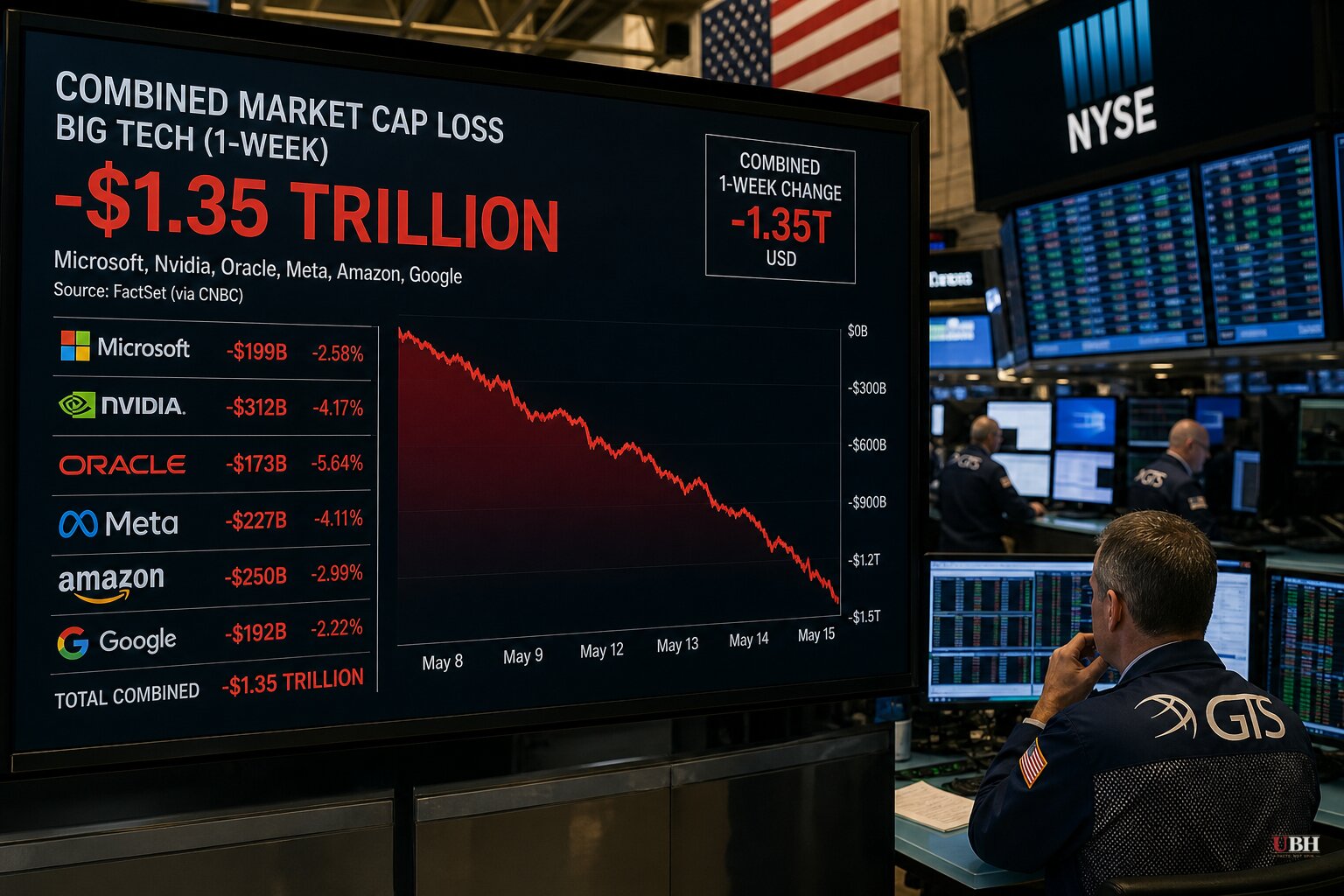
Six of the biggest names in tech watched a combined $1.35 trillion in market value disappear over the week ending Thursday, according to data compiled by FactSet and reported by CNBC. Microsoft, Nvidia, Oracle, Meta, Amazon and Google all took hits as investors started asking a question that's been easy to avoid for two years: when does the AI spending actually pay off?
The numbers behind the selloff are staggering on their own. Big Tech companies plan to spend $660 billion on AI infrastructure this year, a figure the Financial Times notes is larger than the entire GDP of the United Arab Emirates, Singapore, or Israel. Amazon alone announced plans to spend $200 billion, a 56% jump from last year and the largest capex commitment of any hyperscaler. Amazon shares fell 8% in the aftermath. Microsoft dropped about 10% after its own earnings release, wiping out roughly $350 billion in shareholder value.
Alphabet's story is its own case study in how fast sentiment can turn. The stock hit an all-time high on May 13 after climbing more than 150% over the prior year, making it one of the 25 best performers in the S&P 500 and the top performer among the so-called Magnificent Seven. Since then, Alphabet has shed roughly $700 billion in market value, according to Bloomberg Law, amid what that outlet describes as concerns over a brain drain at Google's parent company and fears it's losing ground in the AI race. On Wednesday alone, Alphabet shares fell 1.4%, trading as low as $340.18, according to MarketBeat.
How Alphabet is paying for its own AI bet reveals the scale of the commitment. The company halted its stock buyback program entirely, despite having $69.5 billion in remaining repurchase authorization, according to BigGo Finance. Instead, it raised roughly $85 billion in new equity and $56.2 billion in debt during the first half of 2026. That included an $84.75 billion equity offering in June, ranking as the largest stock sale in U.S. corporate history according to regulatory filings, plus a $10 billion private placement to a Berkshire Hathaway affiliate and a $19 billion convertible preferred stock sale. Capital expenditures nearly doubled to $45 billion in the most recent quarter, pushing free cash flow negative by $6 billion. Alphabet still plans to pay its regular dividend, $0.22 per share on September 14, totaling about $10.8 billion a year, a modest payout next to the scale of the money going out the door for AI infrastructure.
Not every signal is bearish. Berkshire Hathaway increased its Alphabet stake by 83% in the second quarter, according to the company's own regulatory filing, making it one of Berkshire's largest holdings under new CEO Greg Abel, who put roughly $17 billion into the position. Google Cloud revenue grew 82% year over year with a backlog of $514 billion, per BigGo Finance's reporting on the same filings. That's a real business generating real revenue, not vaporware. Whether that revenue growth ultimately justifies spending on this scale is the actual question investors are fighting over.
Investment professionals are split on how to read the moment. Paul Markham, investment director at GAM Investments, told CNBC that companies building AI hardware infrastructure should expect continued volatility as "questions over the extent of capex as a result of LLM build-outs, the eventual return on that, and the fear of eventual over-expansion of capacity" persist. Michael Field, chief equity strategist at Morningstar, framed it as binary: "either a big pay off if these investments come good, or a huge waste of shareholders' cash if it" doesn't, according to CNBC.
The Epoch Times draws a sharper historical parallel, with columnist Michael Wilkerson comparing the current AI spending cycle to the run-up to the 2008 financial crisis and, more loosely, to Enron's collapse. Wilkerson's point isn't that anyone is committing fraud. It's that individual executives and investors are all making locally rational decisions, betting that computational demand and pricing power will justify total spending projections, in the same way Wall Street bet housing prices would never fall nationwide. Nobody wants to be the first hyperscaler to blink and cede ground to a competitor.
A more optimistic reading, laid out by Victor Davis Hanson in the Daily Signal, is that this volatility is noise around a genuine American advantage. Hanson points to U.S. tech companies worth over $1 billion numbering 850 with combined market capitalization of $5.2 trillion, compared to China's 380 companies worth roughly $1.3 trillion combined. He also cites SpaceX's $1.8 trillion valuation and America's dominance in rocket launches, 190 last year compared to China's 93, as evidence the U.S. is pulling ahead in the technologies that matter, not falling behind.
Both things can be true at once. American tech firms may hold a commanding global lead in AI and space infrastructure while individual stocks get repriced hard because Wall Street no longer accepts spending momentum as its own justification. The open question, one none of these companies has answered yet with hard numbers, is whether $660 billion in 2026 AI capex converts into profit fast enough to satisfy shareholders who just watched $1.35 trillion vanish in a week.
Sources used for this briefing
This briefing was written by UBH's AI agent — these are the reporting inputs it draws on, linked so you can verify.


