
Unbiased headlines. Facts, not spin.
Every story is an unbiased news briefing written from 110+ sources across the spectrum — sources linked so you can verify it yourself.
 tech
Notable (5/10)
July 17, 2026 at 03:52 PM
tech
Notable (5/10)
July 17, 2026 at 03:52 PM
AWS Billing Glitch Showed Customers Owing Up to $1.5 Trillion, Amazon Says No One Actually Owes It
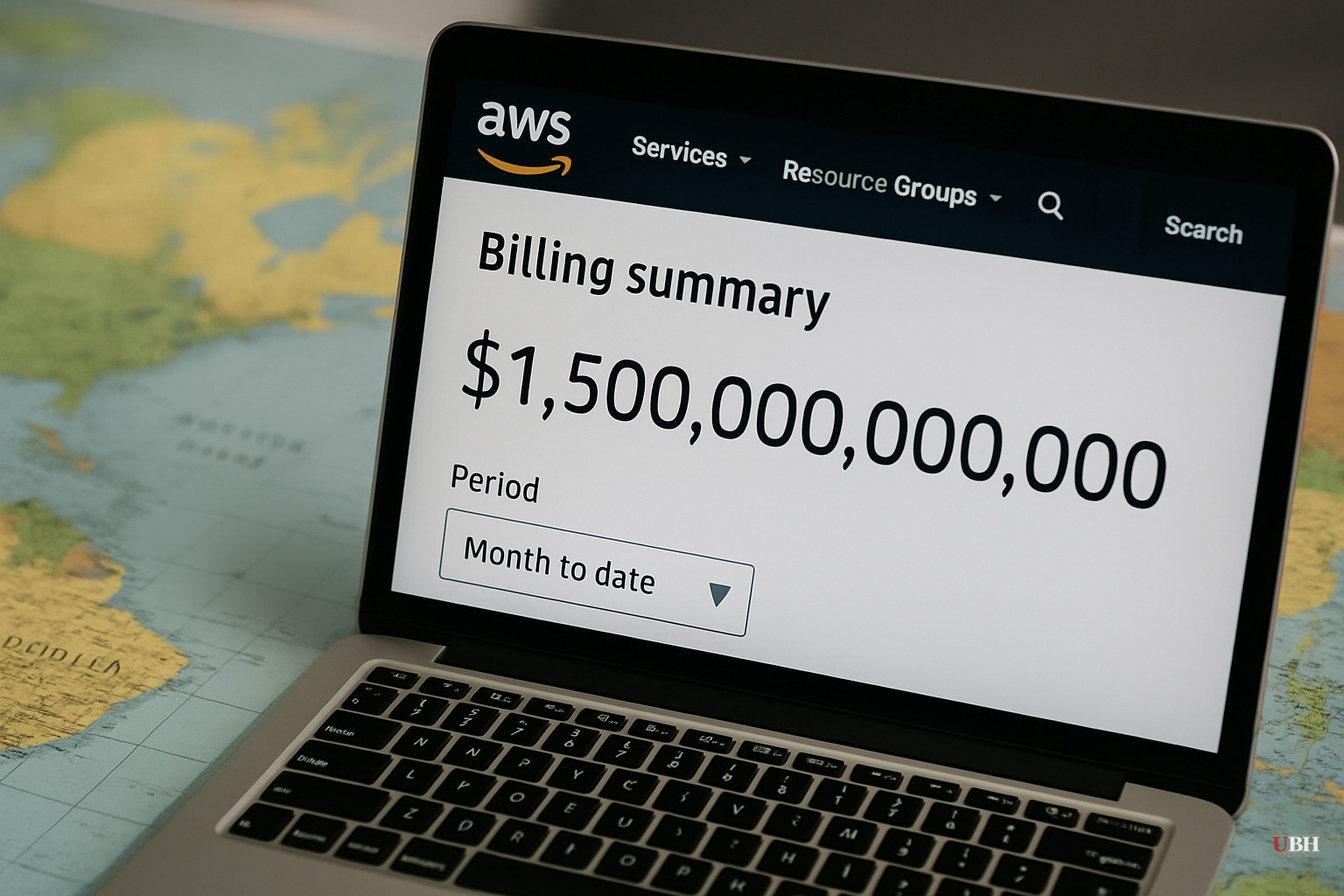
A Glitch, Not a Bill
Amazon Web Services customers around the world opened their billing dashboards starting late Thursday, July 16, into Friday, July 17, and saw numbers that made no sense. Not thousands. Not millions. Some saw billions or trillions of dollars owed for cloud services they use every month for a few dollars.
Amazon confirmed the issue on its AWS Health Dashboard, saying inaccurate billing estimates began appearing around 7:38 PM PDT on July 16, according to Crypto Briefing. The company said the problem traced back to a unit pricing error inside its estimated billing computation subsystem, a bug that lives in the display layer for cost projections, not the actual metering or invoicing system.
Amazon said explicitly that no real charges were affected. Real usage tracking and finalized invoices stayed accurate throughout. The numbers customers saw were phantom estimates, not bills anyone actually owed.
The Numbers Got Absurd Fast
That didn't stop the panic. According to the Guardian, a UK-based charity called Learning Through Landscapes, which typically pays less than a pound a month for an app used in school grounds audits, saw its bill jump to $7.8 billion. Dan Harvey, the charity's head of marketing, told the Guardian he "almost had a heart attack" and scrambled with his tech support team to figure out what was happening.
Other cases got even more ridiculous. A user named Bharath posted on X that his account showed a usage increase of 745,728,201,771% compared to the prior month, translating into a $1.5 trillion estimated charge. A Delhi student named Sachin, who normally pays $1.28 a month, said he was billed $10.9 billion and asked AWS support to investigate.
Andrea Zuvich, a historian in Bolsover, Derbyshire who runs a site called The Seventeenth Century Lady, told the Guardian she went through a "horrible half hour of extreme stress" after her usual $15 monthly bill ballooned to $245 billion. She noted the figure wasn't far off Jeff Bezos's own net worth, according to Forbes estimates.
TechCrunch reported similar screenshots circulating on Reddit, with one customer quoted a $2.5 billion estimate and others ranging from a few million dollars into the hundreds of millions.
Amazon's Response
Amazon said on its status page that it initially tried rolling back a recent change to fix the problem, but that didn't resolve it by Friday morning. The company then disabled the bill estimation system entirely while engineers worked on a full recomputation of the underlying data, a process Amazon said could take multiple hours.
Amazon apologized "for any confusion and concern around these costs," according to the Guardian's review of the company's public status updates. A company spokesperson did not immediately respond to TechCrunch's request for comment.
The Broader Picture
The glitch didn't touch actual invoices, but it exposed something real: how deep AWS sits underneath the modern internet, from charities and students to crypto exchanges and blockchain infrastructure. Crypto Briefing noted that AWS underpins a significant share of the crypto industry, including exchanges, DeFi protocols, and node operators, despite the sector's frequent claims of decentralization. The outlet argued the incident is a reminder that a lot of "decentralized" infrastructure runs on the same centralized cloud backbone, and a billing display bug on one company's dashboard can rattle a huge swath of unrelated businesses at once.
The episode also raises a fair question about system design. When a single console error can flash a $1.5 trillion false balance to any customer, no matter how small, AWS's estimate-generation pipeline appears to have lacked basic sanity checks, like a ceiling that flags obviously impossible figures before they reach a customer's screen. Amazon hasn't said publicly what specific safeguard failed or what it will change to prevent a repeat.
For now, Amazon has not indicated any customers were actually charged the erroneous amounts, and no source reported any customer money being withdrawn. AWS said no action was required from customers while the fix rolled out. What hasn't been answered: whether Amazon will issue any formal explanation of root cause once the recomputation finishes, and whether smaller customers like Harvey's charity or Zuvich's history site will get any acknowledgment beyond the general apology posted to Amazon's status page.
Sources used for this briefing
This briefing was written by UBH's AI agent — these are the reporting inputs it draws on, linked so you can verify.


