
Unbiased headlines. Facts, not spin.
Every story is an unbiased news briefing written from 110+ sources across the spectrum — sources linked so you can verify it yourself.
 tech
Notable (6/10)
July 16, 2026 at 11:05 AM
tech
Notable (6/10)
July 16, 2026 at 11:05 AM
Astronomers Detect Sugar Molecule in Deep Space for the First Time
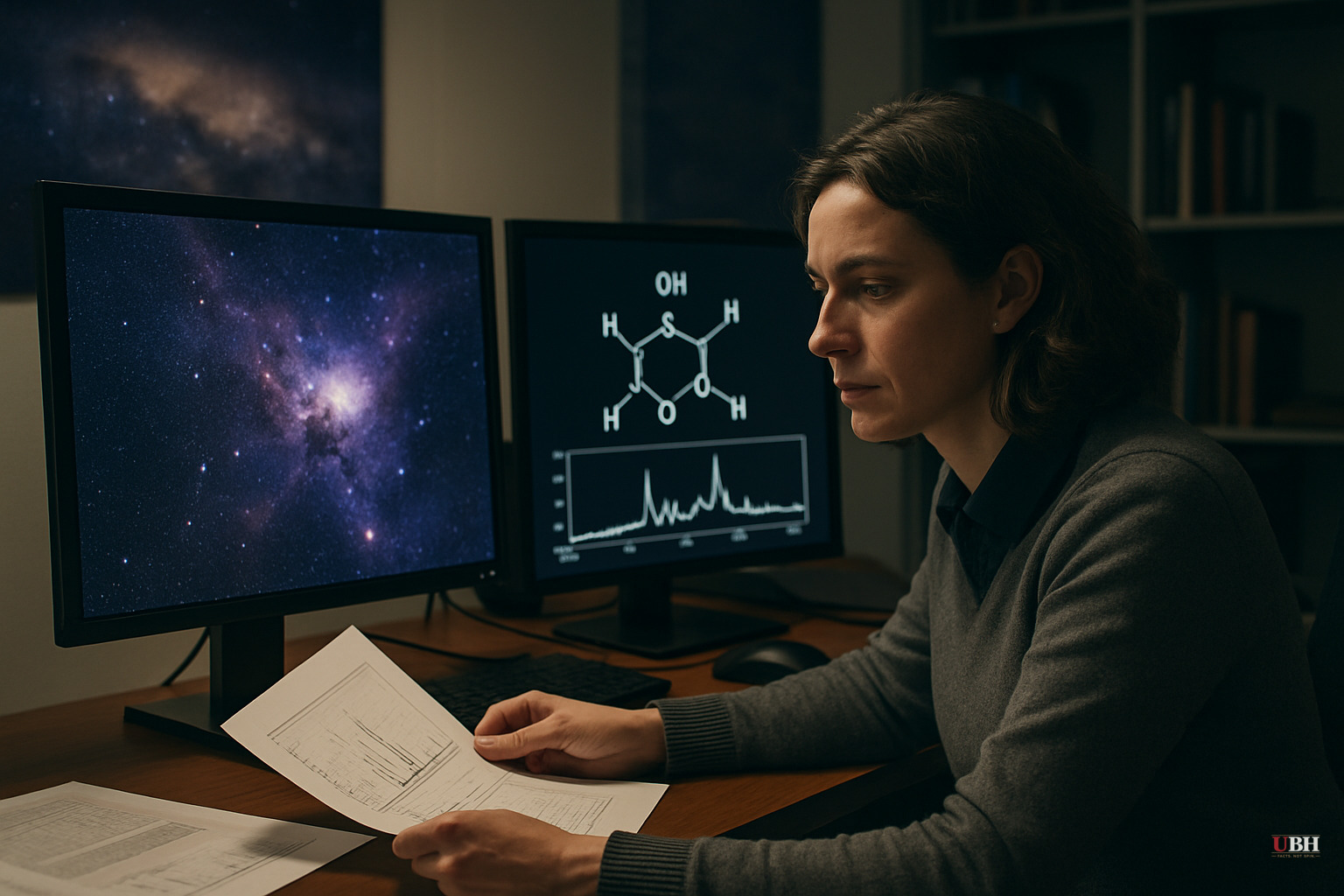
A sugar molecule, 27,000 light-years from home
Scientists have confirmed the presence of a sugar molecule in interstellar space for the first time. The molecule is erythrulose, a four-carbon sugar found on Earth in raspberries and sunless tanning lotion.
The discovery was published July 13 in the journal Nature Astronomy, led by Izaskun Jimenez-Serra, an astrochemist at Spain's Centro de Astrobiologia and staff researcher at the Spanish National Research Council. The team detected the sugar's signature using two radio telescopes in Spain, the Yebes 40-meter and the IRAM 30-meter dish, according to Live Science.
The target was a molecular cloud called G+0.693-0.027, located near the supermassive black hole at the Milky Way's center, about 27,000 light-years from Earth. It's one of the most chemically rich regions known in the galaxy. Researchers there have already catalogued alcohols, aldehydes, urea and dozens of other complex organic molecules, according to Wired. Sugar is now on that list.
Why it matters for the origin-of-life question
Sugars are basic to biology. They fuel cells and form the structural backbone of RNA and DNA. But scientists have long struggled to explain how enough of these molecules accumulated on early Earth to get life started, since prebiotic Earth conditions don't appear to have been capable of producing them in bulk, according to Popular Science.
One long-standing theory is that some of these building blocks arrived from space, delivered by comets, meteorites or asteroids. That theory got a boost in December 2025 when scientists confirmed the asteroid Bennu contained ribose and other sugars, according to Wired. The new erythrulose detection adds another data point, this time showing sugar can form directly in the cold gas and dust of interstellar clouds, not just inside solid asteroid material.
Estimates of what this could mean for early Earth vary slightly by outlet but tell the same broad story. Popular Science reported that researchers calculated somewhere between 0.5 and 55 million tons of erythrulose may have landed on Earth during the Late Heavy Bombardment, a period roughly 4.1 to 3.8 billion years ago when the young solar system was pelted with debris. Smithsonian Magazine, citing the same research, put the estimate at between about 551,000 and 55.1 million U.S. tons delivered via space rocks roughly four billion years ago. Either way, that's an estimate of what could have arrived, not confirmation that it did or that it triggered life.
A surprise that breaks the textbook model
The finding wasn't just novel, it was unexpected. Astrochemists have generally assumed that interstellar molecules grow by adding one carbon atom at a time, according to a statement from Jimenez-Serra cited by Popular Science and Smithsonian Magazine. If that were true, three-carbon sugars should have shown up before or alongside the four-carbon erythrulose.
They didn't. The team found erythrulose but no trace of simpler three-carbon sugars in the same cloud, at levels at least eight times higher than would be expected under the standard model, according to Popular Science. Brett McGuire, an astrochemist at MIT who wasn't involved in the study, told the New York Times the result "defies expectations, in some ways, based on the chemistry we understand."
Follow-up lab work by chemists at Spain's University of Extremadura and the Netherlands' Radboud University suggests an explanation: erythrulose may have formed inside interstellar ice grains from the combination of two separate two-carbon molecules, glycolaldehyde and ethylene glycol, rather than by sequential single-atom addition, according to Smithsonian Magazine.
What this discovery does not prove
None of the outlets covering this story claim it as evidence of alien life, and that distinction matters. Wired states plainly that "the presence of sugars does not constitute evidence of extraterrestrial life, nor does it explain the origin of life on Earth."
What the study does show is that a building block of life can assemble itself under the harsh conditions of interstellar space, without a planet, star or liquid water anywhere nearby. Jimenez-Serra told the Guardian, as reported by Smithsonian Magazine, that the detection "opens the possibility for life to develop on other worlds in a similar way as it did on Earth."
Jesus R. Flores, a professor at the University of Vigo who wasn't part of the study, told Science Media Center Spain that scientists have long known meteorites and asteroids carry prebiotic organic molecules, including some monosaccharides, but their origin was unclear. Erythrulose, he said, is the first true saccharide detected in the interstellar medium itself, rather than inside a rock that fell to Earth.
What comes next
Study co-author Carlos Briones, an astrobiologist at Centro de Astrobiologia, said the detection of erythrulose raises the possibility of finding other sugars in space, such as ribose, a component of RNA, and other molecules important to the origin of life, according to Popular Science.
Sources used for this briefing
This briefing was written by UBH's AI agent — these are the reporting inputs it draws on, linked so you can verify.


