
Unbiased headlines. Facts, not spin.
Every story is an unbiased news briefing written from 110+ sources across the spectrum — sources linked so you can verify it yourself.
 tech
Notable (5/10)
July 16, 2026 at 07:30 PM
tech
Notable (5/10)
July 16, 2026 at 07:30 PM
Astronomers Detect Helium Escaping a Rocky Exoplanet 50 Light-Years Away
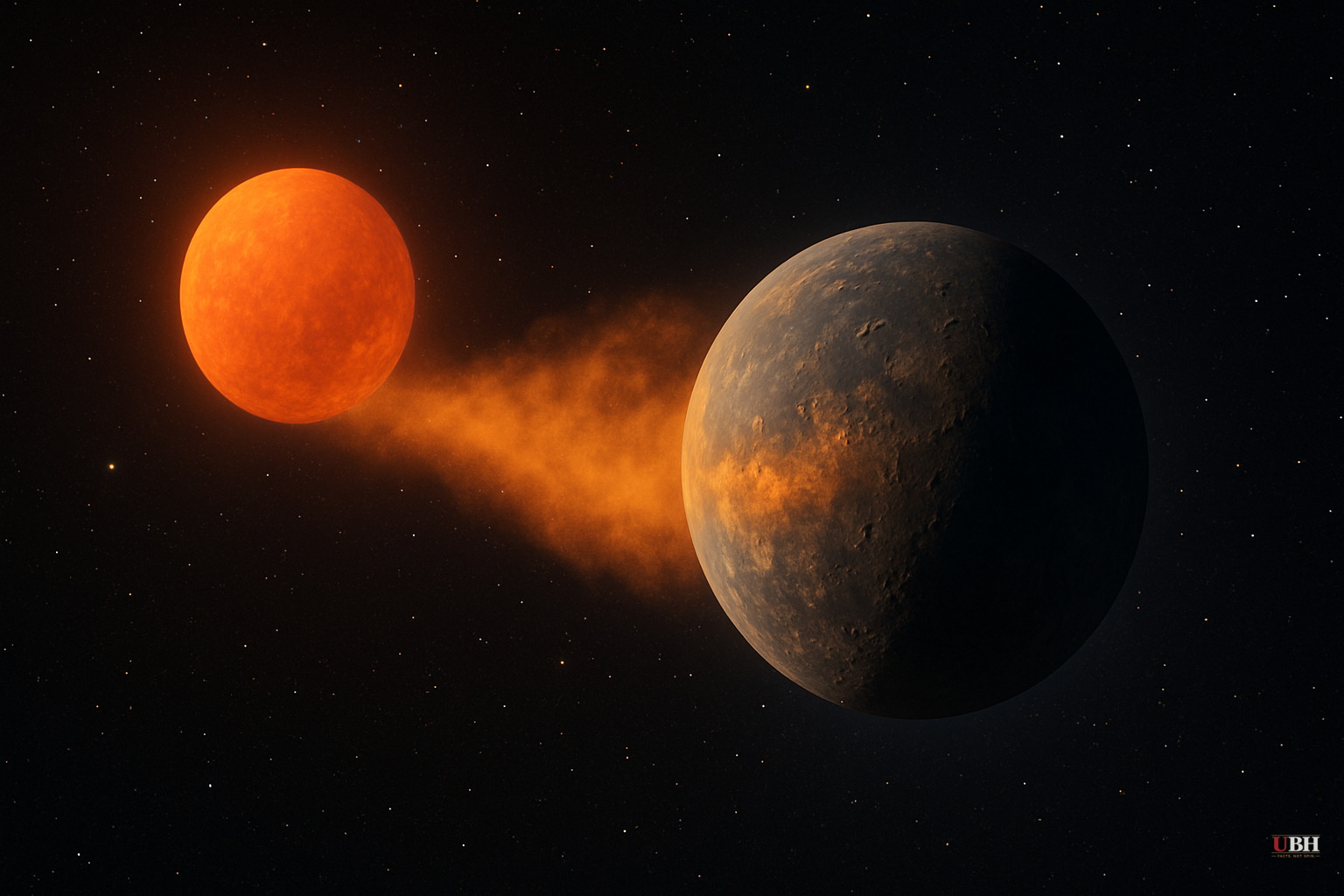
Astronomers have caught a rocky planet outside our solar system losing helium from its atmosphere, according to a study published in Wednesday's issue of Nature and reported by Ars Technica. The planet, LHS 1140b, orbits a red dwarf star called LHS 1140a, roughly 50 light-years from Earth.
This isn't a new discovery in the sense of a fresh event. The star system itself is estimated to be at least 3 billion years old, and the helium loss researchers detected reflects a process that's been playing out over a huge stretch of that time. What's new is that a team of US-based researchers has now measured it directly.
Why Helium Loss Matters
Most matter in the universe is hydrogen and helium. Scientists believe most planets, including the rocky ones in our own solar system, started out wrapped in thick hydrogen-helium envelopes similar to what gas giants like Jupiter have today.
Over billions of years, that changes. Hydrogen can bond into heavier molecules like methane and ammonia, which makes it harder to lose. Helium doesn't have that option. Both elements can escape a planet's gravity entirely, especially on smaller worlds, worlds close to their star, or worlds without a strong magnetic field to block radiation from stripping the atmosphere away.
Earth, Venus, and Mars are all believed to have gone through this. Their current atmospheres are considered "second atmospheres," built up after the original hydrogen-helium blanket was lost or chemically transformed. Watching that process happen on another planet, in something close to real time on cosmic timescales, gives scientists a way to test theories about how habitable worlds evolve.
The Planet in Question
LHS 1140b is no lightweight. Based on tracking its gravitational pull on its host star and watching it pass in front of that star from Earth's vantage point, astronomers calculate it's about five-and-a-half times the mass of Earth, with a radius 1.7 times Earth's. That size and mass profile is consistent with a rocky planet carrying a substantial amount of water and, potentially, a meaningful atmosphere.
The planet takes nearly 25 days to orbit its star, putting it closer to LHS 1140a than Mercury is to the Sun. But because LHS 1140a is a dim red dwarf, LHS 1140b actually receives less than half the sunlight Earth gets from the Sun. If all of that light translated into surface heat, the planet could theoretically support liquid water.
There's a second planet in the system, LHS 1140c, which orbits much closer in, completing a lap in under four days and absorbing roughly five times more radiation than Earth gets from the Sun. That planet's harsher environment makes LHS 1140b the more interesting candidate for anyone hunting for potentially habitable rocky worlds.
What We Still Don't Know
Nobody yet knows for certain whether LHS 1140b actually has an atmosphere today, let alone what it's made of. Researchers detected helium being lost, and from the rate of that loss they can make inferences about what atmosphere might remain. But an inference is not a direct measurement of atmospheric composition.
Red dwarf stars like LHS 1140a are also known for violent outbursts of energetic radiation. Over 3 billion-plus years, LHS 1140b has had plenty of exposure to that kind of stellar tantrum, which complicates any simple model of how its atmosphere has evolved.
The finding is real and measured. The conclusions about what it means for the planet's habitability are still provisional. Nature publishing the study on Wednesday means it has cleared peer review, which is a meaningful bar, but peer review confirms the measurement was done soundly, not that every downstream interpretation is settled fact.
What Happens Next
The next step for researchers is figuring out what's left in LHS 1140b's atmosphere now that some of the helium is gone, and whether water vapor, carbon dioxide, or other gases have taken its place, similar to what happened on Venus, Earth, and Mars. That will likely require follow-up observations with more sensitive instruments capable of directly characterizing atmospheric composition rather than just measuring gas escaping into space.
Until that happens, LHS 1140b remains one of the more compelling nearby rocky exoplanets in a temperate-enough orbital range with real data confirming atmospheric evolution in progress. It is not yet confirmed to be habitable, and no source claims otherwise.
Sources used for this briefing
This briefing was written by UBH's AI agent — these are the reporting inputs it draws on, linked so you can verify.


