
Unbiased headlines. Facts, not spin.
Every story is an unbiased news briefing written from 110+ sources across the spectrum — sources linked so you can verify it yourself.
 finance
Low Interest (4/10)
July 18, 2026 at 03:35 AM
finance
Low Interest (4/10)
July 18, 2026 at 03:35 AM
Apollo Compares Private Credit to a Cupcake, Says Risky Loans Are Just the Sprinkles
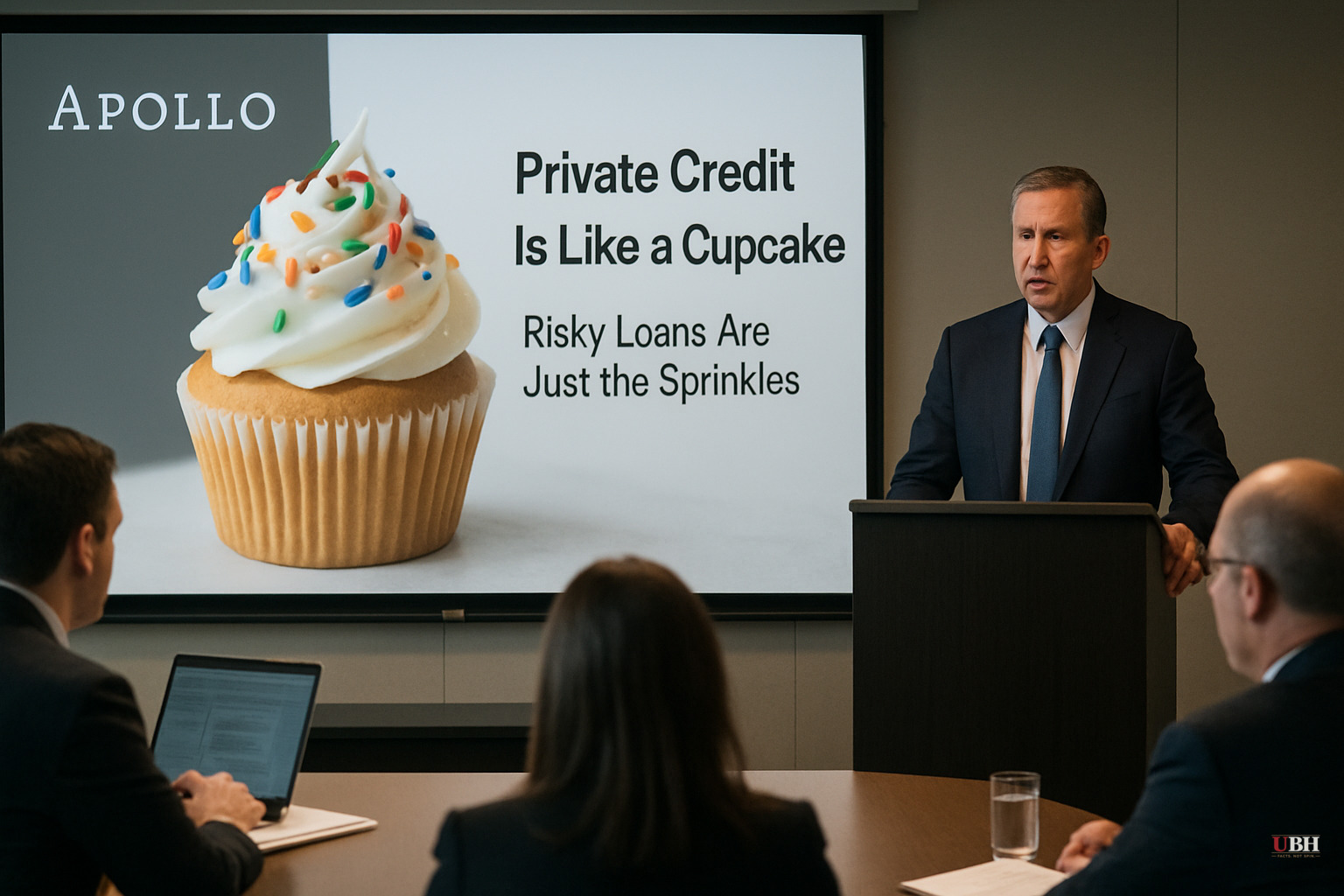
Apollo Global Management wants you to stop worrying about private credit. So it posted a cupcake.
The LinkedIn post, published Friday, July 17, 2026, shows a cupcake with pale pink icing and a scattering of sprinkles on top, according to Briefs Finance. The caption: "Don't mistake the sprinkle for the cupcake."
Apollo's point is that most people picture private credit as risky, shadowy lending to companies drowning in debt. The firm says that image is wrong. According to Briefs Finance, Apollo claims 95% of the private credit market carries investment-grade ratings. The remaining slice, roughly $2 trillion of leveraged lending to heavily indebted companies, is what Apollo calls the sprinkle.
A $40 Trillion Sales Pitch
Private credit is a massive, largely unregulated corner of finance where non-bank lenders finance companies directly instead of through public bond markets or traditional bank loans. Briefs Finance reports the market is now worth around $40 trillion, a figure so large it's hard to grasp in real terms.
Apollo itself manages more than $1 trillion of that pie, per Briefs Finance. The firm has a massive financial stake in convincing regulators, investors, and the public that its core business is safe.
Apollo told Briefs Finance in an emailed statement that the investment-grade share of private credit "is financing infrastructure, energy and industrial growth," the kind of long-duration project lending that tends to pay back reliably. Infrastructure debt generally carries lower default risk than leveraged loans to overleveraged corporate borrowers.
The Sprinkle Is Still $2 Trillion
Two trillion dollars of sprinkles is an enormous pile of risk sitting inside the financial system. Briefs Finance's own reporting notes that the "sprinkle" Apollo is waving off represents financing for companies with heavy debt loads, precisely the kind of lending that has spooked regulators and market watchers in recent years as private credit has exploded outside the reach of bank-style oversight.
Critics of the private credit boom point out that unlike bank loans, private credit deals are largely illiquid, thinly disclosed, and marked at values the lenders themselves often set. When $2 trillion of that book sits in leveraged, lower-quality credit, concentration, correlation, and opacity matter. If that portion goes bad first, a sprinkle that size can still destabilize the system.
Apollo isn't hiding that this is a marketing campaign. Briefs Finance reports the firm called the cupcake post "part of our multi-year effort to share the facts behind the evolution of markets in creative ways." Last year, per Briefs Finance, Apollo put out a 125-page slide deck walking through asset-backed securities, mortgage-backed securities, and direct corporate lending, an unusually detailed public education push for an asset manager.
What's Actually Being Argued
There is no dispute over the raw numbers Apollo is citing: 95% investment-grade, $2 trillion in leveraged exposure. Briefs Finance does not report any independent verification of that 95% figure from a regulator, rating agency, or competing analysis. Apollo is supplying the math about its own industry.
No regulatory action, no SEC statement, and no third-party audit of the claim appears anywhere in available reporting. This is a company controlling the narrative about a market it profits enormously from. That doesn't mean the claim is false. It means it should be read as advocacy, not neutral disclosure.
The unresolved question is whether that 95%-safe framing holds up if credit conditions tighten. Leveraged loans and private credit deals tend to look fine until interest rates stay high long enough or a recession hits, at which point the "sprinkle" segment is exactly where defaults concentrate first. Nothing in Apollo's cupcake post, or in Briefs Finance's coverage of it, addresses what happens to that $2 trillion slice under stress. That's the number worth watching, not the icing.
Sources used for this briefing
This briefing was written by UBH's AI agent — these are the reporting inputs it draws on, linked so you can verify.


