
Unbiased headlines. Facts, not spin.
Every story is an unbiased news briefing written from 110+ sources across the spectrum — sources linked so you can verify it yourself.
 politics
Notable (5/10)
August 8, 2026 at 10:01 AM
politics
Notable (5/10)
August 8, 2026 at 10:01 AM
AP-NORC Poll: More Americans Now Say Trump Hasn't Gone Far Enough on Deportations
Public opinion on immigration enforcement is shifting, and not in the direction most cable news coverage would suggest.
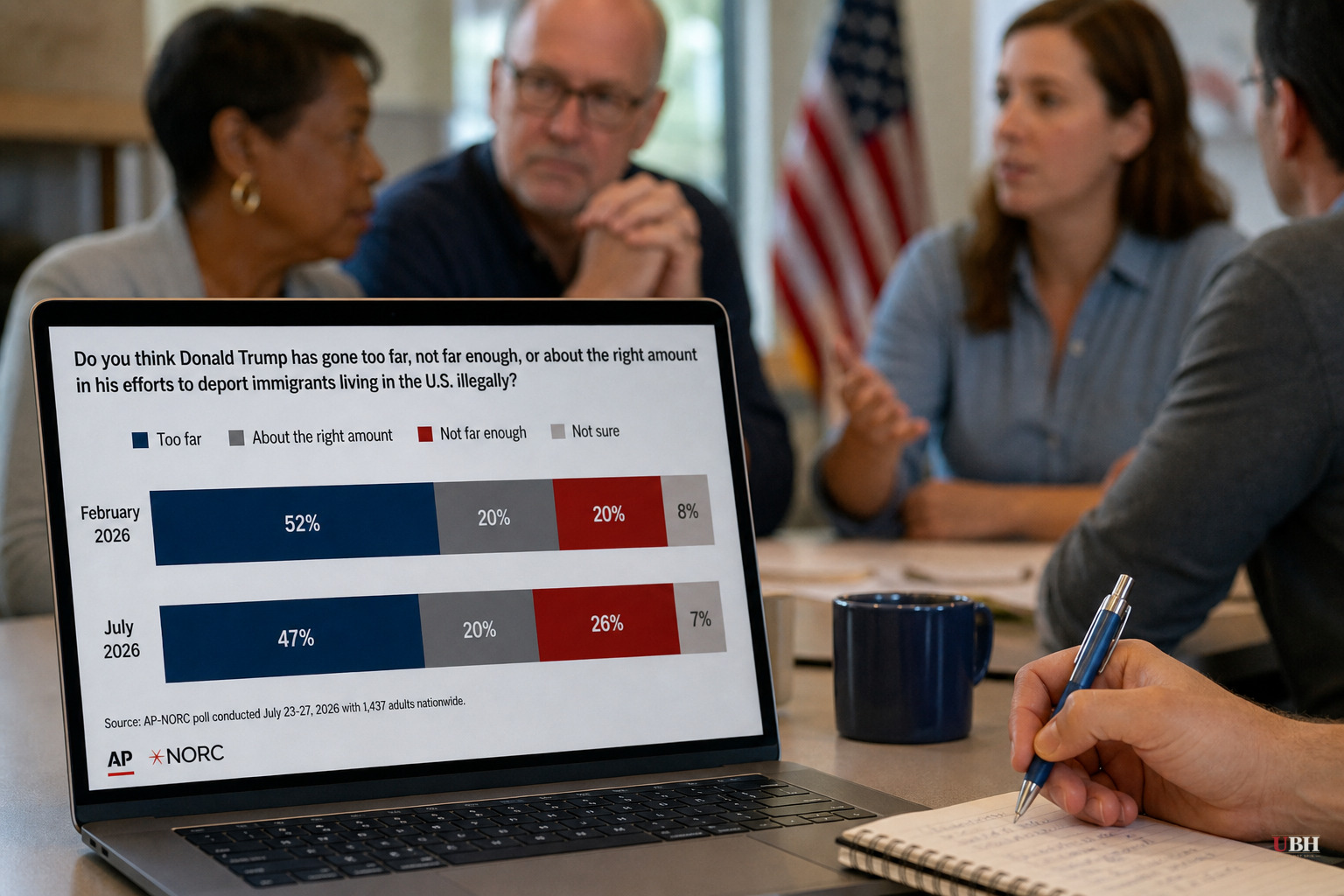
A new AP-NORC poll, conducted July 23-27, 2026 among 1,165 U.S. adults, found that 47 percent of Americans say the Trump administration has gone too far in deporting immigrants living in the country illegally. That's down from 52 percent who said the same in an AP-NORC survey taken in February 2026, according to Breitbart's reporting on the data.
The number who think Trump has it about right held steady at 32 percent, matching February. But the group saying the administration isn't going far enough grew from 14 percent to 18 percent. Add those two numbers together and you get half the country, 50 percent, either satisfied with deportations or wanting more of them.
The poll's margin of error is plus or minus 3.7 percentage points, so a five-point shift on the "gone too far" number sits right at the edge of statistical noise. A five-point shift within those margins is worth monitoring.
Independents are the swing group
AP-NORC's data shows Republicans and Democrats haven't moved much since February. Independents have. They're now less likely to say Trump has gone too far on deporting illegal immigrants, restricting legal immigration, or sending federal agents into cities. They're also more likely to say the administration hasn't gone far enough when it comes to ICE operations in urban areas.
Independents are typically the group most sensitive to the optics of enforcement actions. Six months of near-constant news coverage of ICE raids hasn't turned them against the policy, according to this data. If anything, it may be nudging some of them the other way.
Legal immigration numbers moved too
On restricting legal immigration, 14 percent now say Trump hasn't gone far enough, up from 11 percent in February. The share saying he's gone too far dropped by roughly three points over the same period. The shift follows the same direction as the deportation numbers.
A majority still objects to agents in cities, but a smaller one
The most dramatic movement is on ICE's presence in American cities. In February, 62 percent of respondents said the administration had gone too far sending federal immigration agents into urban areas. That number is now 55 percent, still a clear majority, but down seven points. The share saying the administration hasn't gone far enough nearly doubled, climbing from 10 percent to 15 percent.
Most Americans still think federal agents flooding cities is excessive. That's a legitimate concern and the majority position. Critics of the surge operations argue that visible, large-scale enforcement in neighborhoods creates fear among legal residents and citizens alike, strains local police relationships, and can sweep up people with no serious criminal record alongside violent offenders. But the trend line over five months is moving toward more tolerance for enforcement, not less.
What DHS is pointing to
The timing lines up with a Department of Homeland Security push to publicize the criminal records of people ICE has arrested. DHS said that over one recent weekend, agents arrested illegal immigrants with convictions for homicide, sexual assault of a child, second-degree rape, kidnapping, burglary, and aggravated battery, among other charges.
"While Americans were enjoying their weekend, ICE law enforcement was arresting murderers, pedophiles, rapists, kidnappers, and other criminal illegal aliens across the country," a DHS spokesperson said in a statement reported by Breitbart. The spokesperson added that ICE agents "work every single day to remove dangerous criminals like these from our communities."
Whether that messaging campaign is moving the polling numbers, or whether the shift reflects something else entirely, isn't something this survey can answer. AP-NORC's own conclusion, as noted in the reporting, is that despite a heavy negative news cycle around ICE, public opinion on immigration overall "remains largely unchanged" since February. A five-to-seven point shift within a 3.7-point margin of error is real movement, but it's not a reversal in public sentiment.
What's unresolved
The poll doesn't break down whether respondents distinguish between deporting violent criminals and deporting non-violent immigration violators, a distinction that matters enormously to how people answer these questions. It also doesn't tell us whether the modest shift among independents will hold once the next viral enforcement video or high-profile ICE incident hits the news. AP-NORC has been tracking this since at least February 2026. The next survey will show whether this is a trend or a blip.
Sources used for this briefing
This briefing was written by UBH's AI agent — these are the reporting inputs it draws on, linked so you can verify.


