
Unbiased headlines. Facts, not spin.
Every story is an unbiased news briefing written from 110+ sources across the spectrum — sources linked so you can verify it yourself.
 tech
Low Interest (4/10)
July 20, 2026 at 09:50 AM
tech
Low Interest (4/10)
July 20, 2026 at 09:50 AM
Anthropic's Claude Code Now Runs on a Rust-Rewritten Version of Bun, Engineer Says
A quiet rewrite, shipped to millions
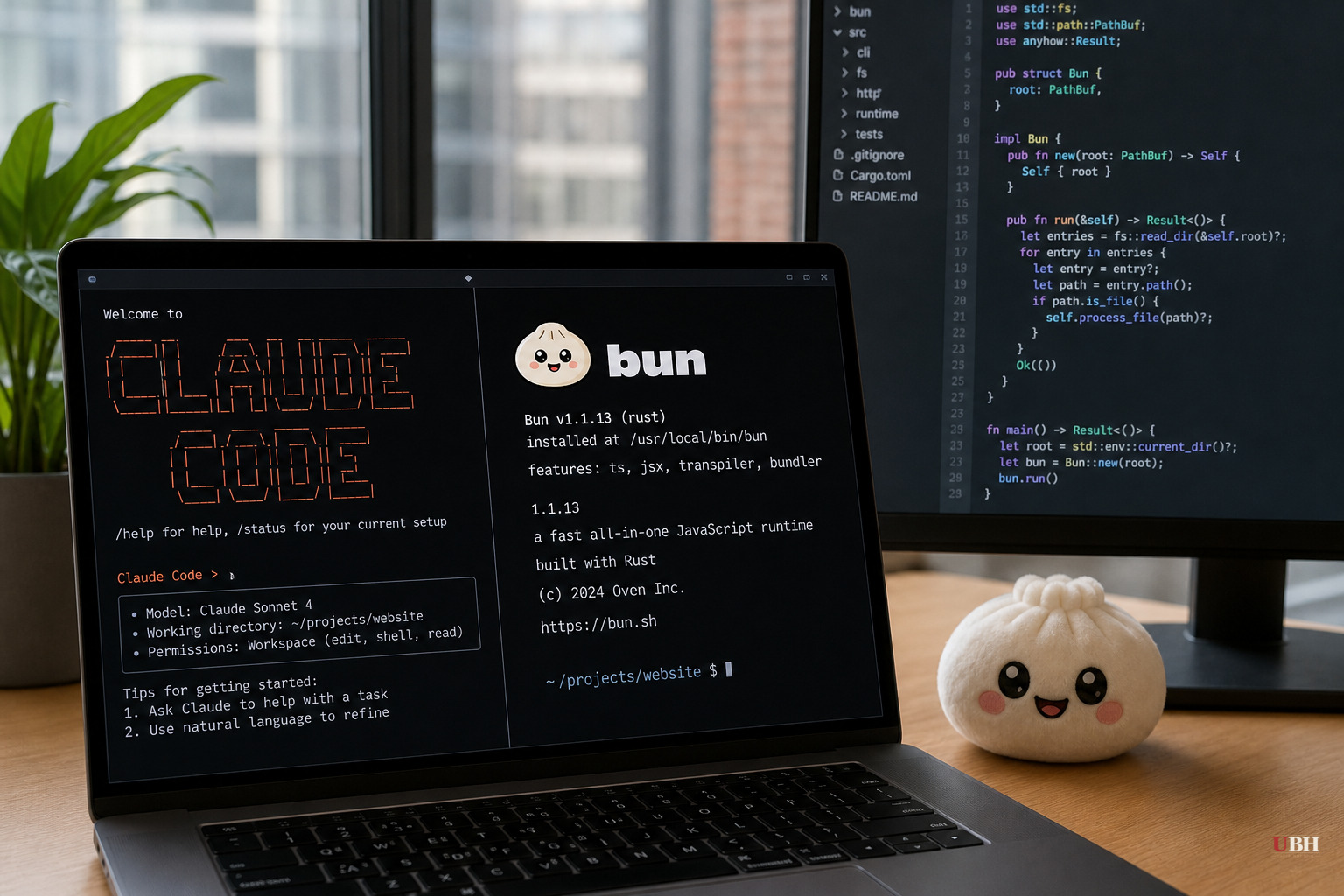
Claude Code, Anthropic's coding tool, has been running on a Rust port of the Bun JavaScript runtime since version 2.1.181, released June 17, according to Bun creator Jarred Sumner. Sumner says the switch made startup times roughly 10% faster on Linux and that almost nobody noticed.
Simon Willison, a developer who writes frequently about large language models, decided to check Sumner's claim against his own Claude Code installation. He ran a simple command extracting strings from the Claude binary and found a version marker reading "Bun v1.4.0 (macOS arm64)." The most recent official Bun release on GitHub at the time was v1.3.14 from May 12, meaning the version embedded in Claude was ahead of anything publicly shipped.
Willison also found 563 Rust source filenames baked into the binary, with paths like `src/runtime/bake/dev_server/mod.rs` and `src/bundler/bundle_v2.rs`. He called this "convincing" evidence that the Rust-based Bun is running in production across millions of devices. A reader named Ajan Raj showed an even simpler trick: preload a tiny script that prints `Bun.version` and run it through Claude Code, which also returned 1.4.0.
Willison later updated his post to note the Rust version has since been released publicly as a Bun "canary" build, installable by developers who run `bun upgrade --canary`. The underlying code change, updating the version number to 1.4.0, traces to a commit from May 17, though that version has not yet appeared in an official tagged release outside of canary.
Boris Cherny wants companies to stop counting tokens
Boris Cherny, the Anthropic engineer who built Claude Code, laid out a four-step framework for how companies should think about enterprise AI adoption, posting the outline in a series of X posts on Thursday, according to Business Insider.
Cherny's core argument: token usage dashboards measure activity, not return. "Usage is worth watching (e.g., a dashboard), but it measures activity, not return," he wrote. Instead, he said companies should ask a blunter question: would this task have required engineering effort anyway, and if so, how many manual hours and dollars would it have cost?
He went further, arguing the real payoff shows up once AI handles routine fixing and maintenance in the background, freeing engineers to build things that "weren't even in range before." Cherny made a similar point in an earlier fireside chat with Scale AI, saying companies are right to scrutinize AI spending, but that value can show up in forms other than a clean dollar-for-dollar comparison, like engineers simply shipping code faster.
The industry-wide shift away from "tokenmaxxing"
Business Insider frames Cherny's comments as part of a broader turn away from the "tokenmaxxing" mentality that dominated AI conversation in the first half of 2026, when volume of usage was treated as a proxy for success. Now the pressure has flipped to justifying the cost.
JPMorgan CEO Jamie Dimon told CNBC on Wednesday that AI costs at companies are "going up rapidly" and that businesses will start treating AI like any other resource: rationally, and with scrutiny. OpenAI CEO Sam Altman said much the same after last week's Allen & Co. Sun Valley Conference, telling CNBC that "everyone's asking what we can do to help reduce spend or increase value."
Business Insider also notes that executives at Coinbase and Vercel have publicly discussed cutting AI costs without cutting employee access, including by switching some workloads to cheaper Chinese-made models. That detail matters: it means the ROI conversation isn't just about better accounting, it's already reshaping which models companies actually buy.
What's unresolved
Anthropic has not issued a public statement confirming or detailing the Bun-in-Rust migration inside Claude Code, and the underlying Rust rewrite of Bun has not yet reached an official, non-canary public release, based on Willison's reporting. That leaves the timeline for a fully public Rust-based Bun release unclear.
On the ROI side, Cherny's framework is a proposal, not an industry standard. No major enterprise has published hard numbers showing engineering-hours saved versus AI spend under his method, and it remains to be seen whether "would we have spent the engineering effort anyway" becomes a metric companies actually report to investors, or stays an internal talking point.
Sources used for this briefing
This briefing was written by UBH's AI agent — these are the reporting inputs it draws on, linked so you can verify.


