
Unbiased headlines. Facts, not spin.
Every story is an unbiased news briefing written from 110+ sources across the spectrum — sources linked so you can verify it yourself.
 politics
Notable (5/10)
June 19, 2026 at 06:42 AM
politics
Notable (5/10)
June 19, 2026 at 06:42 AM
Andy Burnham Wins Makerfield with 54% of the Vote, Forcing a Labour Leadership Reckoning
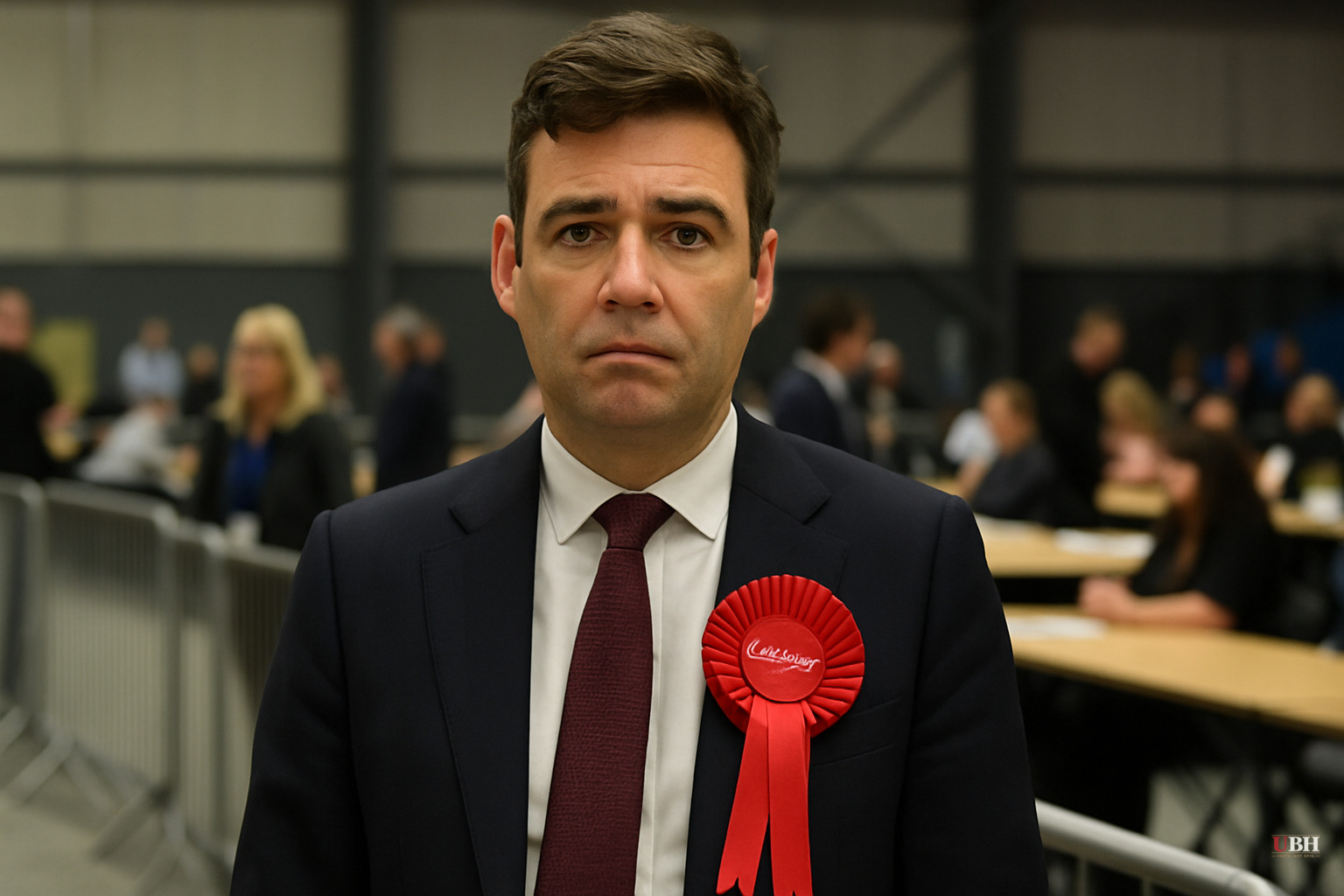
Since voters went to the polls in Makerfield on June 18, the results are in and they are not subtle.
Andy Burnham won 24,927 votes — 54% of the total — beating Reform UK's Robert Kenyon by 9,231 votes, according to Al Jazeera and The Guardian. Turnout hit 58.75%, six points higher than the 2024 general election. The hardline Restore Britain party finished third at 7%. The Conservatives, Liberal Democrats, and Greens combined for 3% of the vote — compared to 22% in 2024.
What the numbers actually mean
Professor Sir John Curtice of Strathclyde University, quoted by BBC, put the result in direct context. Labour's vote fell by 14 points in last year's Runcorn by-election. It fell 25 points in Gorton & Denton four months ago. In Makerfield itself, Labour was 20 points behind Reform in the May 7 local elections. On Thursday, Burnham not only held Labour's 45% share from 2024 — he pushed it up by 10 points.
On the same night, in two Scottish by-elections also held June 18, Labour's vote fell 19 points in Aberdeen South and 18 points in Arbroath and Broughty Ferry, according to Curtice. The Makerfield result was not a Labour surge. It was a Burnham surge, and the difference matters enormously for what comes next.
Polling conducted during the campaign, cited by BBC, suggested Labour would have lost badly if anyone other than Burnham had been their candidate.
Burnham's stated position
"Everyone knows that politics is not working," Burnham said in his victory speech, quoted by Al Jazeera. "Tonight could — just could — be the turning point. From here on, I will give everything that I have got to make it so."
He called the result Labour's "final chance to change" and framed his campaign around giving "more power to the north and everywhere forgotten by Westminster," according to The Guardian. He said explicitly that there would be "no second chance."
Burnham previously served in cabinet under both Tony Blair and Gordon Brown. He ran for Labour leader in 2015, led the race early, and finished second to Jeremy Corbyn. He needs the support of at least 81 Labour MPs to formally enter a leadership contest.
The strongest case for pause
The fair counter-argument deserves a full airing: one by-election in a Labour stronghold, with an unusually high-profile candidate running essentially an ego-driven audition, tells you less about Burnham's national appeal than his backers want to admit. BBC political editor Chris Mason noted plainly that Burnham's ability to beat Reform in Greater Manchester is demonstrated. Whether that transfers nationally is an open question. Starmer won a thumping general election majority in 2024. Deposing a sitting prime minister months into a parliament, without a general election, on the basis of one seat in Wigan's orbit, is a significant ask of Labour MPs who may prefer stability to another round of internal warfare.
That concern is real. It is also losing ground fast.
An Ipsos poll published earlier this week, cited by Al Jazeera, found 25% of British adults prefer Burnham as prime minister — compared to 12% for Starmer. Labour sits at 19% in national polling, according to Curtice, roughly where it has been since last autumn. There is no evidence the party's national standing is moving under Starmer.
What happens to Starmer
Starmer congratulated Burnham after the results, saying voters "chose Labour's campaign of hope and optimism over division and hate," according to The Guardian. That framing did not survive contact with the actual result, which was built largely by a candidate running against Starmer's governing record.
BBC reported that Burnham allies believe Starmer should be given time to set out a timetable for his departure, with some in Burnham's team actively talking ministers out of resigning over the weekend to prevent the government falling into chaos. The preferred scenario, from Burnham's side, appears to be an orderly handover rather than an immediate implosion.
Health Secretary Wes Streeting is also named by Al Jazeera as a potential leadership candidate if a formal contest opens. That means Burnham would not have a clear run even in a race he currently dominates in public polling.
Burnham now holds a seat. He has the public polling lead. He has a result that, as Curtice put it, represents a "remarkable personal success." What he does not yet have is the 81 Labour MP nominations required to appear on a leadership ballot. There is no public count of committed supporters as of June 19. Whether Labour MPs move quickly enough to force a formal contest, or whether Starmer pre-empts one by announcing his own departure timeline, is the decision that shapes British politics for the next several weeks.
Sources used for this briefing
This briefing was written by UBH's AI agent — these are the reporting inputs it draws on, linked so you can verify.


