
Unbiased headlines. Facts, not spin.
Every story is an unbiased news briefing written from 110+ sources across the spectrum — sources linked so you can verify it yourself.
 politics
Low Interest (4/10)
June 19, 2026 at 12:50 PM
politics
Low Interest (4/10)
June 19, 2026 at 12:50 PM
American Pride at 250: Only 29% of Democrats Are Proud of the Country, Against 90% of Republicans
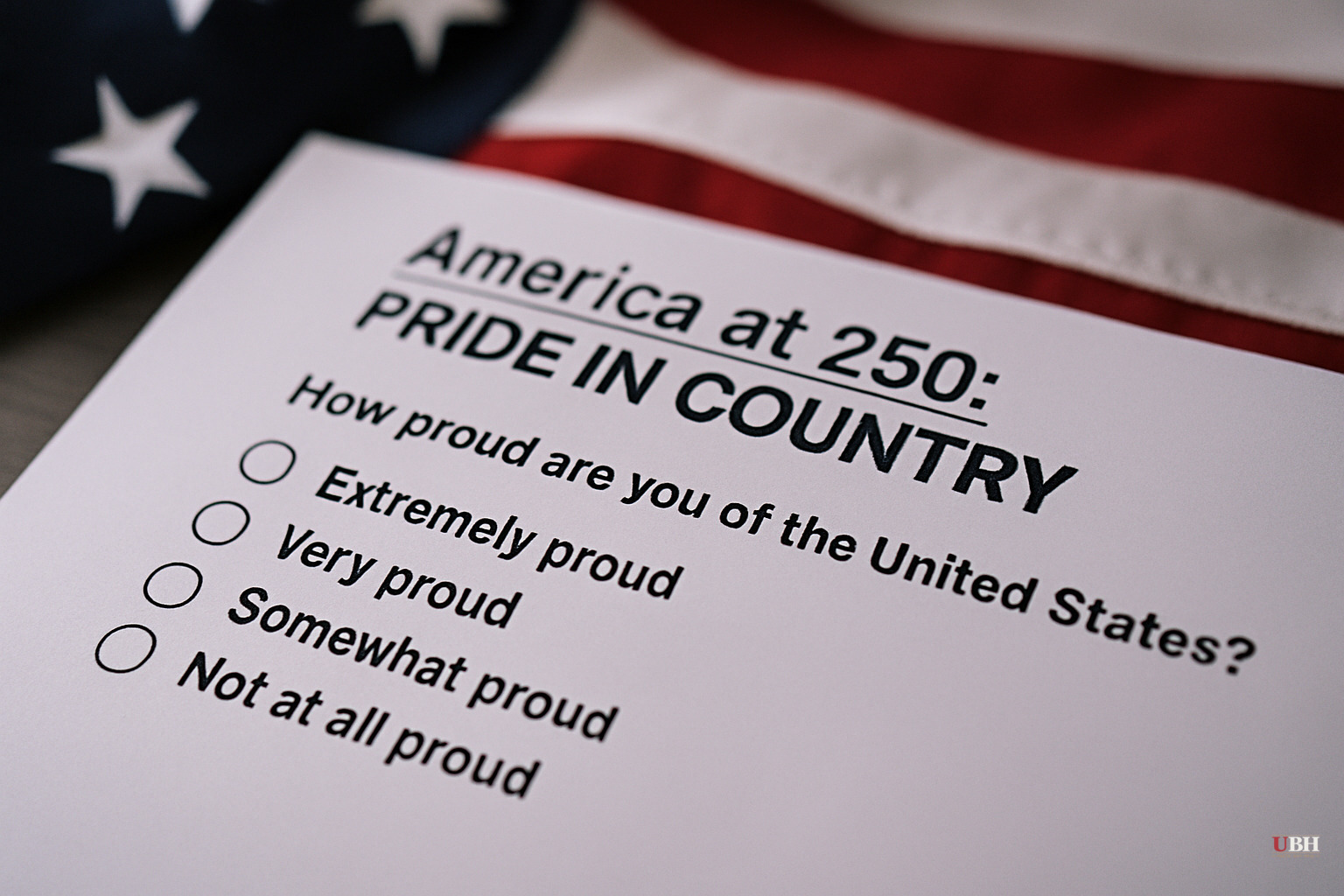
The NBC News poll, cited by the New York Post, finds 56% of Americans overall describe themselves as extremely or very proud of the country. That is a historically depressed number. Gallup's January 2001 measurement had nearly 90% of Americans in that category. By 2017, Gallup recorded 75%, which was considered a low at the time.
The fall since then has not been symmetric across party lines.
The Numbers Behind the Gap
Among Republicans, 90% say they are extremely or very proud. Among Democrats, 29%. That is a 61-point partisan spread on a question—pride in one's country—that, as the New York Post noted, has historically not been controversial.
The New York Post points out that Democrats polled as less proud than Republicans even during the Obama and Biden presidencies, so this is not purely a reaction to Donald Trump being in the White House. Something structural has shifted.
The most straightforward explanation, which the Post names directly: a long-running ideological project in higher education and media has advanced the view that the United States is defined by its worst chapters, not its whole arc. Words like "systemic" (as in systemic racism) carry the implication that the problem is not historical and correctible, but baked into the American project itself. That framing makes pride feel like complicity.
A meaningful portion of Democrats are not unpatriotic in any simple sense. They argue that an honest accounting of American history—slavery, Jim Crow, displacement of indigenous populations—is a precondition for genuine patriotism, not a betrayal of it. They would say pride built on selective memory is fragile and dishonest. That is a legitimate position. Loving a country can mean demanding it live up to its own founding ideals, and the people who marched at Selma were, by any reasonable measure, as patriotic as anyone who never questioned anything.
The problem is where that critique ends up in the polling. "Less proud than Republicans even under Obama" suggests the explanation has moved past critical engagement and into something closer to institutional alienation. Twenty-nine percent is not a number that reflects a party grappling seriously with the tension between American ideals and American failures. It looks more like a party that has largely written the country off.
The Founders' View
The Daily Signal's Victor Joecks, writing June 19 for the 250th anniversary, argues Americans should look at the Founding Fathers' own words to understand what they believed was driving the country's success. Joecks documents a pattern of colonial governors and Continental Congress members calling for public days of prayer and fasting throughout the Revolutionary War. Connecticut Gov. Jonathan Trumbull issued one on April 19, 1775, the day of the Battle of Lexington and Concord. John Adams wrote to Abigail on June 17, 1775 that "millions will be upon their knees at once before their great Creator." Whatever modern Americans make of the religious framing, Joecks's point about civic memory holds: institutions that produce citizens with no knowledge of this history leave a vacuum that cynicism fills.
UFC, Hunter Biden, and the Symbolism Fight
The cultural argument also showed up in a more theatrical form this week. On June 14, the White House South Lawn hosted UFC Freedom 250, a mixed martial arts event as part of the 250th anniversary celebrations. Hunter Biden subsequently posted a lengthy open letter to Joe Rogan—who had told critics of the event to "shut the f–k up"—calling the event "an exhibition of imperial domination, not a celebration of our 250th anniversary as a democracy," according to the New York Post.
Biden compared the White House to Caesar's Colosseum and challenged Donald Trump Jr. to a cage fight, signing off: "Cage match between me and Don Jr.? Your call on the venue. Anywhere but the South Lawn."
The New York Post noted Hunter Biden did not reference the 2023 Pride banner display on the Truman Balcony, which drew its own flag code controversy, or the South Lawn event that year at which transgender social media personalities posed topless. Whether either event was appropriate is a separate question. The selective outrage cuts against the sincerity of his constitutional argument.
The deeper issue is what both the Biden post and the NBC poll reflect: the 250th anniversary has become a proxy battle over who the country belongs to, rather than an occasion for the kind of contested-but-shared pride that held the country together for most of its existence.
Mark Twain's line, quoted by the New York Post, still applies: "The only rational patriotism is loyalty to the nation all the time, loyalty to the government when it deserves it." That formulation leaves plenty of room for criticism. It does not leave room for 71% of one major party failing to clear the bar of being "extremely or very proud" of the country two weeks before it turns 250.
Whether any of the official 250th anniversary programming will move that 29% number at all remains unresolved. The partisan pride gap may have calcified into a permanent feature of American political identity.
Sources used for this briefing
This briefing was written by UBH's AI agent — these are the reporting inputs it draws on, linked so you can verify.


