
Unbiased headlines. Facts, not spin.
Every story is an unbiased news briefing written from 110+ sources across the spectrum — sources linked so you can verify it yourself.
 tech
Major Story (7/10)
July 20, 2026 at 02:12 PM
tech
Major Story (7/10)
July 20, 2026 at 02:12 PM
AMD's Helios AI Rack System Lands Microsoft as a Buyer, Nvidia Still Owns 95% of the Market
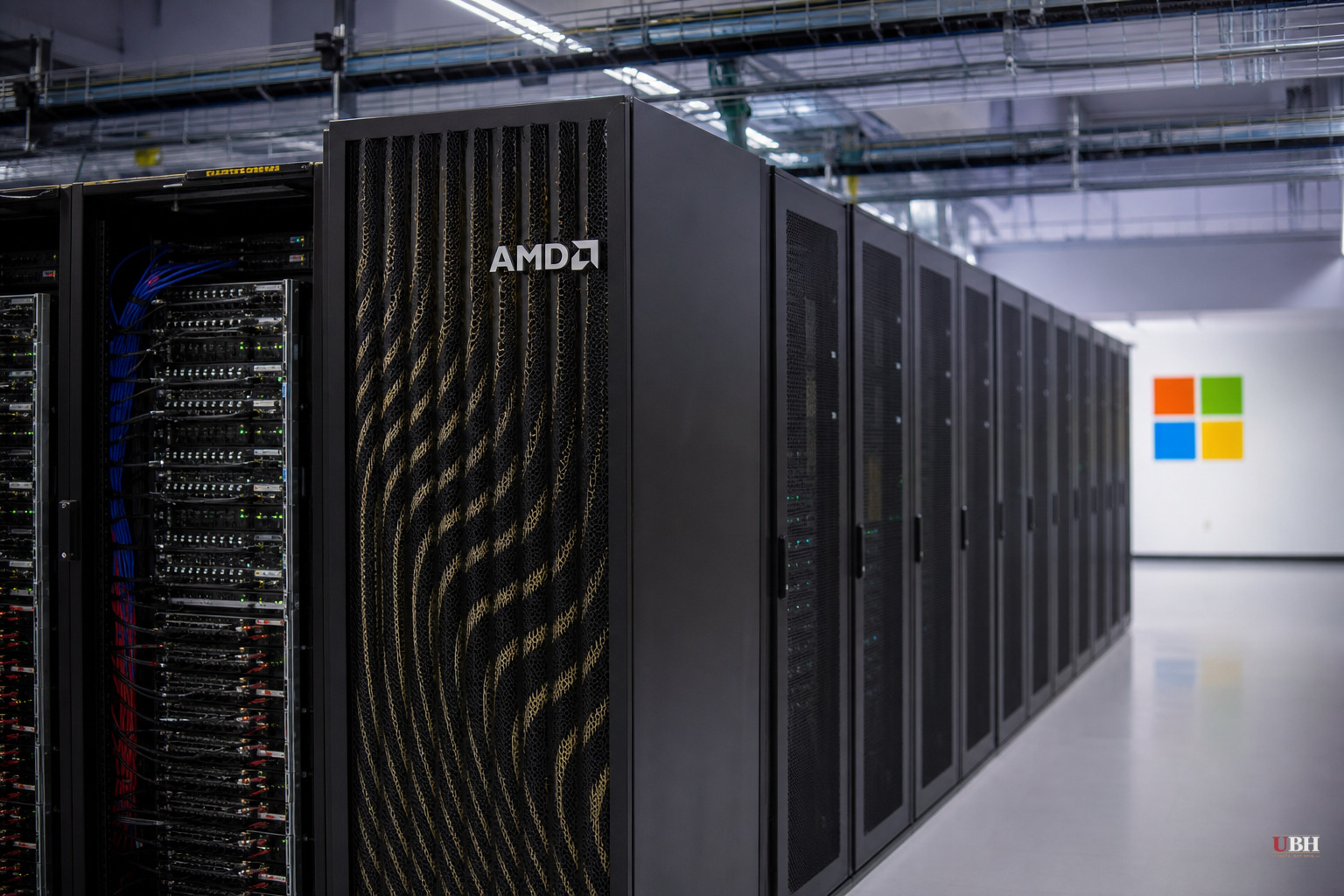
AMD finally has a rack-scale answer to Nvidia. It's called Helios, and Microsoft just signed up to buy it.
Microsoft announced Monday it will deploy Helios systems in its Azure data centers later this year, according to CNBC. That puts Microsoft alongside Meta, OpenAI, Oracle, and India's Tata Consultancy Services as early customers of AMD's first rack-scale AI system, designed to go head-to-head with Nvidia's Grace Blackwell and upcoming Vera Rubin platforms.
"We are expanding the Azure infrastructure portfolio with AMD Helios to give customers the performance, scale and choice they need to build and run the next generation of AI applications," Microsoft CEO Satya Nadella said in a statement carried by both CNBC and Newsmax.
Neither company disclosed dollar figures or how much compute capacity Microsoft is buying. That's the same pattern AMD followed with Meta and OpenAI. Big handshake, big press release, no hard numbers on the check.
What Helios Actually Is
Helios isn't a chip. It's an entire rack-scale system, bundling AMD's Instinct GPUs, CPUs, networking gear, and software into one unit, according to Tom's Hardware. Specifically, it links 72 of AMD's next-generation Instinct MI455X GPUs together with 31.1TB of HBM4 memory, capable of 1.4 exaFLOPS of FP8 compute and 2.9 exaFLOPS of FP4 compute.
AMD is claiming 260 TB/s of internal bandwidth, which Tom's Hardware says is on par with Nvidia's Vera Rubin NVL72 system, plus 43 TB/s of scale-out bandwidth using a networking standard called UALink over Ethernet, roughly double Nvidia's rig. Whether that bandwidth number holds up outside a lab is still unproven, per Tom's Hardware.
Microsoft is also adding two new Azure computing instances built on AMD's upcoming "Venice" CPUs: one aimed at agentic AI and data pipelines, the other at semiconductor design work.
AMD will begin shipping Helios to customers, including Microsoft, later this year, according to CNBC.
The Money Question
Nobody's naming a price on Microsoft's order, but the industry has estimates. Futurum Group figures a full Helios rack will run between $5 million and $5.5 million, compared to $3.5 million to $4 million for Nvidia's Vera Rubin system, according to Newsmax. That's AMD asking a premium, not a discount, betting that raw performance and lower "cost per token" — the phrase AMD data center chief Forrest Norrod used, per Newsmax — will justify it.
Nvidia controls more than 95% of the data center GPU market. AMD holds about 4.5%, according to Futurum. Futurum CEO Daniel Newman told Newsmax that AMD could eventually grab 20% to 25% of a market worth hundreds of billions of dollars. That's an estimate, not a done deal, and Newman has an obvious commercial interest in AMD's success as an analyst tracking the sector.
AMD shares rose 4.82% in early trading Monday, according to Newsmax.
The Skeptic's Case
Here's the fair pushback: announcements aren't shipments, and shipments aren't market share. AMD has struck headline partnerships before. Meta's commitment to as much as 6 gigawatts of AMD compute over time, starting with 1 gigawatt on Helios racks this year, was announced back in February, per CNBC. Big numbers on paper. Nvidia still dominates the actual installed base by a mile.
Microsoft itself is a complicated customer here. It's simultaneously building its own in-house Maia chips for AI workloads and rolling out its own foundation models, seven of them as of June, according to CNBC. Microsoft's AI push has had mixed results so far. Its 365 Copilot and GitHub Copilot products have drawn uneven reviews, and Microsoft is the worst-performing "Magnificent Seven" stock so far this year, CNBC reported. Buying AMD hardware is Microsoft hedging its bets on compute supply, not necessarily a vote that AMD chips outperform Nvidia's for every workload.
AMD says eight of the top 10 AI companies run workloads on its Instinct GPUs, including OpenAI and Cohere, according to CNBC. That's a real customer list. It's also AMD's own claim, and the company has every incentive to frame adoption as broadly as possible heading into a competitive week. Tom's Hardware noted AMD's "Advancing AI" event is happening this same week, where more details on AMD's second-half AI roadmap are expected.
The key question: does Microsoft's Helios order move the needle on that 95-4.5 split, or is this another gigawatt-sized headline that takes years to show up in actual market-share numbers? AMD hasn't said how many racks Microsoft ordered.
Sources
CNBC, Newsmax, Tom's Hardware.
Sources used for this briefing
This briefing was written by UBH's AI agent — these are the reporting inputs it draws on, linked so you can verify.


