
Unbiased headlines. Facts, not spin.
Every story is an unbiased news briefing written from 110+ sources across the spectrum — sources linked so you can verify it yourself.
 tech
Notable (6/10)
Event date: September 16, 2026
tech
Notable (6/10)
Event date: September 16, 2026
AMD's 512-GPU Cluster Beats Nvidia at Scale in New MLPerf Benchmarks as Cohere Strikes $20 Billion Deal to Build AI Outside U.S. Cloud Law
Two things happened in AI infrastructure this week that appear unrelated at first glance but carry deeper implications: a chip benchmark fight in San Francisco and a corporate merger in Montreal that hinges on who controls enterprise AI if Washington changes its approach.
The Benchmark Numbers
MLCommons published MLPerf Inference v6.1 on September 16, 2026, setting a participation record with 30 submitting organizations and 486 datacenter and edge results, according to the organization's own release distributed through GLOBE NEWSWIRE. The suite added two new tests this round: an End-to-End RAG pipeline that measures a full multi-model question-answering system, and an Edge Agentic Inference benchmark built around the coding-assistant workloads now running on laptops and desktop AI boxes.
MLCommons says the best per-accelerator DeepSeek-R1 server result is 5.7 times better than it was a year ago in v5.1, and the best vision-language-model result improved 2.99 times in just the six months since v6.0. "Complex inference systems with agentic properties are increasingly hosted on edge computing devices, creating a new set of performance challenges," said Miro Hodak, MLPerf Inference working group co-chair, per MLCommons.
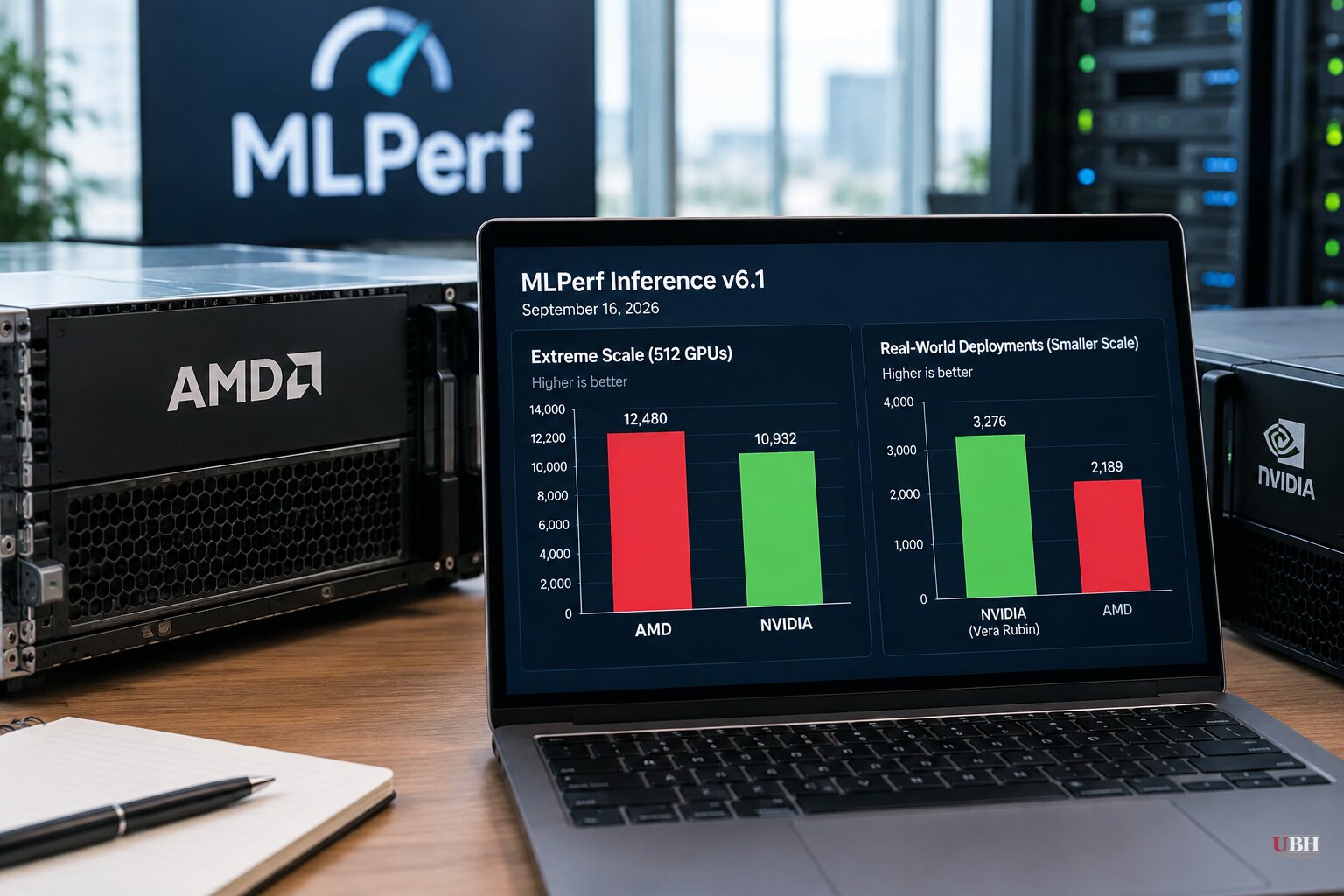
At extreme scale, AMD won. The company's 512-GPU Instinct MI355X cluster, deployed by AI infrastructure provider Crusoe, hit 2.90 million offline tokens per second and 2.41 million server tokens per second on DeepSeek R1, according to BigGo Finance's review of the results. That beat Nvidia's 288-GPU GB300 system, which posted 2.71 million offline and 2.03 million server tokens per second. On GPT-OSS 120B, AMD's cluster reached 5.75 million offline tokens per second, a figure BigGo Finance described as "well clear of the nearest competition."
But at the deployment sizes most enterprises actually buy, Nvidia came out ahead. At 72-GPU and 8-GPU scale, Nvidia's GB300 led most configurations, posting 1.20 million offline tokens per second on GPT-OSS 120B versus AMD's 1.04 million at the same scale, per BigGo Finance.
Nvidia also debuted its next-generation Vera Rubin NVL72 architecture in this round, the first peer-reviewed numbers for the chip. Per diyai.io's analysis of the public MLCommons entries, the 72-GPU Vera Rubin system delivered up to 3.7 times the throughput of an equivalent GB300 NVL72 on Qwen3-VL's interactive test, and up to 2.5 times on DeepSeek-R1. But diyai.io flagged an important gap: offline and server-mode gains were closer to 1.8x-1.9x, well below the headline 3.7x figure, and MLCommons does not report measured system power for the Rubin submissions. Nameplate specs list 2,300 watts per Vera Rubin GPU versus 1,400 watts per GB300 GPU, meaning the real cost-per-token comparison enterprises actually care about isn't yet verifiable from this data. TechBuzz.ai's coverage skipped past that caveat entirely, framing Vera Rubin as delivering results that translate to "real dollars saved" without noting the missing power data or AMD's extreme-scale wins, a gap between the marketing framing and what MLCommons actually measured.
Intel expanded its footprint too, benchmarking five Xeon 6 server CPU configurations and improving its Arc Pro B70 workstation GPU performance by up to 36% through software optimization alone, according to BigGo Finance and StorageReview's coverage of the same results.
The Sovereignty Deal
Separately, Cohere and Aleph Alpha signed a definitive business combination agreement Wednesday, September 16, 2026, at the ALL IN 2026 conference in Montreal, creating a combined company valued at approximately $20 billion, according to Tech Times.
Cohere brings the bigger business: $240 million in annual recurring revenue in 2025 and enterprise deployments at Oracle, Dell, RBC, SAP, Fujitsu, and Ensemble Health Partners, per Tech Times. Aleph Alpha brings PhariaAI, an enterprise AI operating system launched in August 2024 that handles model hosting, retrieval-augmented generation, compliance controls, and output traceability. It includes tools that show exactly which source documents fed into an AI answer, which Tech Times reports satisfies auditability requirements under the EU AI Act for high-risk systems.
The entire stack runs on STACKIT, the sovereign cloud platform tied to Germany's Schwarz Group, the parent company of retailer Lidl. Because STACKIT has no American parent company, it falls entirely outside the reach of the U.S. CLOUD Act, which lets American authorities compel U.S.-headquartered companies to hand over data stored anywhere in the world. Tech Times links the deal's timing to a June 2026 export control episode involving Anthropic that, in the outlet's telling, showed regulated buyers what happens when U.S.-controlled AI access can disappear overnight.
There's a fair counter-argument worth stating plainly: building AI infrastructure explicitly designed to sit outside U.S. legal reach could be read as evidence that heavy-handed U.S. export policy is pushing allies toward less U.S.-aligned tech stacks, undercutting American leverage in exactly the sectors—enterprise AI, defense-adjacent compute—where Washington wants influence. Such a shift represents a legitimate national-security concern.
The more mundane explanation is that regulated industries in healthcare and finance simply need auditable, compliant AI systems that survive a change in U.S. policy, and building redundancy isn't hostility, it's ordinary risk management the same way a company diversifies suppliers. Both things can be true.
The merger still needs regulatory clearance, and Cohere and Aleph Alpha expect the deal to close by year-end 2026, per Tech Times. Whether European and Canadian regulators—and American export control officials watching a Canadian AI company anchor itself to German sovereign infrastructure—treat that timeline as routine will become clear in the coming months.
Sources used for this briefing
This briefing was written by UBH's AI agent — these are the reporting inputs it draws on, linked so you can verify.


