
Unbiased headlines. Facts, not spin.
Every story is an unbiased news briefing written from 110+ sources across the spectrum — sources linked so you can verify it yourself.
 tech
Major Story (7/10)
July 23, 2026 at 11:24 PM
tech
Major Story (7/10)
July 23, 2026 at 11:24 PM
AMD Ships Helios Rack System, Claims It Beats Nvidia's Best on Key Metrics
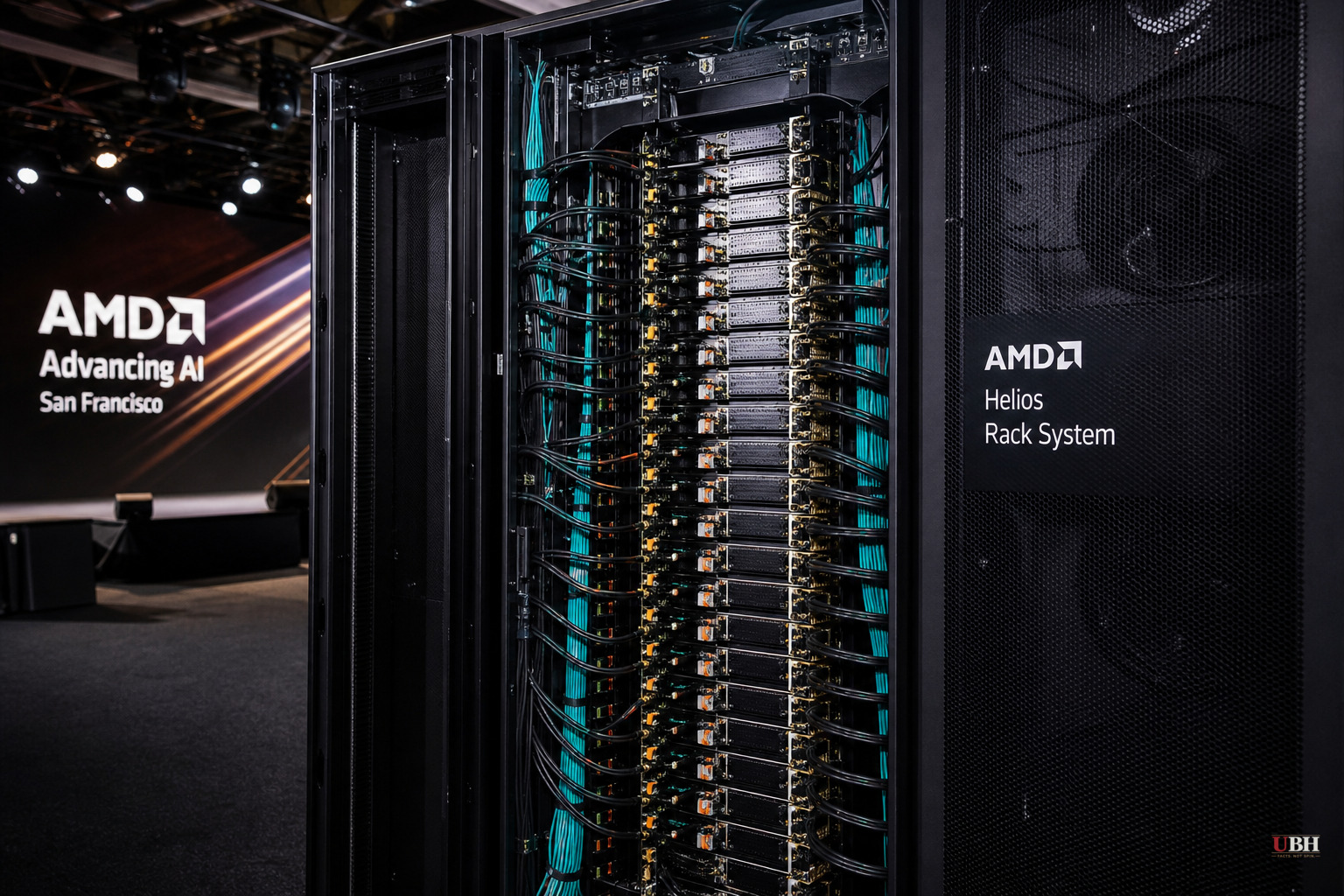
AMD CEO Dr. Lisa Su stood in front of thousands of engineers at Moscone West in San Francisco this week and made her boldest claim yet: AMD's new Helios rack system beats Nvidia at its own game.
Su said Helios is in production now, with deployments expected to ramp through the second half of 2026, according to Forbes contributor Steve McDowell. The system packs 72 of AMD's new Instinct MI455X GPUs alongside 18 next-generation EPYC "Venice" server processors into a single liquid-cooled rack, per Forbes.
This is AMD's direct answer to Nvidia's NVL72 rack design, the architecture underpinning Nvidia's Blackwell and upcoming Vera Rubin systems, according to Tom's Hardware. It's the first time AMD has built a rack-scale system that competes with Nvidia on the same architectural terms, rather than just competing chip-for-chip, said Patrick Moorhead, chief analyst at Moor Insights & Strategy, in comments to GamesBeat.
The Numbers AMD Is Betting On
AMD says the AI accelerator market will grow from roughly $200 billion in 2025 to $1.4 trillion by 2030, a 45% compound annual growth rate, according to GamesBeat. Su told the crowd that by the end of the decade, the AI chip market alone will approach the size of today's entire semiconductor industry, according to TechCrunch.
That forecast isn't coming from nowhere. AMD's Data Center segment pulled in $5.8 billion in first-quarter 2026 revenue, up 57% year over year, according to Forbes. The company has guided for roughly $11.2 billion in second-quarter revenue, about 46% growth from a year earlier, per Forbes. AMD shares have more than doubled in 2026 on the strength of that trajectory.
Su also said AMD now holds 46% of server CPU revenue share, according to GamesBeat, positioning the company's new Venice CPU family as the only fresh x86 server chip shipping in volume this year. Ryan Shrout, an analyst at Shrout Research, told GamesBeat that AMD built its Venice-versus-Nvidia-Vera comparisons off benchmark data Nvidia itself published, rather than internal estimates. Shrout called that "a confident position to take against a processor that has not shipped," while cautioning that "every vendor claim needs independent verification."
Who's Actually Buying It
The customer list is the part that separates this from a slide deck. Microsoft, OpenAI, Meta, Oracle, and Anthropic have all committed to deploying Helios, according to TechCrunch. Microsoft CEO Satya Nadella said Monday that Azure will expand its infrastructure with the new rack system, per TechCrunch. Anthropic and AMD announced a strategic partnership this week to deploy up to two gigawatts of GPUs through Helios.
The Skeptic's Case, Stated Plainly
Here's the fair pushback: Nvidia is still worth close to $5 trillion. AMD is worth around $880 billion, according to GamesBeat. Nvidia's Vera Rubin platform hasn't shipped yet either, so AMD is making comparisons against a competitor's unreleased product using Nvidia's own published numbers, not independent third-party testing.
A company claiming victory over a rival's chip that isn't on the market yet is not the same as a company proving superiority in the field. Moorhead's own framing to GamesBeat was careful: he called Helios's shipping status "the most impressive thing," not a declared win over Nvidia's performance. Shrout's comment cuts the same way. He liked that AMD used an industry-standard benchmark suite rather than a cherry-picked slice, but he still flagged that the claims need independent verification.
Notably, on the day of the announcements themselves, AMD's stock fell about 2% and Nvidia's fell around 1.5%, according to GamesBeat, before Nvidia recovered slightly in after-hours trading. Investors didn't treat Thursday's news as an immediate market-shifting event either way.
What's Actually New Here
The MI455X chip itself is a legitimate engineering leap. It's built from 320 billion transistors using TSMC's most advanced 2-nanometer gate-all-around process on its compute dies, paired with TSMC's N3P process on supporting dies, according to Tom's Hardware. AMD calls it "the most advanced AI accelerator we've ever built."
The CDNA 5 architecture underneath it changes the fundamental wavefront size from 64 to 32, a shift AMD says improves latency and flexibility for handling varied AI workloads, per Tom's Hardware. AMD also introduced its Venice-X CPU, aimed at data centers, expected to launch in 2027, according to TechCrunch.
None of this settles the argument between AMD and Nvidia. AMD now has customer commitments, revenue growth, and a shipping product to back up a challenge that used to be mostly roadmap talk. Whether Helios actually beats Vera Rubin in production workloads, at scale, across real customer deployments, remains an open question that only independent benchmarking once both systems are live will answer.
Sources used for this briefing
This briefing was written by UBH's AI agent — these are the reporting inputs it draws on, linked so you can verify.


